Binding affinity is a measure of how strongly a protein attaches to a specific DNA sequence. This interaction is fundamental to gene regulation: proteins called transcription factors bind to DNA to activate or repress genes, and the strength of that binding determines how often a gene is turned on. A high binding affinity means the protein sticks tightly and for a long time, leading to strong regulatory effects, while a low affinity results in weak or transient interactions. Understanding binding affinity is essential for deciphering how cells make decisions, how mutations cause disease, and how drugs can be designed to interfere with these processes.
History
The concept of protein-DNA binding affinity emerged in the 1970s with the study of gene regulation in bacteria, particularly the lac repressor, and was later expanded to eukaryotic transcription factors with the discovery of zinc fingers and other motifs.
How it works
Binding affinity is governed by the physical and chemical complementarity between the protein's DNA-binding domain and the specific nucleotide sequence. It is quantified by the dissociation constant (Kd), which measures the concentration at which half the binding sites are occupied. The interaction involves hydrogen bonds, electrostatic contacts, and hydrophobic effects. Researchers measure affinity using techniques like electrophoretic mobility shift assays (EMSA), surface plasmon resonance, or high-throughput methods like SELEX, which systematically test many DNA sequences to map the binding preferences of a protein.
In practice
Binding affinity data is used in drug development to design molecules that block or enhance specificprotein-DNA interactions, and in synthetic biology to engineer transcription factors with desired regulatory properties.
Fun fact
Some transcription factors have binding affinities that vary by over 1000-fold depending on the DNA sequence, allowing cells to fine-tune gene expression with remarkable precision.
A protein is like a tiny machine that switches on and off on command. The command arrives when another molecule sticks to it, like a key in a lock. The protein then changes shape and passes the signal along. But exactly how the signal travels inside the protein has long been a mystery.
When an antibody meets a virus, it doesn't latch on with a single death grip. Rather, it's like two bunches of grapes tumbling in water, catching each other with dozens of short tendrils. Each tendril is weak on its own, easily torn by the thermal jitter of water molecules, but together they hold tight.
A mountain pass connects two valleys. In one, the protein is folded; in the other, it is unfolded. To get from one to the other, you must cross the saddle — the highest point on the path. In protein science, this point is called the transition state, and the coordinate that shows the distance to it is the committor.
Inside every cell, things are constantly meeting and parting. Some pairs hold tight, like Velcro, while others barely touch, like pollen on the wind. These fleeting touches, where the binding strength is comparable to a grain of salt dissolving in a glass of water, govern many of the cell's signals and decisions.
A protein slides along the DNA strand like a key along a keyring, searching for its lock. One wrong turn and a gene stays switched off. To know where a protein will grip firmly, you need to measure the strength of that grip — the binding energy.
The immune system is like a tireless editor, revising antibody drafts to make them stickier to viruses and bacteria. This process is called antibody maturation: random typos (mutations) arise in the genes, and natural selection keeps those that improve target capture.
Imagine a flashlight that only lights up when you're near a road sign: that's roughly how drug discovery works when scientists follow genetic clues. A team of researchers examined over 26,000 target-disease pairs: combinations of a protein that a drug acts on and the disease it treats.
A lab sends a robot a list of a thousand candidate molecules for a new drug. The predictor robot, trained on old data, gives each one a 'fit or no fit' score. But when the list comes from an unfamiliar area, a different virus or a rare tumor, the robot starts to get confused. Its confidence stays high, while actual hits drop to zero.
A torn telephone wire is a nuisance, but a torn DNA is a catastrophe. A double-strand break, when both strands of the helix snap at the same spot, threatens the cell with death or transformation into cancer. Fortunately, the cell has its own 'glue': special proteins that gather into a droplet right at the accident site.
A protein is a tiny magnet with a complex shape, and a nanoparticle is a smooth ball. Depending on which side of the protein approaches the ball, the attraction differs. Scientists have built a detailed map of these "landings" to understand how allergen molecules from birch pollen attach to silica nanoparticles.
They used two approaches.
When a key slides into a lock, it's not just the shape of the teeth that matters, but also how they press against the pins. In the world of drugs, hydrogen bonds play the role of these 'pressers'—weak but numerous bridges between the drug molecule and the target protein. They decide whether the drug holds on or slips off.
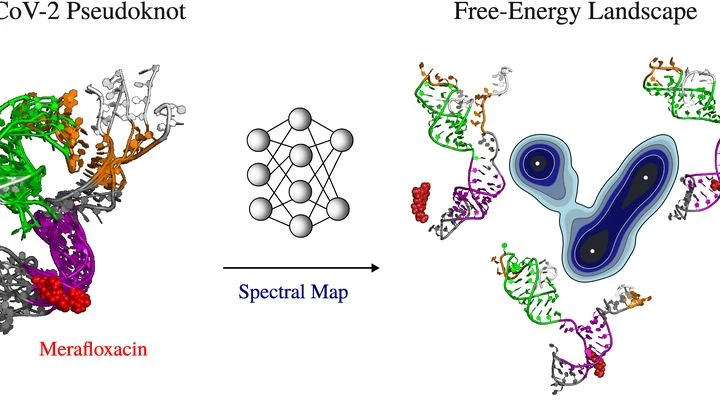
The RNA of SARS-CoV-2 is not just a chain but a complex structure. It contains a region that ties itself into a knot, much like a tangled shoelace. This knot helps the virus produce two proteins from a single stretch of genetic code. Without such a knot, the virus replicates less efficiently, so scientists are hunting for compounds that can undo it.
Searching for a new drug is like matching a key to a lock. The protein in a cell is the lock, and the candidate molecule is the key. You need to know whether the key fits and how snugly it sits. Previously, the computer would examine every atom in the lock and the key to check this. A single lock could take hours or even days. Checking millions of keys was out of the question.
A doctor prescribes a pill for the heart and a pill for blood pressure. Individually, each helps, but together they can scramble signals in the blood and cause harm. These unwanted encounters between drugs are called interactions, and testing every pair in the lab is impossible: there are millions of them.
A cell is like a kitchen where thousands of recipes (genes) are collected in one thick book (DNA). The chef-protein Klf4 flips through the pages and decides which recipe to cook today. But how does it find the right line among billions of letters? Previously, researchers thought the protein looked for a short 'password'—a few consecutive letters.