Post-transcriptional regulation encompasses all changes and the fate of RNA molecules after transcription (RNA synthesis on a DNA template). These include: splicing (removing non-coding introns and joining exons), alternative splicing (creating different protein variants from one gene), capping, polyadenylation, base editing, transport from the nucleus to the cytoplasm, localization, control of stability and translation rate (protein synthesis). This is critical for dynamic cellular adaptation to environmental conditions and underlies many diseases.
History
Until the 1970s, regulation of gene expression was largely associated with transcription (the Jacob and Monod operon model). In 1977, Phillip Sharp and Richard Roberts independently discovered introns and splicing in adenoviruses, and in the 1980s, Thomas Cech and Sidney Altman proved the catalytic activity of RNA (ribozymes). In 1993, Victor Ambros and colleagues described the first microRNA, lin-4 in C. elegans, demonstrating the regulatory function of small RNAs. Later, mechanisms of RNA interference (siRNA) and editing (APOBEC enzymes) were discovered. These works shifted the paradigm from linear information transfer DNA→RNA→protein to a complex network of post-transcriptional control, recognized as key in development, immunity, and pathology.
How it works
Post-transcriptional mechanisms modulate the fate of the transcript through the formation of ribonucleoprotein complexes. The cap-binding complex attracts elongation factors, the spliceosome recognizes splicing sites by consensus sequences, and the poly(A)-binding protein stabilizes mRNA. MicroRNAs within RISC partially pair with the 3' untranslated region of mRNA and repress translation or cause deadenylation and degradation. Localization is achieved by cytoskeleton-dependent transport and anchoring. Disruptions of these processes underlie many diseases: from spinal muscular atrophy (splicing mutation in SMN1) to cancer (global splicing imbalance).
In practice
Explains how cells adapt to stress without changing DNA; underlies RNA vaccines and small interfering RNA therapy.
Fun fact
The same gene can yield over 38,000 protein variants through alternative splicing—like assembling different sentences from the same set of words.
Two ink reservoirs stand on opposite sides of the cell junction. From them, two types of monomers flow onto the membrane, and when they meet, they form viscous droplets of complexes. The droplets barely move, but the free monomers dart around as fast as perfume molecules in a room.
Two ink reservoirs stand on opposite sides of the cell junction. From them, two types of monomers flow onto the membrane, and when they meet, they form viscous droplets of complexes. The droplets barely move, but the free monomers dart around as fast as perfume molecules in a room.
Picture a long thread trapped inside a sphere with charged walls. The thread is the virus's RNA; the sphere is its protein shell. The thread tries to settle so that its charges sit as close as possible to opposite charges on the wall.
In a nine-story building with a thousand rooms on each floor, some people whisper and others shout. Neighbors pass the message along, but if everyone speaks too softly, the message fades by the third floor. If too loudly, by the top floor it becomes an unintelligible roar. Between these extremes, there is a regime where a whisper makes it all the way through without distortion.
Construction is in full swing: neurons are laying down their processes the way bricklayers stack up walls. But an error has crept into the blueprints. The protein tau, which normally serves as scaffolding for the cellular framework, in its mutant form starts dictating the wrong dimensions.
Picture a muscle's control panel where buttons are removed with age. First to go are the buttons that handle hormone response, then those that kick off recovery after exercise. Researchers studied cell nuclei from vastus lateralis muscle biopsies from 287 donors aged 20 to 79 and saw exactly how these buttons disappear at the level of DNA packaging.
A detective arrives at a crime scene and finds a shoe print. He doesn't ask, "What would happen if this boot walked through mud?" He asks, "Which of the known owners could have left exactly this print?" That's how RevPert works too, except instead of prints it has activity profiles of thousands of genes, and instead of a criminal database it has a catalog of genes that scientists already know how to switch off in…
As you slowly turn the tuning knob of an old radio, the sound doesn't fade in gradually from the static: it bursts forth in a sudden jump, the moment the antenna hits resonance with the wave. Genes in a living cell behave much the same way.
As you slowly turn the tuning knob of an old radio, the sound doesn't fade in gradually from the static: it bursts forth in a sudden jump, the moment the antenna hits resonance with the wave. Genes in a living cell behave much the same way.
A kitchen mixer runs at a single speed, but start jabbing the button and the mixture whips up differently. Chemical reactions behave much the same way when the rates of their individual steps are not constant but pulse over time.
When biologists measure the activity of thousands of genes, they usually just see a list of coincidences, like two ingredients in a soup that often end up together. The standard method looks for such pairwise connections but doesn't show who influences whom.
A new approach, like a detector of dark matter, uncovers hidden threads of causation.
The cells of an organism are like twin chefs sharing a kitchen. They have the same cookbook (DNA), but when copying the recipe to a cheat sheet and assembling the dish, random errors occur. This unpredictability, entropy, means that in identical cells, protein levels are sometimes high, sometimes low.
Inside each of us, invisible clocks are ticking. They control the release of cortisol — the hormone that helps us wake up in the morning, cope with anxiety, and keep our immune system on its toes. In adrenal insufficiency, these clocks break down: the body can't produce the right amount of cortisol on its own.
Inside every cell, a complex network of genes determines what it will become — a nerve cell, a muscle cell, or part of the skin. This choice often resembles flipping a toggle switch: two stable positions, and the cell decides which way to tip. But cells have a feature rarely considered in such models: they divide.
Inside every cell, construction never stops: molecules constantly cluster together and drift apart. Sometimes they form dense droplets, like oil in water, but without a membrane. These droplets act as temporary storage: they hold proteins, gene copies, or DNA repair tools.
Two road crews are paving a street from opposite ends. They move toward each other, and how well they coordinate determines when the street is finished.
An engineer building a bridge cannot strengthen one beam without affecting the load on adjacent ones. Drug development works similarly: a molecule must fit snugly into the 'pocket' of a target protein, like a key in a lock, while also being safe, stable, and convenient to administer.
A torn telephone wire is a nuisance, but a torn DNA is a catastrophe. A double-strand break, when both strands of the helix snap at the same spot, threatens the cell with death or transformation into cancer. Fortunately, the cell has its own 'glue': special proteins that gather into a droplet right at the accident site.
A translator doesn't learn a language from a textbook but by listening to live speech and immediately seeing what people do in response to words. That's exactly how the new method C3P reads bacterial DNA. Standard genomic models try to learn the rules by simply "rereading" billions of letters of the genetic code, and often get confused.
In a car, the steering, brakes, and accelerator gradually fail. At first, you can still swerve around a pothole, but each year the maneuver takes more effort. At some point, even a perfect road becomes impassable — the car no longer obeys the driver.
That's exactly how the authors describe aging: not as the accumulation of rust or wear and tear, but as the loss of "controllability" of the body.
Quantum entanglement is a fragile thing. Two friends move to different cities, each carrying a box with one of a pair of gloves: if one box has the left glove, the other has the right. Entangled particles behave similarly, except that until measurement, no one knows which is where.
Under sunlight, molecules inside bacteria, like the beaters of a kitchen mixer, capture energy and spin electrons in the right direction. But sometimes the spin gets disrupted — 'stuck' triplet particles appear. It's as if the beater momentarily froze and then jerked backward, splashing hot liquid and scalding the walls.
A protein in a cell is like a tiny machine: each has its own precise blueprint and its own task. Some proteins cut molecules, others carry oxygen, and still others capture light. To build such a mechanism from scratch, you need to solve two problems at once: decide what job it will do and how it will fold into the right knot. If the knot goes wrong, the machine jams or breaks.
A microscopic image of tissue is like a city map: streets, houses, parks. An experienced eye can tell a lot about a neighborhood from such a map. But what if you could predict from the map which houses are noisy today and which are quiet?
Long protein threads, their tangled entanglements, and random contacts: this is how the birth of cellular droplets was usually explained. These membrane-less organelles, where important reactions take place, resemble oil drops in water: they arise on their own when molecules separate into phases.
An orchestra without a conductor. Each musician plays their own part, and the overall volume builds, but the melody falls apart — violins rush ahead, brass lags behind. Cells behave much the same way when their DNA is modified: they may shift, but some move far, while others stay put.
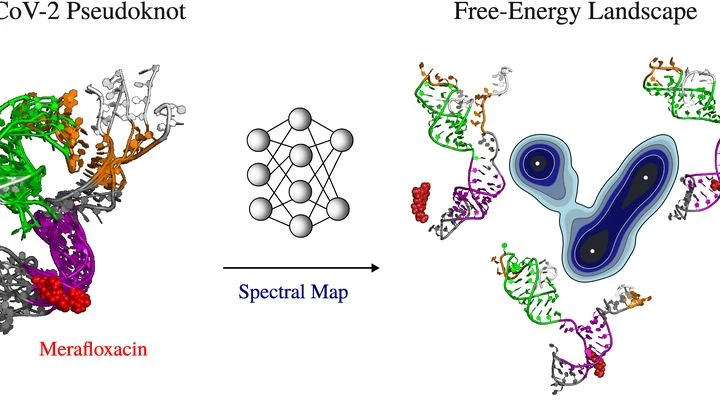
The RNA of SARS-CoV-2 is not just a chain but a complex structure. It contains a region that ties itself into a knot, much like a tangled shoelace. This knot helps the virus produce two proteins from a single stretch of genetic code. Without such a knot, the virus replicates less efficiently, so scientists are hunting for compounds that can undo it.
Inside a cell, there are tiny liquid droplets, like oil droplets in water. They form from proteins and RNA and serve all sorts of purposes, from storing molecules to speeding up reactions. But if droplets start merging with each other, you'd end up with one big puddle, which would wreck the cell's organization.
An ordinary lens always refracts light the same way. Its properties are frozen in glass forever. But now there's a surface that changes the game on the fly.
Scientists made an ultrathin film with resonant elements and infused it with liquid crystals — the same stuff used in phone screens.
A colony of cells is like a city that grows from its outskirts: new houses appear where there's more space. Inside, it's crowded, and construction stalls. Similarly, cells divide more often at the edge, where neighbors squeeze them less. Scientists modeled this without any chemical commands — only mechanics.
In the model, each cell is a ball that presses on others.
You can edit a cell perfectly, and it still turns out useless. The gene is fixed exactly as planned, yet the cell behaves unpredictably: it drifts, changes fate, loses safety. It's like fixing one gear in a watch, but the watch still runs wrong because the whole mechanism is out of sync.
Previously, a cell was viewed as a list of independent parts.
A teacher in class explains the difference between 'dog' and 'tog': put your hand on your throat and feel the vibration. A speech recognition machine does much the same thing, except inside it's not a throat but long lists of numbers. It turns out these numbers can be sorted onto shelves, like alphabet blocks in a child's room.
Inside a cell, work is in full swing: thousands of genes switch on and off like lights on a huge display. Neural networks trained to read this display have learned to guess what will happen if you 'turn off' one gene or add a drug. But how exactly they do it is a mystery.
Our body's tissue is like a city: different neighborhoods are home to different cells, each with its own job. To understand how this city is organized, biologists take images showing which genes are active at each spot. But sharp images are expensive, and cheap ones come out blurry, like a photo of a city from high above, where individual buildings are hard to make out.
A protein language model is like a chef who learned from thousands of recipes and now invents new dishes. Sometimes he gets carried away and salts every dish because one good cookbook used a lot of salt. In proteins, such repetition isn't just ugly: identical stretches in the chain make the protein fragile, it can't fold into the right shape, and it doesn't work.
A cell is like a kitchen where thousands of recipes (genes) are collected in one thick book (DNA). The chef-protein Klf4 flips through the pages and decides which recipe to cook today. But how does it find the right line among billions of letters? Previously, researchers thought the protein looked for a short 'password'—a few consecutive letters.
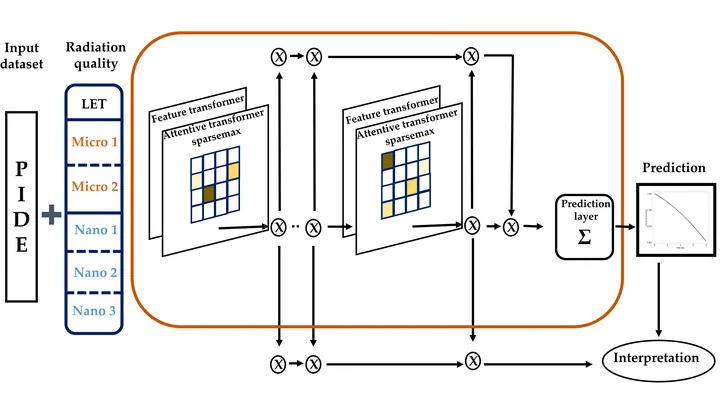
A cell hit by a proton beam is like a city after a pinpoint bombing: some blocks are leveled, others just have broken windows. Whether the city survives depends on which buildings are hit and how the strikes are distributed.
In every cell lives a tireless scribe — an enzyme that copies the long thread of DNA. It moves along it like a read head over a tape, building a new strand alongside. It picks letters by strict rule: opposite A it always places T, opposite G it places C. But sometimes, very rarely, its hand trembles, and a different letter slips in.
After a mastectomy, a woman often gets an implant, and then the chest is irradiated to kill any remaining cancer cells. Proton therapy is great because it hits the target precisely and spares the heart and lungs. But in some patients, a dense scar capsule forms around the implant: it squeezes the implant, making the breast hard and painful. This is called capsular contracture.