The Mystery of 'Impossible' Galaxies: How Outer Color Maps Are Rescuing Cosmology ✦
Original: "Unbreaking the Universe: MINERVA Measurements of Color Gradients in Massive Quiescent Galaxies Can Help Ease Too-Early Star Formation Tensions"
The Webb telescope reveals that ancient massive galaxies have redder cores and bluer outskirts, easing the tension with the standard cosmological model.
Links in the knowledge graph 1
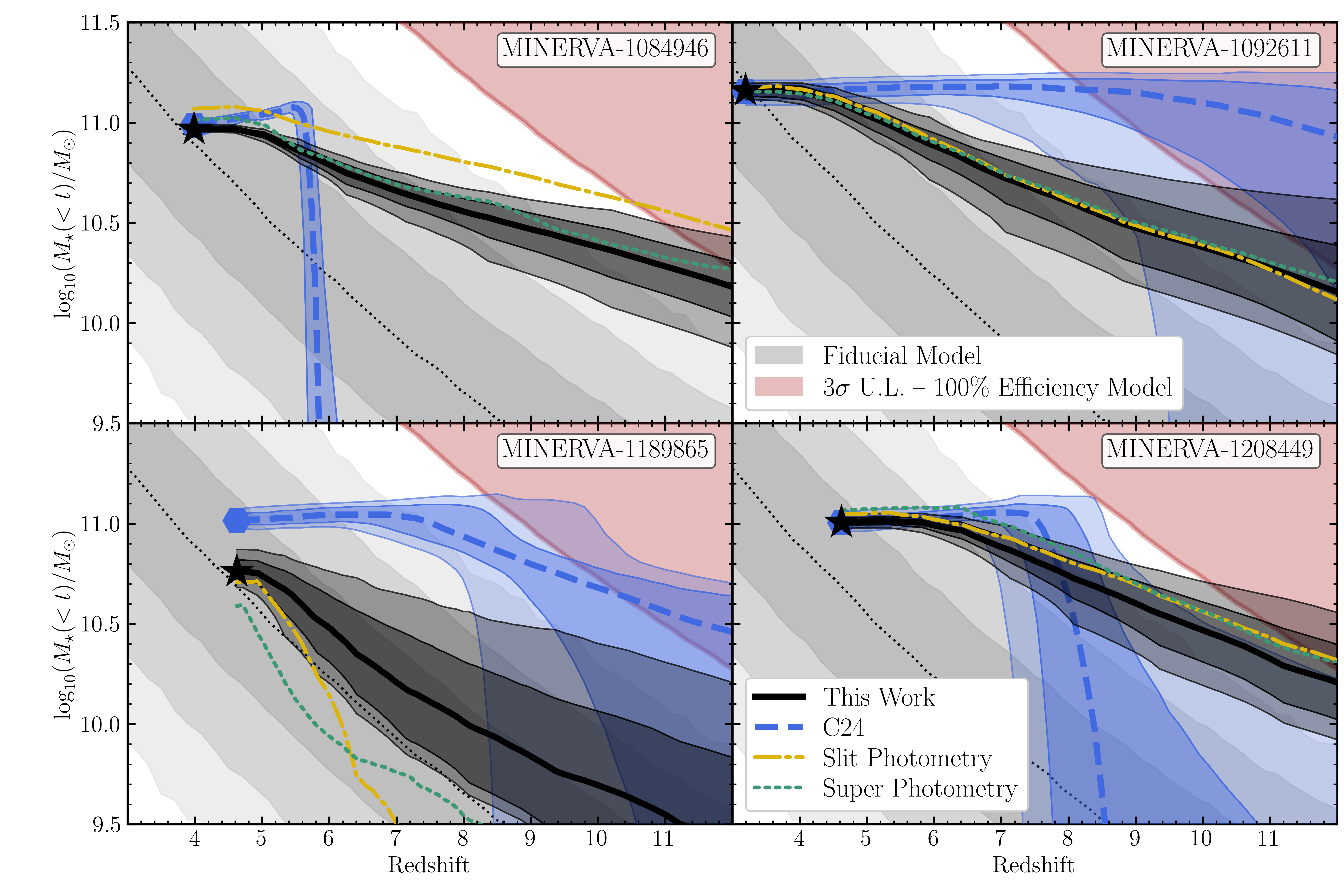
Those incredible ancient galaxies turned out not so impossible after all: we were just peering into their 'historic centers,' mistaking the age of the oldest stars for the age of the entire metropolis. JWST shows that cores are redder and outskirts are younger—so dark matter and ΛCDM aren't in crisis; our measurements are simply becoming more accurate. And the biggest intrigue: one galaxy formed when the universe was just 300 million years old—life there could have arisen before the solar system was born.
🎯 Galaxy MINERVA-1092611, whose age is comparable to the age of the universe at that time, could have been home to life billions of years before Earth formed—if planets existed there.
\frac{\Delta (U-V)}{\Delta R}
The gradient of the U−V color index as we move from the galaxy center to the edge, measured in magnitudes per kiloparsec. A negative value means the core is redder and likely older than the outskirts.