We have retold 9 papers by this author. 3 of them with a full read. most often about: supernova, Reionization, supernova remnant. 30 co-authors across our retellings.
A massive galaxy cluster acts as a giant lens. Its gravity warps the fabric of space, and the light of distant objects, bending around this curvature, is amplified and split into multiple images.
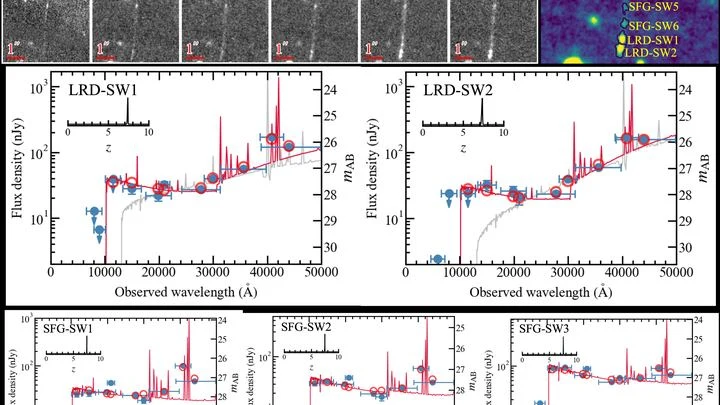
Thanks to gravitational lens — an effect predicted by Fritz Zwicky, where a galaxy cluster acts like a magnifying glass — the James Webb Space Telescope spotted two red dots in a galaxy 800 million years after the Big Bang.
A distant red object usually means one thing: we're seeing a dust veil over a scorching disk falling into a black hole. But when the James Webb split its light into shades, a shadow appeared inside — just like steam from boiling water intercepts rays.
Imagine a city where a skyscraper and a huge park are being built at the same time. The skyscraper grows upward, and the park expands outward. Both processes are fast and get in each other's way, but in the end they are meant to become a single whole. That's the situation in galaxy GNz7q: a black hole grows at the center while new stars burst to life around it.
In the first few hundred million years after the Big Bang, the cosmos was like a noisy teen club: galaxies flared up, collided, and churned out stars by the hundreds.
A fountain shoots from the center of the city at a speed thousands of times faster than a courier bike. Such a 'fountain'—a stream of gas accelerated to 5500 kilometers per second — has been spotted by astronomers in the galaxy GLIMPSED-329380.
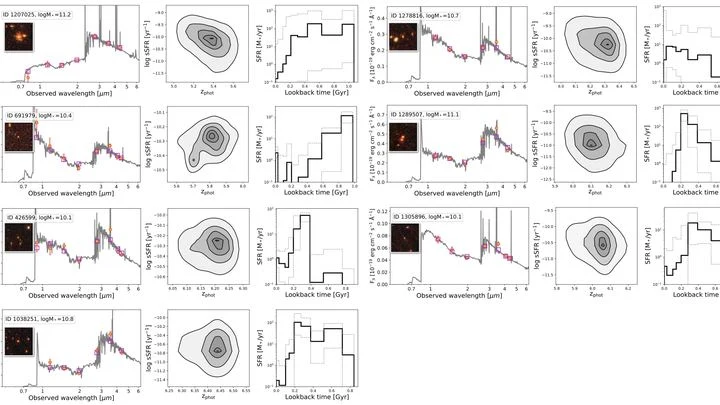
The first two billion years after the Big Bang were an era when the universe resembled a boiling construction pit. Dark matter clumped the gas together, igniting the first stars. It seemed there simply wasn't enough time to assemble massive elliptical galaxies—'dormant' stellar metropolises — from this raw material.
When JWST peered into the young universe at redshifts of 6–10, it revealed a scattering of mysterious 'little red dots' (LRDs). These objects combined features of galaxies and active nuclei, but their spectra refused to fit into familiar patterns.
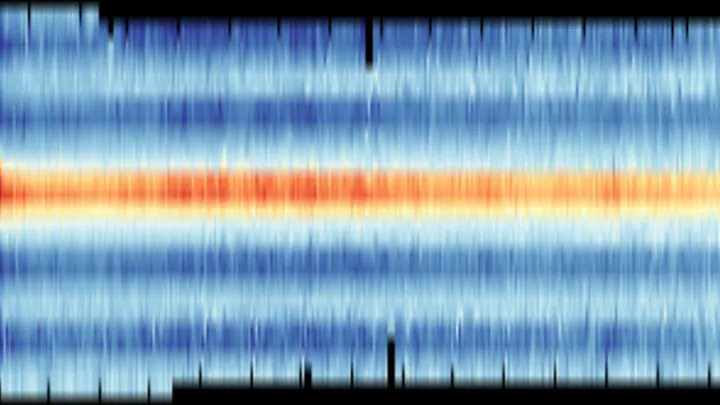
The JWST spectrograph caught a barely perceptible dip in the spectrum of a distant galaxy — two lines, like shadows cast by cold gas. These are the sodium lines, the very yellow light of streetlamps. Here, at the edge of the visible Universe, they betray the slow exhalation of a galaxy returning matter to space.