We have retold 4 papers by this author. 1 of them with a full read. most often about: supernova, Reionization, supernova remnant. 30 co-authors across our retellings.
A massive galaxy cluster acts as a giant lens. Its gravity warps the fabric of space, and the light of distant objects, bending around this curvature, is amplified and split into multiple images.
A distant red object usually means one thing: we're seeing a dust veil over a scorching disk falling into a black hole. But when the James Webb split its light into shades, a shadow appeared inside — just like steam from boiling water intercepts rays.
In the first few hundred million years after the Big Bang, the cosmos was like a noisy teen club: galaxies flared up, collided, and churned out stars by the hundreds.
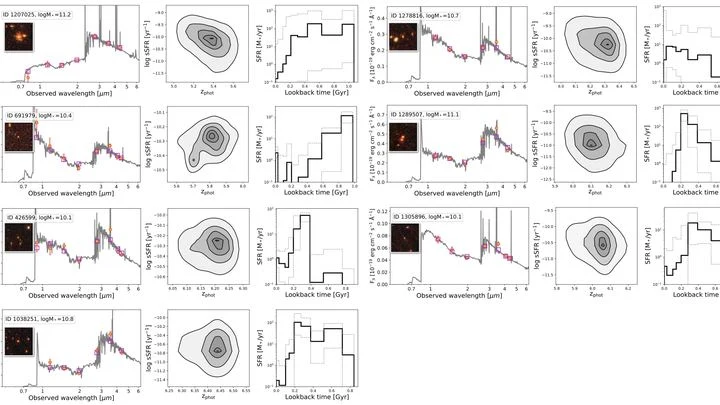
The first two billion years after the Big Bang were an era when the universe resembled a boiling construction pit. Dark matter clumped the gas together, igniting the first stars. It seemed there simply wasn't enough time to assemble massive elliptical galaxies—'dormant' stellar metropolises — from this raw material.