Popular

Luke Robbins

5 articles · 30 co-authors · latest: 2026-06-01

Dusty Black Hole in a Young Galaxy

Astronomers using the spectroscope aboard JWST have, for the first time, measured the amount of dust around a distant black hole. Dust, like fog, dims its light, but the main surprise is that the black hole fluoresces, revealing the secrets of its rapid growth.
arXiv:2507.20684 · 2025-07-28

A Galaxy That Slept for Half a Billion Years

The 'Sleepy' galaxy in the early universe furiously gave birth to stars, but after 300 million years it fell asleep. A record-breaking hydrogen dip in its glow showed that not all bright early galaxies become giants—some doze off and turn into dwarfs.
arXiv:2512.03154 · 2025-12-02

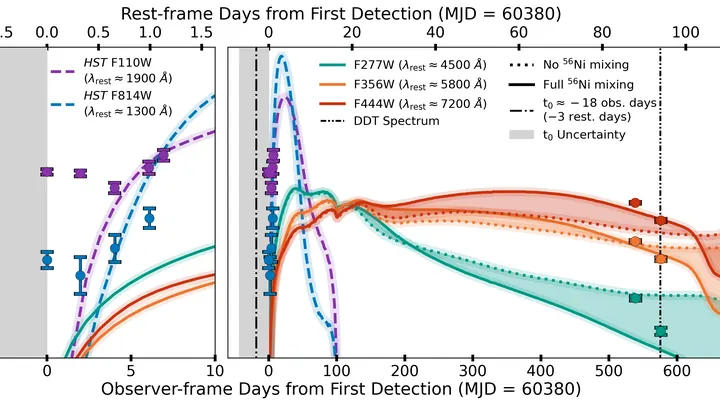
Сверхновая из детства Вселенной

Самую далёкую сверхновую SN Eos подтвердили, разложив её свет в спектр. Взрыв произошёл в среде, почти лишённой тяжёлых элементов, — прямое доказательство рождения массивных звёзд в ранней Вселенной. Открытие стало возможным только благодаря гравитационному линзированию и поможет уточнить темп рожде
arXiv:2601.04156v2 · 2026-01-07

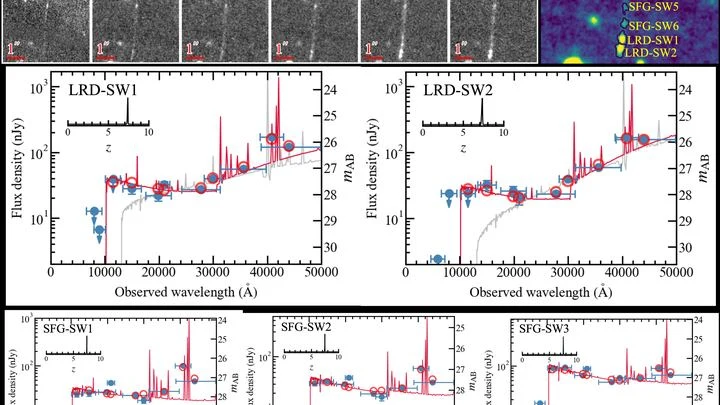
Red Eyes: Cosmic Lens Reveals a Pair of Black Holes

Using a gravitational lens — a massive cluster of galaxies bending light — the James Webb Space Telescope detected two red dots in a distant galaxy. These are intermediate-mass black holes, located not in the center but on the outskirts. The discovery suggests such invisible objects might be widespr
arXiv:2601.06015v1 · 2026-01-09

The Mystery of 'Impossible' Galaxies: How Outer Color Maps Are Rescuing Cosmology

Using NIRCam on JWST, astronomers studied four supermassive quiescent galaxies whose light has been traveling to us for over 11 billion years. It turns out that in three of them, the color shifts smoothly from center to outskirts: red old cores surrounded by bluer, younger regions. This color map re
arXiv:2606.02698v1 · 2026-06-01