The Mystery of 'Impossible' Galaxies: How Outer Color Maps Are Rescuing Cosmology ✛ ✦
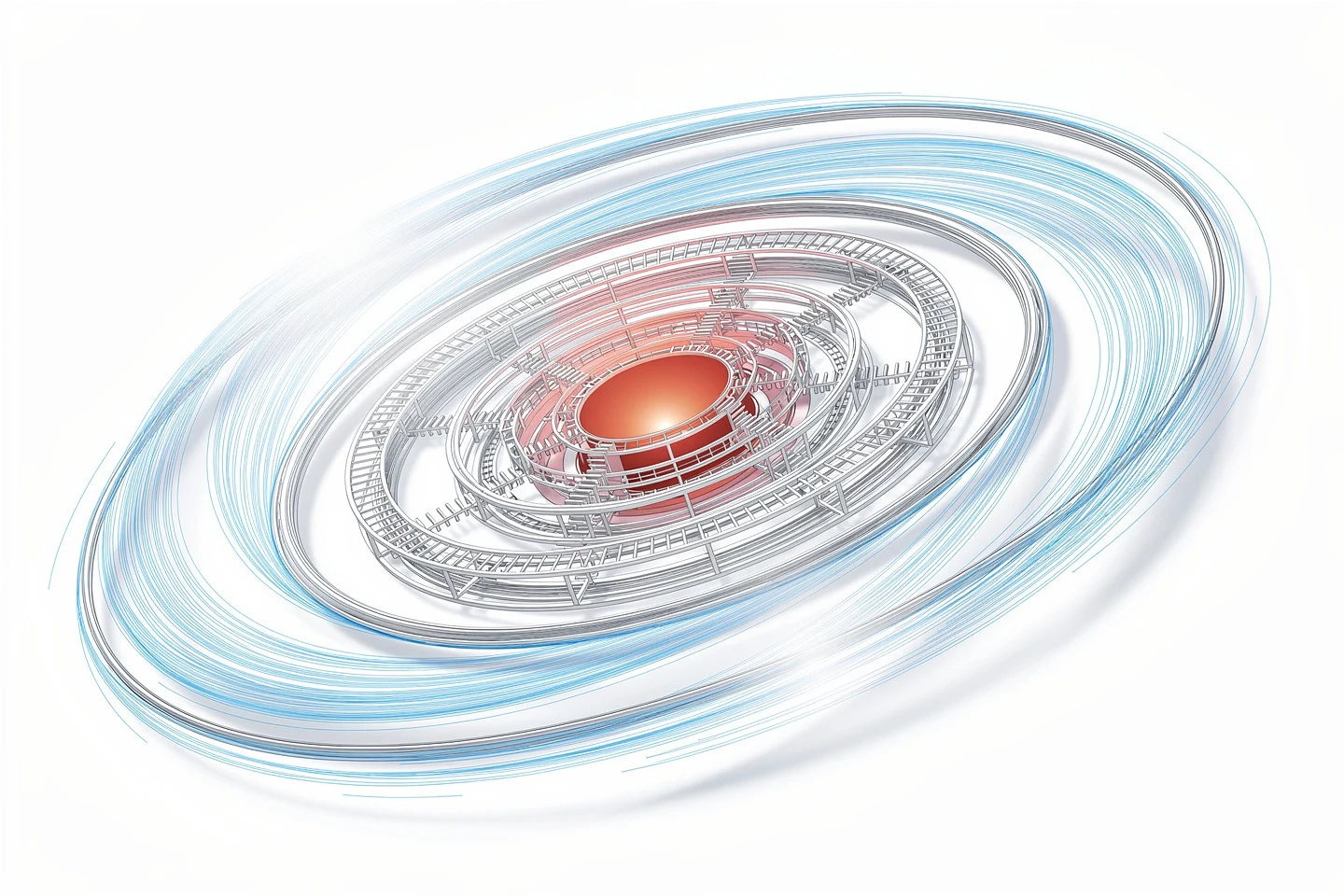
The first two billion years after the Big Bang were an era when the universe resembled a boiling construction pit. Dark matter clumped the gas together, igniting the first stars. It seemed there simply wasn't enough time to assemble massive elliptical galaxies—'dormant' stellar metropolises — from this raw material. Yet such objects kept turning up, each discovery challenging the established picture of the universe's expansion confirmed by Edwin Hubble. Their masses, measured from central light, conflicted with the theoretical limit.
Archaeological optics came to the rescue. Imagine an ancient city: at its center are temples and palaces built first, while the outskirts were developed later with simpler materials. If you only look at the core, it's easy to imagine the whole city is incredibly old and monumental. Slit spectroscopy of distant galaxies worked much the same way: it mostly captured light from the central, oldest regions, leading to overestimated masses. New images from the Webb telescope with unique photometry from the MINERVA survey in 16 filters allowed scientists to measure color in concentric rings, like an archaeologist excavating the outskirts. And the picture changed.
Three out of four galaxies showed a clear gradient: red centers, bluer outskirts. A classic signature of older stellar populations. The record-holder, MINERVA-1084946, showed a color change of U−V by −0.126 magnitudes per kiloparsec, as if age fades from the center outward. If we attribute the whole effect to age, the central bulge mass drops by 0.1 dex, and summing over the entire galaxy, the tension with the ΛCDM model, where dark matter distribution plays a crucial role, first proposed by Vera Rubin, significantly weakens. For the fourth galaxy, MINERVA-1189865, the gradient was reversed — likely a post-starburst object, where star formation recently ceased and young blue stars still shine in the core.
This discovery is more than a technical correction. It expands the horizon of theoretical cosmology. When scientists learn to build truly resolved age maps with integral field spectrographs, they will peer into the era when cosmic dust first began to cool the gas for cloud fragmentation. Then the mystery of 'impossible' galaxies may finally transform into a coherent story of how the first star cities grew from cold clumps of dark matter, and fell asleep, leaving behind reddening core archives. Yet one thought lingers: could these ultra-dense cores harbor a population of stars we will never see, so ancient that their light is forever trapped in gravitational wells?
Galaxy MINERVA-1092611, whose age is comparable to the age of the universe at that time, could have been home to life billions of years before Earth formed — if planets existed there.