Dance of Vortices in the Magnetic Heart of a Pulsar ✦
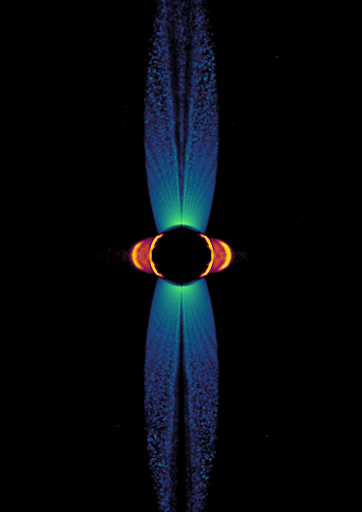
Electric vortices in the heart of a pulsar live their own life: they grow in a fraction of a second and make charges dance across magnetic lines. Like a trembling tuning fork, the dipole mode modulates the radio pulse, producing mysterious nullings and drifts. Simulations predict that new radio telescopes will see this dance in detail—and then pulsars will speak the language of plasma instabilities.
🎯 The name 'diocotron' comes from the Greek Διώκω, meaning 'to pursue': because the density waves in this instability excitedly chase each other azimuthally. In laboratory positron traps, this effect was described decades earlier, but only now have astrophysicists confirmed its cosmic scale.
🎬 In Carl Sagan's 'Contact,' an extraterrestrial intelligence turns a pulsar into a modulated beacon. The diocotron instability offers a natural mechanism for such modulation—nature, without engineers, can tune cosmic beacons.