Simple

Pulsars flicker because of electric funnels in their magnetic field

Original: "Diocotron Modes in Pulsar Magnetospheres: Charge Diffusion and Implications for Radio Emission Variability"
arXiv:2606.03984v1 · 2026-06-02 · CC BY · ⏱ 1 min · High Energy
The rotation of plasma in a pulsar's magnetosphere creates electric whirlpools, which cause it to go silent and then flare up.
Abstract

Diocotron instability is like a ‘vortex’ in the plasma around a pulsar, growing and creating a rotating asymmetry. It can mix charges and alter the radiation, explaining oddities in pulsar flickering. Imagine an elusive dance of charges making a stellar lighthouse fade and flash.

Links in the knowledge graph 1

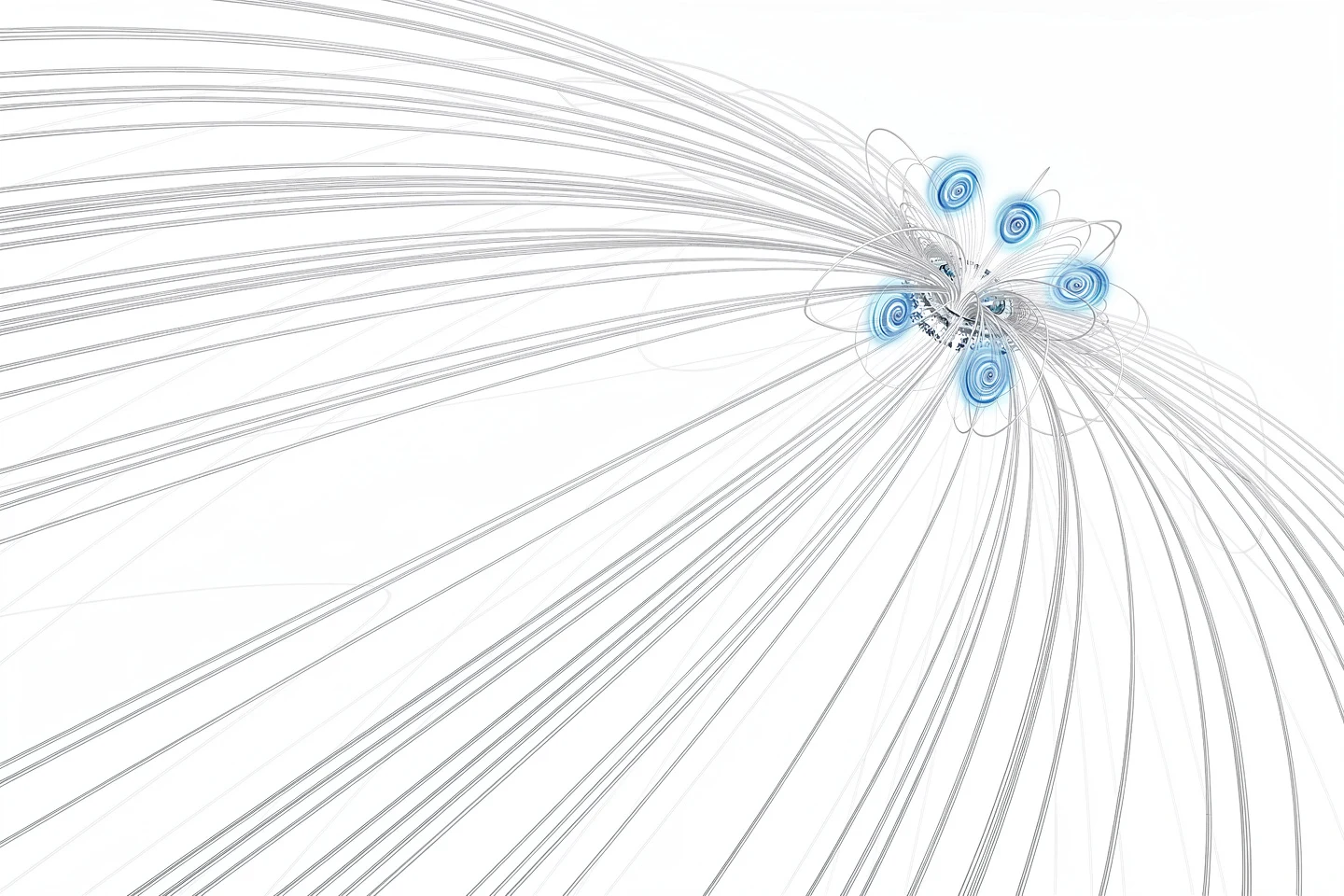
A pulsar is a super-dense neutron star left over after a supernova explosion. It spins rapidly, holding a cloud of plasma with its magnetic field. The plasma rotates unevenly: faster near the axis than at the edges. This difference spawns electric funnels—like a whirlpool. They grow in just a few rotations of the star (which for an Earth observer stretch out due to the immense gravity). The funnels stir up charges and fling them toward the light cylinder—the outer boundary of the magnetosphere. There, particles disrupt the radio signal, causing the pulsar to flicker or fall silent altogether.

Diocotron instability has been observed for decades in antimatter traps, but this is the first time it's been spotted in space.

Astronomers detect these changes using spectroscopy: they break radio waves into frequencies, tracking how the funnels distort the emission. Now the variability of pulsars has a clear cause.

🎯 The strength of the electric funnel is just a couple percent of the pulsar's total charge, but that's enough to make this cosmic lighthouse flicker.

🎬 In Carl Sagan's 'Contact,' aliens turned a pulsar into a beacon; nature does just fine without them: electric funnels turn the star into a twinkling transmitter all on their own.

\rho_{\rm GJ} = -\frac{\mathbf{\Omega} \cdot \mathbf{B}}{2\pi c}
The required charge density to screen the longitudinal electric field in a corotating magnetosphere.
Scientists
Christian DopplerD. B. McLaughlinDidier QuelozMichel MayorR. A. RossiterAlbert Einstein
Tags
pulsar neutron star supernova speed of light spectroscopy antimatter Time dilation
Laws
Doppler effectprinciple of constancy of the speed of lightmass–energy equivalenceMaxwell's equationsPlanck's lawLorentz transformations
Original: arXiv:2606.03984v1 · CC BY · bridge42worlds