Dance of Vortices in the Magnetic Heart of a Pulsar ✛ ✎ ✦
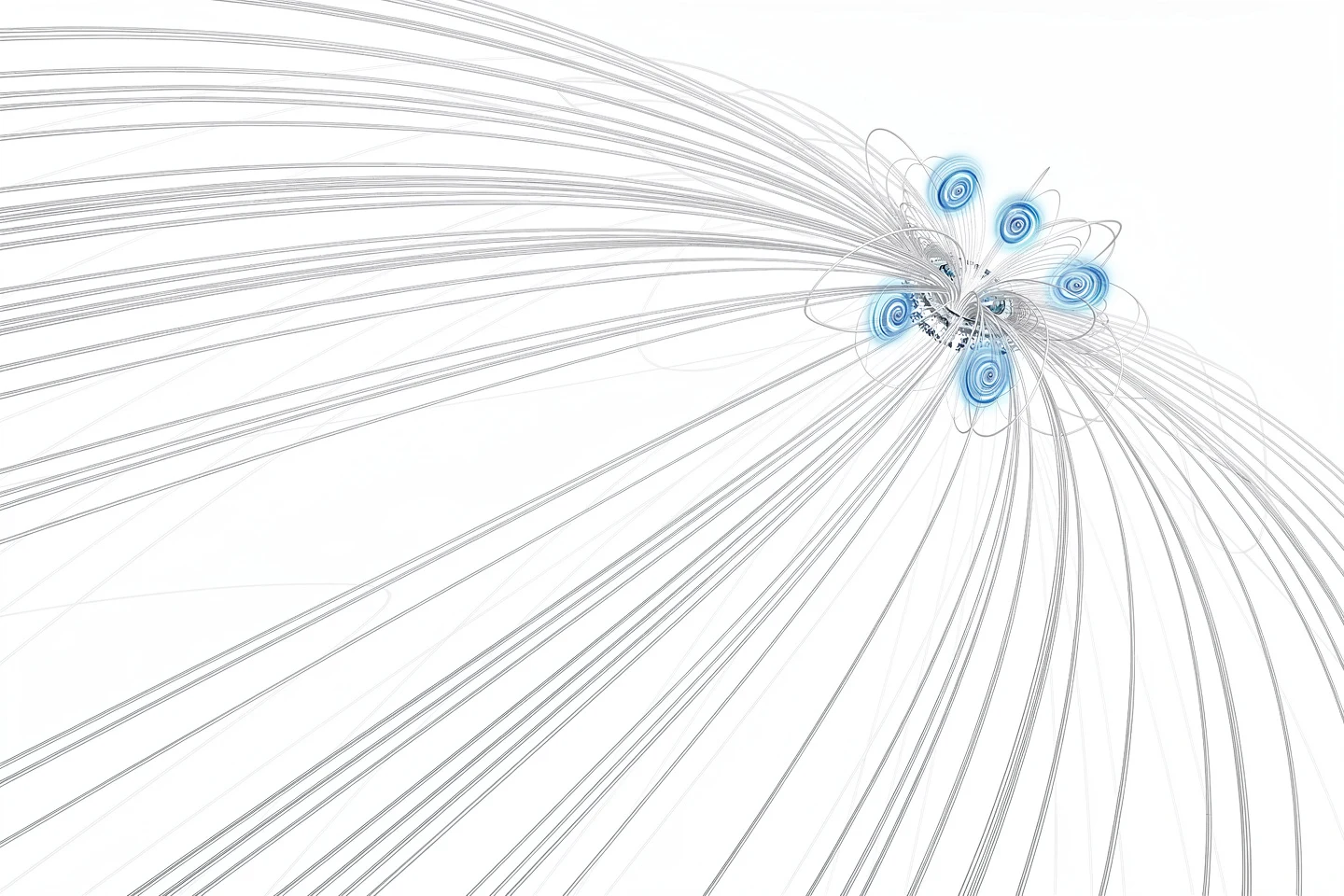
Even Jocelyn Bell Burnell, who first detected the strict periodicity of radio signals, noticed that some pulses would suddenly vanish. Today we know: variability is not a whim, but the voice of intricate electrodynamics. Chandrasekhar showed that a white dwarf's collapse is inevitable beyond a certain mass, while Fritz Zwicky earlier predicted the existence of neutron stars — the ultra-dense remnants of supernovae. But the magnetosphere of such an object was long depicted as static. Now, three-dimensional simulations reveal its true dynamics: it's not a frozen cage, but a stage for an electromagnetic ballet where electric vortices are born and fade.
Imagine a mad carousel-ballet: dancers spin, clinging to taut ropes — the magnetic field lines. Strictly speaking, plasma must glide along them, but a difference in angular speeds creates shear, and charges begin to 'stumble' over each other. A mode is born — a stable pattern of clumps and voids that, like a heartbeat, pulses with a period on the order of the star's rotation time. The stochastic jolts in amplitude and phase of this dipole mode (m=1) act as invisible backstage machinery. They push particles across the magnetic field, forcing them to diffuse with a coefficient Dr ≈ 10⁻⁵ $R_d$²/P_⋆. This leisurely drift is a reminder that even under extreme conditions, some processes flow with glacial slowness: in a matter of hours, the plasma reaches the light cylinder — the boundary where rotation reaches the speed of light. Then the electric fields of the mode begin to rock the potential above the polar cap, deflecting the radio beam by degrees.
The connection to observed variability is direct: slow wandering of the mode amplitude is the key to nullings, when a pulsar falls silent for tens to hundreds of periods. Rapid phase fluctuations explain subpulse drift and periodic amplitude modulation. It was previously thought that the closed zone of the magnetosphere was nearly a vacuum, but diocotron diffusion shows it is filled with plasma, constantly replenished from the surface. In essence, the pulsar creates its own fluctuating magnetic cocoon, which, like a trembling tuning fork, modulates its emission. Future radio telescopes like SKA will be able to map these vortices in detail by their fingerprints in dynamic pulse spectra, thereby testing the predictions of numerical models. Remarkably, similar vortex modes may prove to be a universal variability mechanism for other compact objects — from magnetars to accreting X-ray pulsars. Perhaps we stand on the brink of understanding how time and space near neutron stars become a stage for an electromagnetic ballet born in the fire of a supernova.
The name 'diocotron' comes from the Greek Διώκω, meaning 'to pursue': because the density waves in this instability excitedly chase each other azimuthally. In laboratory positron traps, this effect was described decades earlier, but only now have astrophysicists confirmed its cosmic scale.
In Carl Sagan's 'Contact,' an extraterrestrial intelligence turns a pulsar into a modulated beacon. The diocotron instability offers a natural mechanism for such modulation — nature, without engineers, can tune cosmic beacons.