Cosmic Prospector: Sifting Stars in Search of Life ✦
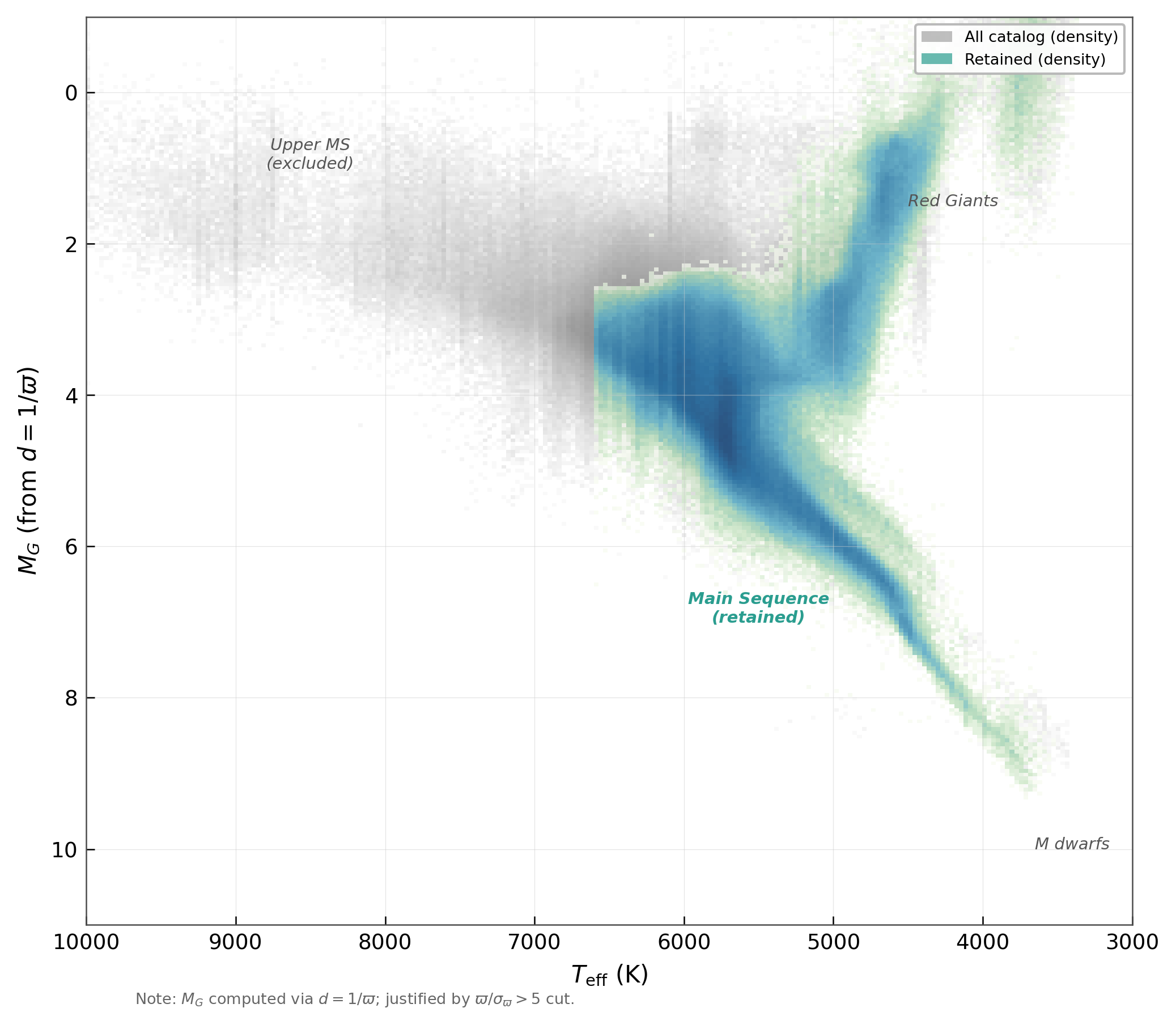
Over half of Gaia's 1.7 million stars have been deemed barren. The astrophysical filter, like a prospector's sieve, discarded young and metal-poor stars, leaving 778,000. This sifting turns the Great Filter from a metaphor into a measurable frontier. The silence of the ether no longer oppresses — it shows where to look. Perhaps the signal has been waiting all this time for us to stop groping blindly and start washing the right layers.
🎯 Heavy elements are the building blocks for planets. Half of the rejected stars have catastrophically few. And the age filter turned out to have a double bottom: using the upper boundary saved 355,000 stars — as many as were rejected for multiplicity and variability combined. The irony is that we saved them simply by admitting, 'We don't know the exact age.'
🎬 The method of 'avoiding' stars echoes the Great Filter, which explains the Fermi Paradox. If most stars are lifeless, then the silence of the ether is not a sign of loneliness, but evidence of the rarity of 'quiet harbors.' In Liu Cixin's 'Dark Forest,' civilizations hide in fear; this catalog seems to circle in chalk the stars where they might lurk. And in 'The Expanse,' the protomolecule selectively remakes biospheres — it's easy to imagine the filter excluding worlds unresponsive to its call.