Broken Prism: How a Pulsar Became a Cosmic Ghost ✦
Original: "A series of unfortunate events: CHIME/FRB misclassification of a Galactic pulsar as a periodic fast radio burst"
A faulty calibration after rain turned an ordinary galactic pulsar into a phantom twin — the first 'periodic' fast radio burst that never existed.
Links in the knowledge graph 1
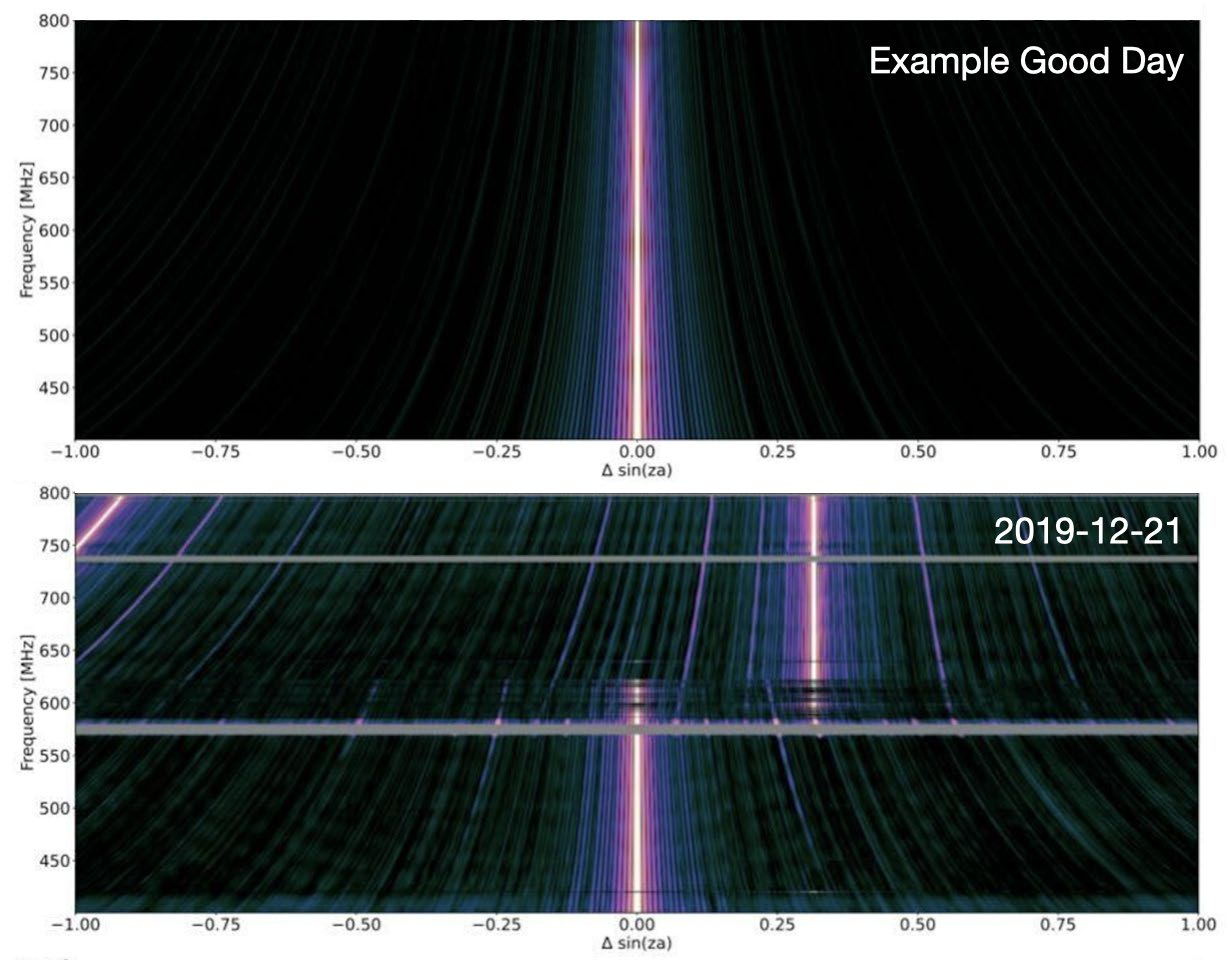
The pulsar pulses every 217 milliseconds. But one day its signal split, like a reflection in a cracked prism, and gave birth to a phantom twin — an ideal candidate for a periodic fast radio burst. That's how rain over the CHIME telescope nearly altered astronomical catalogs. Now algorithms hunt for such cracks to avoid mistaking a cosmic mirage for a real discovery.
🎯 Pulsar PSR J0248+6021 is a true record-holder: its dispersion measure reaches nearly 400 pc/cm³, which is anomalously high for a direction far from the galactic plane. The reason is that the line of sight pierces a dense region of ionized hydrogen (HII region), which played a fateful role by masking the pulsar as an extragalactic source.
\mathrm{DM} = \int_{0}^{d} n_e \, dl
Integral of free electron concentration along the line of sight, defining the delay of low-frequency radio waves.