The Planet's Heart Beats Every Six Years express
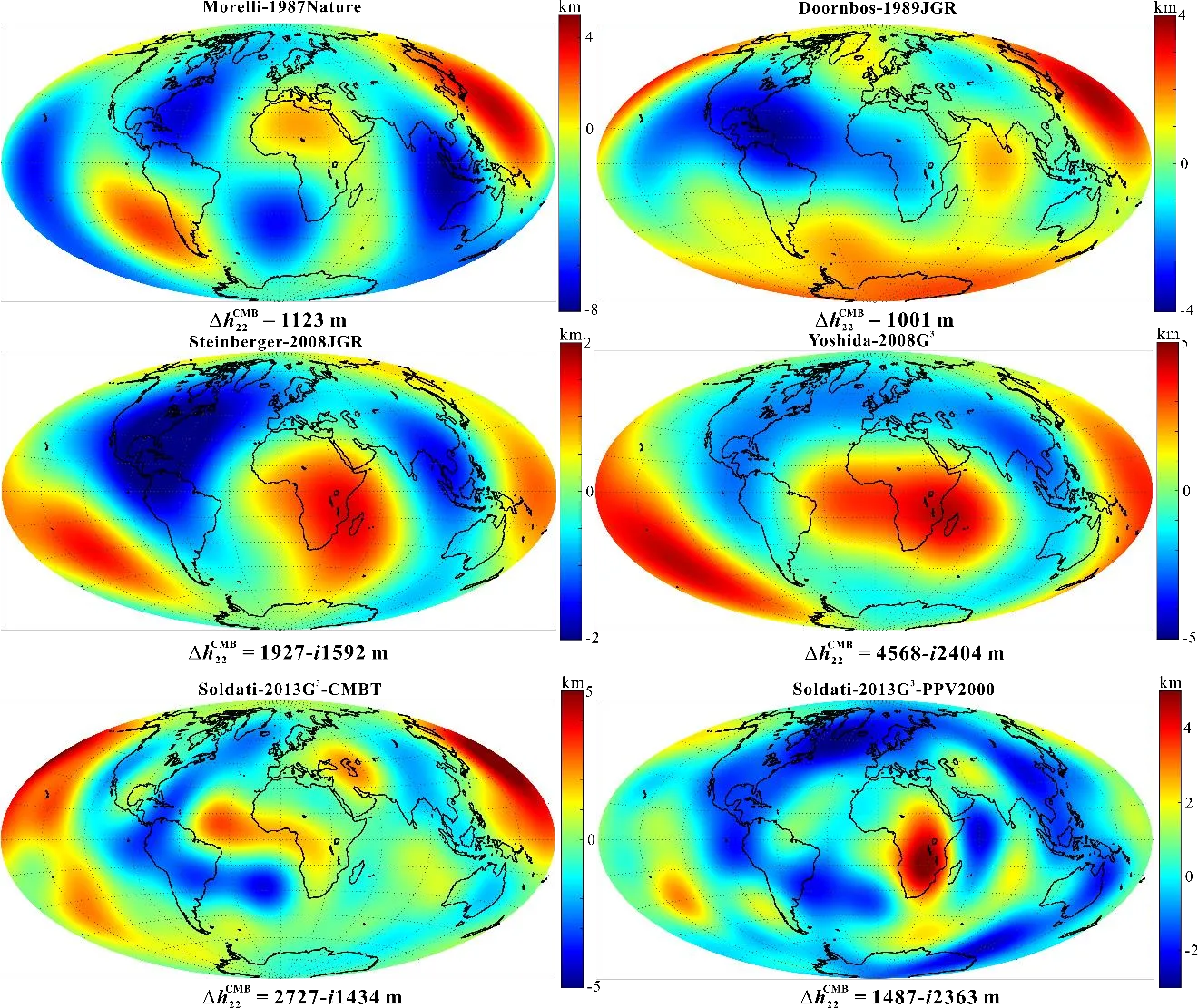
Gravity satellites have noticed that Earth's gravity field breathes imperceptibly with a period of about six years. It's as if an invisible pendulum swings the planet from within, and every six years the scale's needle shifts slightly. The signal turned out to be so clean that it could be separated from the noise of oceans and melting glaciers.
The authors built a model where the solid inner core and the mantle are gravitationally coupled through the liquid outer core, like two gears in viscous oil. When the core rotates slightly, it drags the mantle along, and vice versa. This dance allowed them to calculate the viscosity of the inner core: approximately 4.6×$10^{16}$ Pa·s. For comparison, cold honey has a viscosity of about $10^3$ Pa·s, while glass at room temperature is on the order of $10^{20}$ Pa·s. In other words, the core flows a billion times slower than honey, but it still flows.
Moreover, at the base of the so-called large low-shear-velocity provinces (giant 'mountains' of hot material at the bottom of the mantle), the density turned out to be half a percent higher than average. These continent-sized structures influence how heat escapes from the interior, and now they can be weighed using gravity data. Thus, satellites flying hundreds of kilometers above us become a window into a world five thousand kilometers deep.
Original abstract
as written by the authors arXiv:2606.09296
Constraining the physical properties of Earth's deep interior, particularly the viscosity of the solid inner core and the density structure of large low-velocity provinces (LLVPs), remains a major challenge in geophysics. Here we develop a unified dynamical framework that combines mantle-inner core gravitational coupling (MICG) with torsional oscillations in the fluid outer core and show that their interaction can produce a distinct and testable geodetic signature. Guided by this prediction, we analyze satellite gravity observations together with independent corrections for surface mass variability. We identify a robust approximately 6-year signal in the Stokes coefficient Delta S22, while no corresponding stationary signal is detected in Delta C22. A signal with the same periodicity is independently detected in length-of-day variations (Delta LOD), and the two signals exhibit a near anti-phase relationship. Interpreting this coupled signature within the proposed framework allows us to constrain the inner core viscosity to approximately 4.6 (+/- 1.8) x 10^16 Pa s and the equatorial relief of the inner core boundary to a semi-axis difference of about 200 +/- 70 m. The inversion further indicates mean density anomalies of +5.5 (+/- 0.6) per mil at the base of LLVPs. These results indicate that satellite gravimetry provides a direct observational window into deep-Earth dynamics and the physical properties of Earth's deep interior.
Earth's inner core has a temperature of about 5000 °C, almost as hot as the Sun's surface, but due to enormous pressure, it remains solid and yet slowly flows like a glacier.