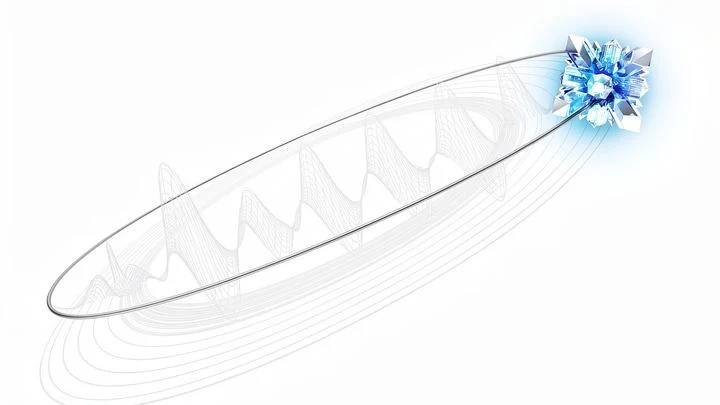
A satellite is an artificial object deliberately placed into orbit around a celestial body, such as Earth, the Moon, or another planet. Unlike natural satellites (moons), artificial satellites are human-made and serve a wide range of purposes, from communication and navigation to scientific observation. In the context of the NUCLEON instrument, a satellite acts as the platform that carries the detector into space, allowing it to measure cosmic rays above the filtering effects of Earth's atmosphere.
History
The first artificial satellite, Sputnik 1, was launched by the Soviet Union on October 4, 1957, marking the beginning of the space age.
How it works
A satellite achieves orbit by being launched to a sufficient altitude and horizontal velocity that its forward motion balances the gravitational pull of the body it orbits. Once in orbit, it continuously falls toward the body but moves sideways fast enough that it never reaches the surface. The satellite's systems—power, communication, attitude control, and the scientific payload—operate in the vacuum of space, often for years, collecting data and transmitting it back to Earth.
In practice
Satellites are used for global communications, weather forecasting, navigation (GPS), Earth observation, and scientific research, including cosmic-ray detection with instruments like NUCLEON.
Fun fact
There are over 8,000 active satellites orbitingEarth as of 2024, but only about half of them are functional.
A drop detaches from a faucet nozzle, and a thin filament trails behind it. At the last instant, the filament breaks not in one place but in two—and between them, a tiny sphere, a satellite droplet, hangs suspended. This "debris" of secondary droplets clogs printheads, ruins microchips, and throws off the accuracy of drug dosing.
Among the hundreds of moons in the Solar System, Nereid dances the most desperate dance: diving toward Neptune as close as 1.4 million kilometers, then soaring away to 9.7 million — all within less than an Earth year. An eccentricity of 0.75 — the brand of a captured wanderer.
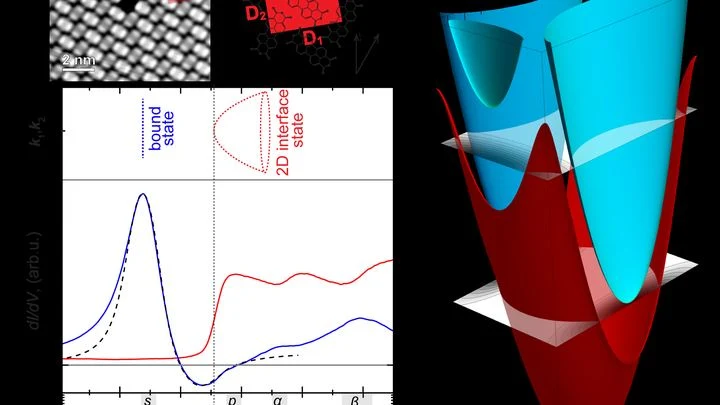
A wafer-thin film of organic molecules was grown on a silicon substrate. In this film, as if on a sheet of graph paper, tiny "pens"—artificial atoms — were laid out with the tip of a scanning tunneling microscope.
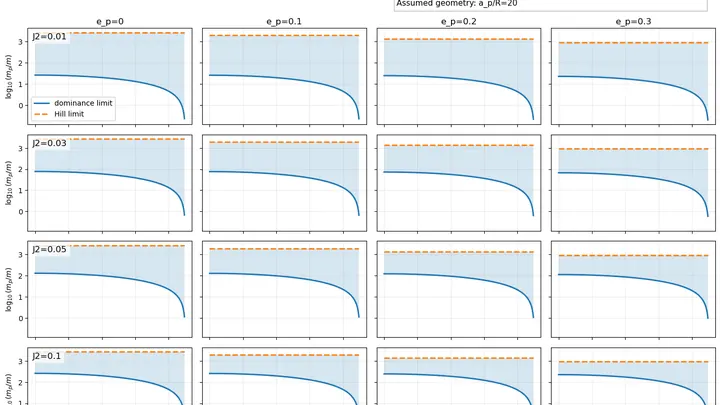
Around distant icy bodies the size of a city, circling beyond Neptune, rings of dust and ice have been found. Small moons often whirl nearby. Mathematical analysis shows that a moon's gravity rocks the ring like a swing, making it tilt.
A comet hurtling through space is a mountain of ice and dust that carries itself across the Solar System. If you mount small engines on such a mountain, it becomes a ship with its own fuel: gas from the interior can be vented through nozzles to change course.
The Comet Interceptor mission launches without a target. The spacecraft freezes at a point of space equilibrium, like a fighter jet on combat standby: engine warmed up, but takeoff only on alert.
Every few hours, narrow beams of radio waves leave the Mojave Desert, near Madrid, and near Canberra, heading into the sky. This is NASA's Deep Space Network: three antenna complexes that keep in touch with spacecraft across the solar system.