Gravitational acceleration is the rate at which an object's velocity changes due to gravity. On Earth, it is approximately 9.8 m/s² near the surface, but it varies slightly with altitude and latitude. This quantity is a fundamental test for theories of gravity, especially when applied to antimatter, which is expected to fall the same way as matter under general relativity but has never been directly measured until recently.
History
Galileo Galilei first demonstrated that gravitational acceleration is independent of mass in the early 17th century. Isaac Newton later formulated the law of universal gravitation in 1687. The first direct measurement of antimatter's gravitational acceleration was reported in 2023 by the ALPHA-g collaboration at CERN.
How it works
Gravity causes all objects to accelerate toward each other. For a body like Earth, the acceleration experienced by a test object depends on the mass of Earth and the distance from its center, following Newton's law of universal gravitation. In general relativity, this acceleration is a manifestation of spacetime curvature. Measuring gravitational acceleration on antimatter requires trapping antiparticles (like antihydrogen) and observing their free-fall motion, which is challenging because antimatter annihilates on contact with matter.
The gravitational acceleration on the surface of a neutron star is about 10^12 m/s² — a billion times stronger than on Earth — which would flatten any object instantly.
Units by system: SI: meter per second squared · CGS: gal · Planck: planck acceleration · natural: meter per second squared
At the very heart of the Milky Way, stars whirl around an invisible supermassive black hole. One of them, S301, completes an orbit in just 8.7 years. Its path is a highly squashed ellipse: sometimes it grazes the black hole, sometimes it shoots far away. At closest approach, the distance to the black hole is tiny by cosmic standards.
An optical trap holds an atom almost motionless, like a ball on a soft spring. But as soon as acceleration appears, say gravity, the equilibrium shifts. The atom moves within the standing light wave, and this changes the rate at which it exchanges energy with the field. The frequency of this exchange becomes a direct indicator of acceleration.
A quantum particle can be a wave, and pass through two paths at once. But if something 'peeks' at which path it took, the wave disappears. This effect is called loss of interference. Usually, photons or air molecules do the peeking.
The vacuum is not as empty as it seems. If an observer moves with acceleration, the vacuum around them heats up: this was predicted by William Unruh back in the 1970s. The effect is akin to black hole radiation, but in flat space.
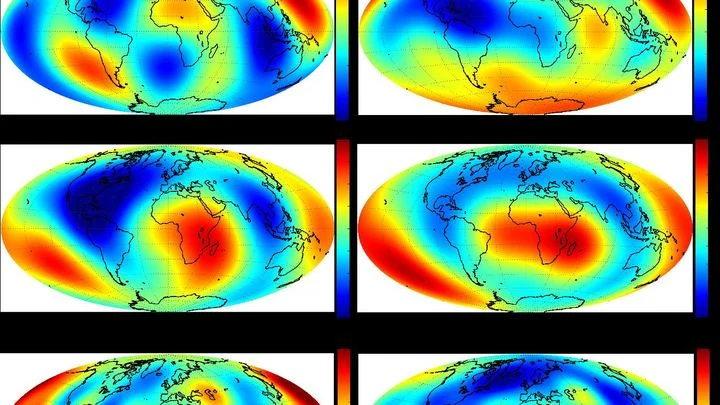
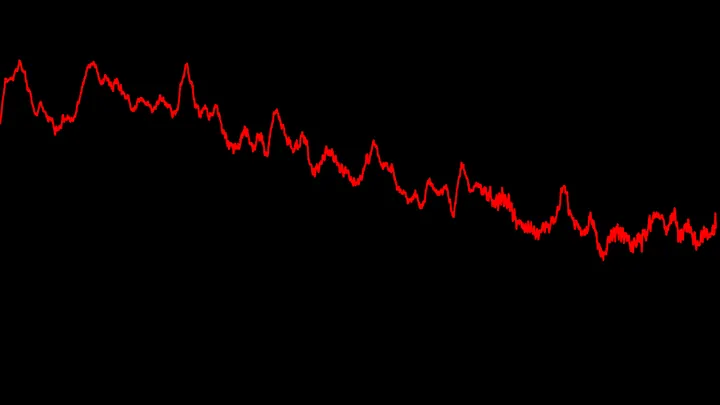
Gravity satellites have noticed that Earth's gravity field breathes imperceptibly with a period of about six years. It's as if an invisible pendulum swings the planet from within, and every six years the scale's needle shifts slightly. The signal turned out to be so clean that it could be separated from the noise of oceans and melting glaciers.
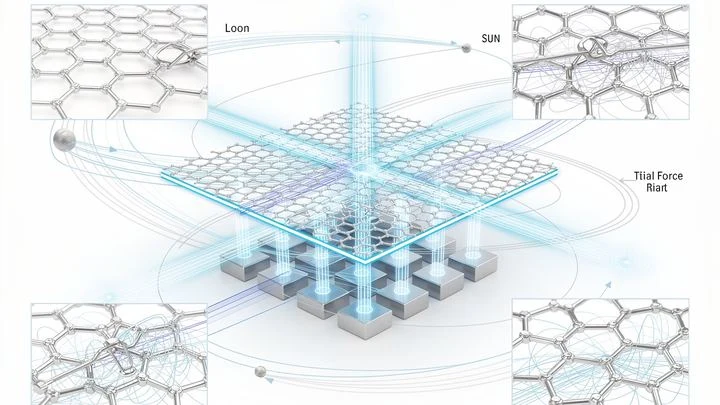
In the quiet of a laboratory, a graphite flake hovers above a magnetic grid. This is not just a demo of diamagnetism's magic — it's listening to the Universe. Like a spider casting its web to catch vibrations from an invisible world, this flake has become a gravitational web.
Hydrogen is the most common element. Its atoms are like antennas: they emit and absorb light at very specific frequencies. Einstein predicted that spacetime can ripple: these are gravitational waves.
In the first second after the Big Bang, the universe was a boiling cauldron of energy. Particle-antiparticle pairs were born and instantly annihilated each other. But for every billion such pairs, one particle of matter survived, and that leftover became stars, planets, and people.
New research blames modified gravity for this.
Take two heavy balls and place them a meter apart: they attract each other with a force that weakens by a factor of four when you double the distance. Newton discovered this law, and it works in a room, in the solar system, in a galaxy. But does it still hold when we're talking about hundreds of millions of light-years?
Astronomers found a way to test this directly.
An atomic gravimeter works like a very precise scale for gravity: it tosses up a cloud of atoms and watches how fast they fall. But these instruments have a hidden flaw — the shape of the signal they produce is slightly skewed. This skew, like a ruler with a chipped edge, subtly shifts every measurement.
A spring scale in a geologist's backpack responds sensitively to every mountain and valley beneath their feet. But springs get tired, and their readings drift — the instrument needs frequent recalibration against a reference. An atomic gravimeter measures gravity flawlessly, but it's the size of a refrigerator and doesn't like being jostled.
According to Einstein's theory, Earth's rotation drags space-time itself along — like a spoon dragging thick honey. This effect is incredibly weak: about one revolution in billions of years. But it can be caught.