86,000 Hours of Brain Signals: Now Just One Click Away express
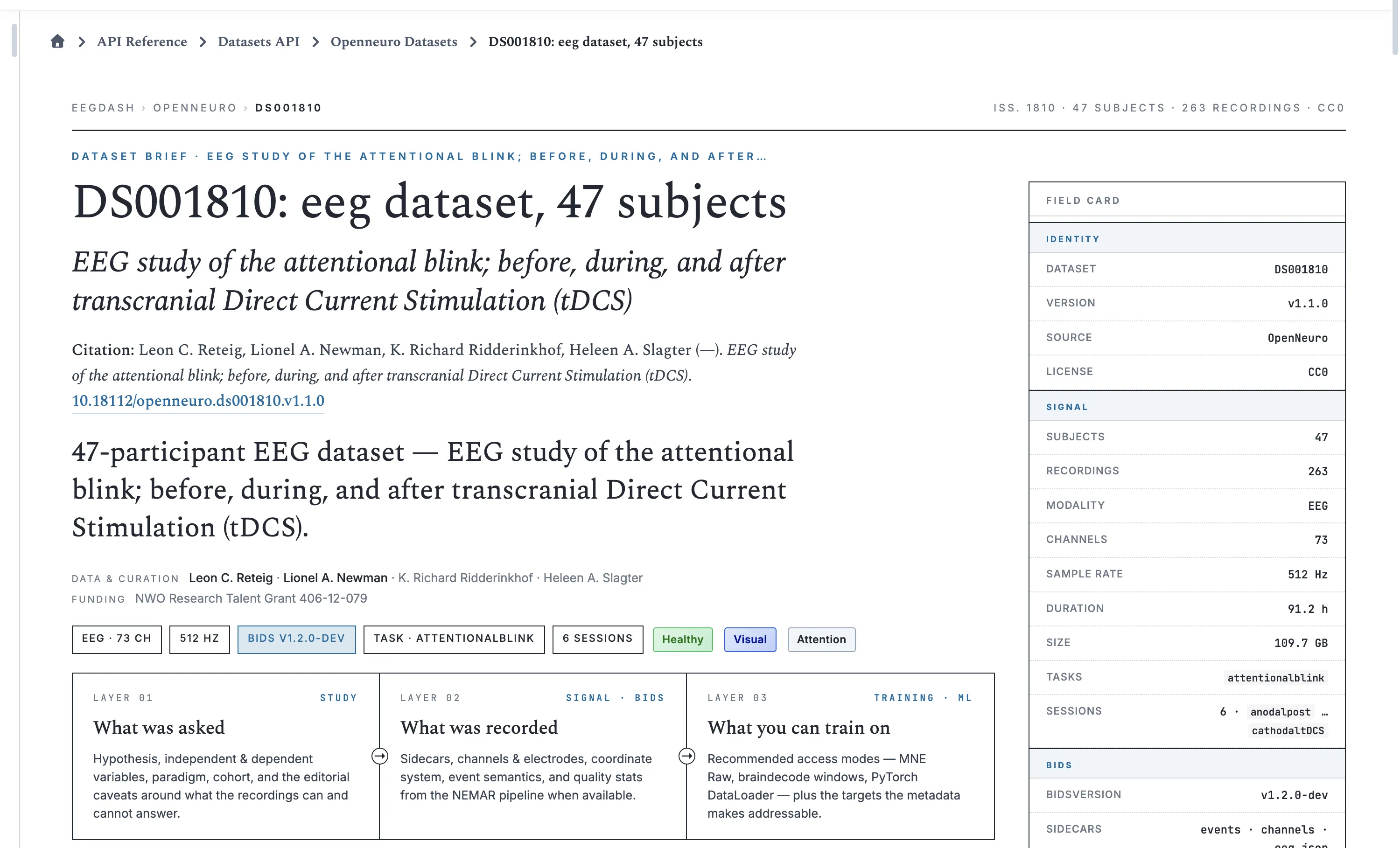
The open archives OpenNeuro and NEMAR hold 791 recordings of the brain's electrical activity from nearly forty thousand people. In total, that's 86,051 hours of signals — roughly ten years of continuous listening. Previously, to take even one such recording off the shelf, you had to write thousands of lines of code: download, unzip, fix format errors, and slice it into chunks of the desired length.
EEG-Dash works like a smart librarian. It knows where everything is, immediately checks the integrity of each recording against the strict BIDS standard (Brain Imaging Data Structure — a unified format for neuroimaging data), and returns an analysis-ready object. Inside, it's already wired up to MNE-Python for signal processing and Braindecode for windowing data for machine learning. The researcher just types the dataset name, and within seconds can start training a model.
A key feature of the system is metadata. Each recording is tagged with labels automatically extracted from the source scientific publication. You can search not by a dull number but by meaning: "left-hand movement" or "epileptic seizure." Semantic search turns a pile of files into a true catalog where what you need is just a couple of clicks away.
Ten years of brain signals are no longer dead weight. Now any researcher can test a hypothesis on hundreds of subjects in an evening without writing a single line of code for data loading. The library is finally truly open.
Original abstract
as written by the authors arXiv:2606.16041
Public neurophysiological datasets are increasingly accessible but remain hard to reuse: turning one into a trained model still takes thousands of lines of code for download, loading, format repair, windowing, and evaluation, and a dataset that meets metadata standards can still fail to load. EEG-Dash is a software resource that catalogues 791 publicly archived recordings (39,778 participants, over 86,051 hours) spanning electroencephalography (EEG), magnetoencephalography (MEG), intracranial EEG (iEEG), electromyography (EMG), and functional near-infrared spectroscopy (fNIRS) from the OpenNeuro and NEMAR archives. It exposes each dataset as an importable, queryable class that preserves signal attributes and loads into machine-learning workflows without custom code, delegating signal handling to MNE-Python, windowing to Braindecode, and format compliance to the official Brain Imaging Data Structure (BIDS) validator. A metadata-first registry adds semantic search, a format-repair layer, automatic dataset-level tags drawn from each source publication, and a feature-extraction framework. The catalogue, with per-record loadability and compliance metadata, supports benchmarking, model development, and cross-dataset analysis.
86,051 hours is more than the total runtime of all episodes of "The Simpsons," including its record 36 seasons.