Neural recording technology encompasses devices and methods used to capture the electrical or chemical signals produced by neurons in the brain. These tools are essential for understanding brain function, diagnosing neurological disorders, and developing brain-computer interfaces. The field has evolved from large, invasive electrode arrays to increasingly refined probes that minimize tissue damage while maximizing signal fidelity.
History
The first recordings of brain electrical activity were made by Richard Caton in 1875 using a galvanometer. Modern microelectrode technology emerged in the 1950s with the work of Edward Evarts, who developed methods for recording from single neurons in awake, behaving animals.
How it works
Most neural recording devices work by detecting the electrical potential changes that occur when neurons fire. Traditional electrodes are inserted into brain tissue to measure these signals directly. Newer approaches use ultra-thin, flexible probes that can conform to brain tissue, reducing inflammation and damage. Some advanced techniques use optical methods, such as calcium imaging, where neurons are genetically modified to produce fluorescent proteins that emit light when active, allowing recording through imaging.
In practice
Neural recording is used in clinical settings for epilepsy monitoring, in research to map brain function, and in brain-computer interfaces that allow paralyzed individuals to control external devices with their thoughts.
Fun fact
Some modern neural probes are so thin that they are smaller than a human hair, yet they can record signals from hundreds of individual neurons simultaneously.
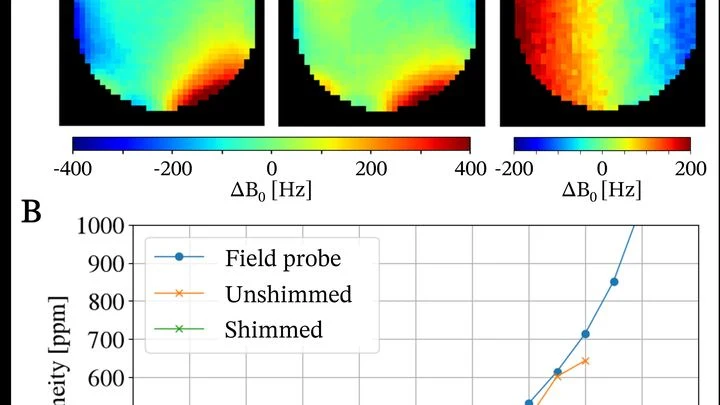
An MRI scanner is a big magnet that aligns hydrogen atoms in the body and then picks up their response signal. Such machines usually take up an entire room and cost as much as a nice house. Engineers from several labs decided to build a scanner that fits in a suitcase and released all the plans as open source.
The instrument shines an infrared beam at a sample, and molecules respond with their own absorption pattern, like bells of different tones. This pattern, the spectrum, holds information about the chemical composition. But to read it, a specialist usually consults a library of reference records, which is slow and not always possible.
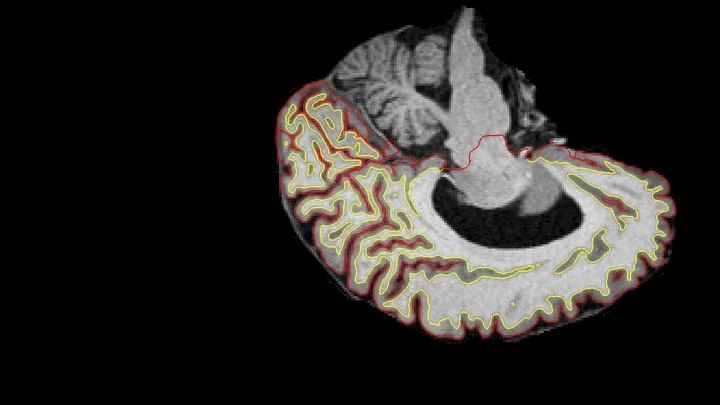
Two scans of the same brain taken at different times are like photographs of the same house before and after renovation. To see what changed, you overlay them and look at the differences. But an MRI scanner is not a perfect camera: it adds its own distortions, as if the photo were taken through slightly warped glass.
Blood vessel cells were seeded onto a transparent film just 700 nanometers thick — a hundred times thinner than a human hair. Flat electrodes are hidden beneath the film. They send a weak alternating current and listen as the resistance changes.
Every time a child with cerebral palsy is about to move their leg, a distinctive electrical blip appears in the brain — a slow voltage shift. Scientists call it a movement-related potential. A brain-computer interface (a system that reads intentions from brain signals) can pick up this blip and turn it into a command for a training device.
A city at night: lights on in some windows, dark in others. If you connect with lines the windows that light up simultaneously, you get a web of connections. Researchers studied such a web in tiny brain organoids — living clusters of nerve cells grown in the lab.
An electron microscope is a giant pipe organ: instead of pipes (electromagnetic lenses, instead of air) a stream of accelerated electrons. It once merely painted mute frescoes of the atomic world, condemning scientists to grueling decipherment.
A neuron is like a complex musical instrument. To understand how it responds to a touch, you used to have to connect to each string directly — a delicate, slow procedure that only works for individual cells.
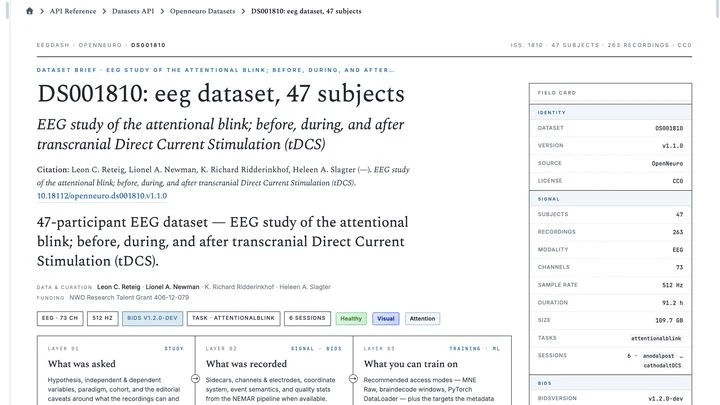
The open archives OpenNeuro and NEMAR hold 791 recordings of the brain's electrical activity from nearly forty thousand people. In total, that's 86,051 hours of signals — roughly ten years of continuous listening. Previously, to take even one such recording off the shelf, you had to write thousands of lines of code: download, unzip, fix format errors, and slice it into chunks of the desired length.
Photographing a delicate spiderweb trembling in the wind: that's roughly what it takes to look into the blood vessels of a living brain. Ultrasound localization microscopy (ULM) turns ordinary ultrasound into a tool capable of seeing individual capillaries, but only if you get the settings just right.
A rock concert blares at full volume, and you're trying to catch your friend's whisper. That's roughly how radio detectors feel when they pick up signals from cosmic dust particles. A particle slams into the atmosphere and spawns an air shower, a cascade of millions of secondary particles, and this shower emits a short radio pulse.
Speech is like an orchestra where every note must sound at just the right moment. The brain turns a thought into a chain of sounds in a fraction of a second, and until now it was unclear how it manages this hierarchy — from individual sounds to syllables to whole words.
In a lab, you measure a very weak signal — say, a tiny change in a magnetic field. The instrument trembles from passing cars, from the experimenter's breathing, from wires heating up. This technical noise can't be fully eliminated, and it sets a limit on precision. An ordinary sensor works like a scale that sways with any draft.
A standard MRI machine is a huge magnet that you can't move, plus a powerful computer that turns signals from the body into a picture. In recent years, portable scanners with weaker fields have appeared: they are light, cheap, and can work in a field hospital or an ambulance.
The gut talks to the doctor, but very quietly. Gurgles and rumbles last fractions of a second and easily get lost among the sounds of the lungs and heart. A stethoscope catches only a fraction, so the diagnosis depends on the experience and hearing of the individual doctor.
An electrocardiogram is like a long strip of paper on which the heart leaves its signature. A doctor studies it to catch rhythm disturbances, but when the recording lasts for days, the strip stretches for miles. The eye tires, attention wanders, and rare but dangerous irregularities can slip by.
AI-HEART works like a tireless assistant that scans the entire strip without a break.
An ECG is not just a wavy line on paper. Like a diary, it records the state of the entire heart: rhythm, wall thickness, and hints of future problems. But currently, programs that learn to read this diary are trained on very narrow tasks — mostly detecting arrhythmias. That's like teaching someone to understand a book by showing them only a list of typos.
A heart cell in a Petri dish contracts, and at that moment, an electrical wave sweeps across its surface. Previously, to catch that wave, you had to poke the cell with an ultra-fine electrode needle. Now, you just look at it under a microscope.
The method is called electrochromic recording.
You're trying not to think about the argument you had this morning, but vivid images keep popping into your head. At the same time, you're preparing a report and holding numbers in your mind. It doesn't go well: memory interferes with work, and work prevents forgetting. Scientists set out to see how the brain copes with this dual load in people with varying levels of anxiety.
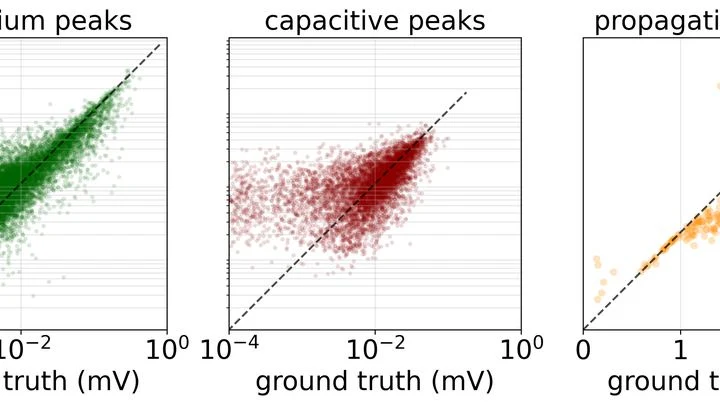
Silence in the operating room. The surgeon slowly lowers a needle thinner than a human hair into the patient's brain. At its tip is not a point but a whole palisade of nine hundred sixty microscopic microphones. Each one listens to its own tiny patch of gray matter.
An electrocardiogram is like a musical score, where each note is a heartbeat. A doctor hears the melody and spots the off-notes — arrhythmia. But listening to the score for hours is tiring, so a smart monitor is placed by the patient's bedside.
Two images of the same place: one taken in the morning from a drone, the other in the evening from a satellite. The first shows shadows from trees, the second shows glints on the water. It's like two accounts of the same event in different dialects: the words are similar, but the grammar is different.