Batteries Learn from the Past express
In a phone battery, there is always energy that cannot be extracted: it seems glued to the terminals. In the quantum world, this "glued" part is called bound energy. The authors showed that if you connect a helper particle to the battery (it only observes, but doesn't give up its own), bound energy ceases to be dead weight.
The key finding is a hard ceiling for this enhancement. When the battery and the helper are intertwined into a single whole without impurities (physicists say "pure state"), the gain hits exactly the bound energy of the battery. Below (possible, above) never. To avoid guessing with measurements every time, the scientists introduced a "purity index"—a simple guide that tells in advance whether it's worth bothering with the helper.
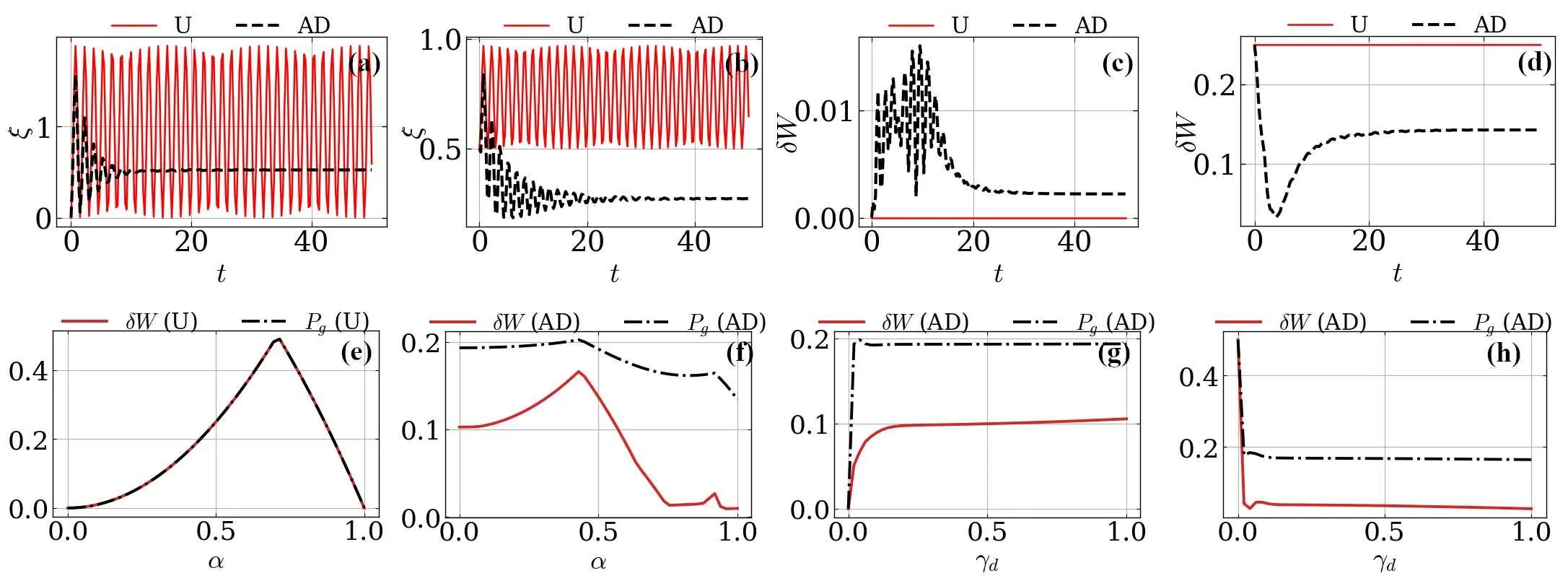
The most unexpected thing happened when the battery was placed in a shared noisy environment. Usually, noise only interferes. But here, the collective environment created an invisible connection between the battery and the helper, and the gain not only survived but stabilized. In systems with internal interactions, the picture is even more striking: when energy levels shift and rearrange, the available bound energy changes abruptly. The gain begins to depend not only on correlations but also on the energy landscape, just as a harvest depends not only on seeds but also on the field's terrain.
Original abstract
as written by the authors arXiv:2606.19945
We investigate ancilla-assisted work extraction in quantum batteries from the perspective of bound energy and purity. We show that the bound energy of the reduced system provides a tight upper bound to the daemonic gain and that this bound is saturated for globally pure system--ancilla states. Motivated by this relation, we introduce a purity-based gain that qualitatively predicts the daemonic gain without requiring explicit optimization over measurements. We further introduce a protocol to analyze the role of dissipation and intrinsic interactions on daemonic gain. Under a collective environment, dissipation can dynamically generate and stabilize finite daemonic gain through environment-induced correlations. In interacting systems, level crossings and spectral restructuring strongly modify the attainable gain through their influence on the accessible bound energy. Our results demonstrate that daemonic gain is governed not only by correlations, but also by the spectral structure of the underlying Hamiltonian and information loss captured by bound energy and purity.
In an ordinary battery, part of the energy is forever locked in chemical bonds: this is the analogue of bound energy. But in the quantum version, this locked part can be freed simply by "peeking" at the system in the right way.
The plot resembles Philip Pullman's "His Dark Materials": the daemon-helper doesn't give its own energy, but without it, the protagonist cannot unlock their true potential.