Binding energy is the energy that must be supplied to a bound system to separate it into its constituent parts. It appears at every scale of physics: the energy that holds electrons in an atom, protons and neutrons in a nucleus, atoms in a molecule, or even stars in a galaxy. The concept is central to understanding why systems are stable and how much energy is released or absorbed when they form or break apart. In the context of the provided titles, binding energy underlies phenomena as diverse as bacterial adhesion, DNA repair, and the attraction of positrons to atoms.
History
The concept of binding energy emerged in the early 20th century with the development of atomic and nuclear physics. Albert Einstein's mass-energy equivalence (E=mc²) in 1905 provided the theoretical basis, and Francis Aston's measurements of atomic masses in the 1920s revealed that nuclei weigh slightly less than their components, directly demonstrating binding energy.
How it works
A bound system has lower total energy than its separated components. The binding energy is the difference between the energy of the separated parts and the energy of the bound state. To break the system apart, you must add at least this amount of energy. Conversely, when the system forms, this energy is released, often as heat or light. The stronger the binding, the more energy is required to break it, and the more stable the system is.
In practice
Binding energy is crucial in nuclear power and weapons (fission and fusion release binding energy), in chemistry for understanding reaction energetics, and in biology for processes like DNA repair and protein folding.
Fun fact
The binding energy of a hydrogen atom is about 13.6 electronvolts, but the binding energy of a carbon-12 nucleus is about 92 million electronvolts—roughly seven million times larger.
Units by system: SI: joule · CGS: erg · Planck: planck energy · natural: electronvolt
A protein slides along the DNA strand like a key along a keyring, searching for its lock. One wrong turn and a gene stays switched off. To know where a protein will grip firmly, you need to measure the strength of that grip — the binding energy.
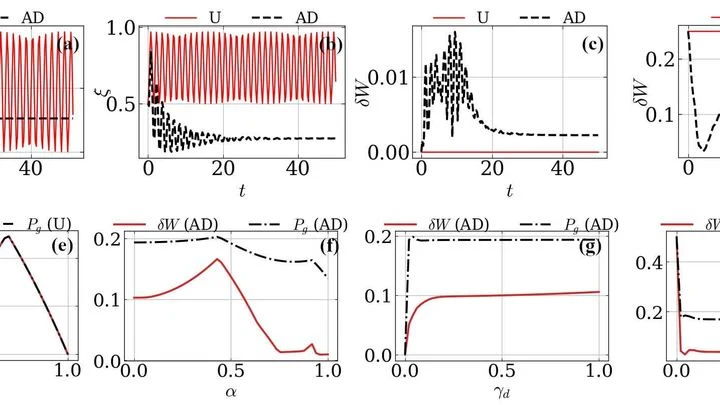
In a phone battery, there is always energy that cannot be extracted: it seems glued to the terminals. In the quantum world, this "glued" part is called bound energy. The authors showed that if you connect a helper particle to the battery (it only observes, but doesn't give up its own), bound energy ceases to be dead weight.
The key finding is a hard ceiling for this enhancement.
A torn telephone wire is a nuisance, but a torn DNA is a catastrophe. A double-strand break, when both strands of the helix snap at the same spot, threatens the cell with death or transformation into cancer. Fortunately, the cell has its own 'glue': special proteins that gather into a droplet right at the accident site.
A pinch of salt falls into water, and sodium and chlorine ions scatter, surrounded by water molecules. Now, instead of an ion, a positron (an antiparticle, the electron's twin but with a plus instead of a minus) joins the molecular crowd.
A semiconductor film just one atom thick is like a communal apartment: it houses negatively charged electrons and positively charged 'holes.' When light hits such a film, an electron and a hole can pair up into an exciton — a bound state of an electron and a hole, akin to a hydrogen atom.
A drop of oil in water behaves like a tiny ball: it seeks the spot with the least energy. If a wall is nearby, the drop often sticks to it, just as a raindrop spreads on glass. In a mixture of two immiscible liquids, such as polyethylene glycol and dextran, tiny droplets of one liquid form inside the other.