A quantum battery is a quantum system designed to store energy and release it on demand with minimal loss. Unlike classical batteries, which rely on chemical reactions or electric fields, quantum batteries exploit quantum effects such as superposition and entanglement to achieve higher efficiency and faster charging. They are a topic of active research in quantum thermodynamics, aiming to create energy storage devices that operate at the quantum scale.
History
The concept of quantum batteries was introduced in 2013 by Alicki and Fannes, who proposed a quantum model of a battery and showed that quantum effects could enhance its performance.
How it works
Quantum batteries typically consist of a collection of quantum systems, such as atoms or qubits, that can be charged by a driving field. The key advantage is that quantum entanglement between the constituent particles can allow for 'collective charging', where the total charging power increases superlinearly with the number of particles. This means that a larger battery can charge faster per unit volume than a smaller one. Additionally, quantum coherence can be used to suppress energy leakage, making the battery more stable.
In practice
Quantum batteries are still in the experimental stage, but they are being explored for powering nanoscale devices, quantum computers, and other technologies where efficient energy storage at small scales is crucial.
Fun fact
In 2022, researchers demonstrated a quantum battery that could be charged without an external field, using only the interaction between the battery and a hot environment, a process called 'heat charging'.
Electric charge is a slippery thing. You can measure how much there is in the entire universe or in a single particle, but try to point your finger and say, 'Right here, in this cubic centimeter, there is exactly this much charge right now,' and you hit a fundamental wall.
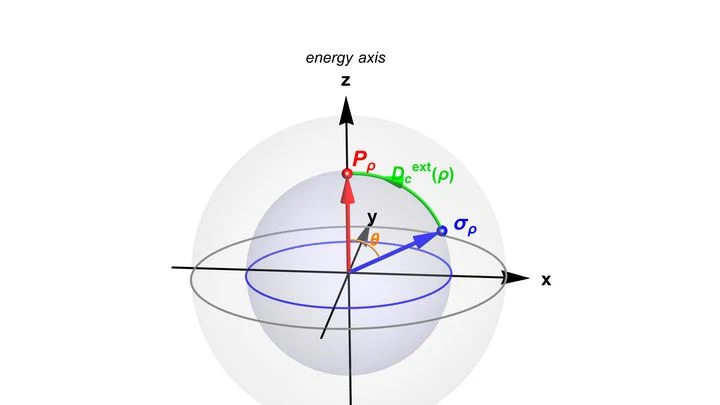
The issue is that total charge, which physicists denote by the letter Q, is nonlocal.
An empty resonator isn't truly empty. Even in an absolute vacuum, where not a single photon exists, quantum fluctuations persist. They resemble ripples on water in a dead calm: the surface appears smooth, but molecules keep jittering. Physicists have learned to turn this jitter into real waves.
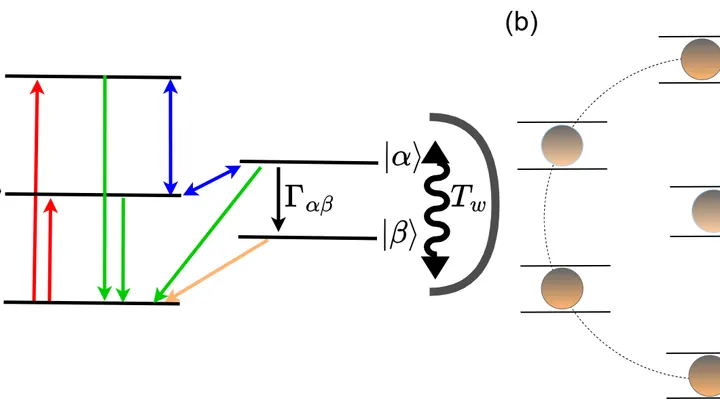
Any battery, from a AA to a quantum one, is simple in principle: there's a store of energy, and there's a way to get it out. In the quantum world, this 'way' looks like a careful switching between particle states, akin to moving a ball from a high shelf to a low one.
In classical thermodynamics, heat engines are like a virtuoso musician on stage: the closer to perfection in performance (Carnot efficiency), the slower the tempo (power).
Two pendulums on a shared string trade motion: push one, and the second starts swinging, and a moment later the first gets a push back. In a thorium-229 atom, energy flows nearly loss-free between the electron shell and the nucleus.
The void is never truly empty. In curved spacetime (for instance, in an expanding universe or near a black hole) the vacuum heats up. This is reminiscent of how acceleration makes particles appear seemingly out of nowhere: a phenomenon known as thermal vacuum radiation.
A lithium battery is like a tiny city: lithium ions are the residents who move between electrode neighborhoods, generating current. But to understand how much energy the city can deliver, you need to know not only the street layout (the material's structure) but also how residents interact with neighbors, transportation, and even the weather.
The atomic nucleus is a natural spring of colossal power. When the protons and neutrons inside it rearrange, it enters a special long-lived state — a nuclear isomer. It stores energy like a spring compressed to its limit.
Quantum batteries harness quantum effects to circumvent the limitations of ordinary devices imposed by entropy — a measure of disorder and energy losses. Imagine a bucket under a powerful jet: filling is lightning-fast. But the bucket has holes: the environment constantly drains the energy.
Ordinary batteries lose charge like tea cools down. A quantum battery works differently: its heart is a tiny cavity with darting photons. If you illuminate it with special photon pairs, energy flows into a chain of qubit cells instantaneously — much like a swing gets a boost from strong pushes.
An ordinary battery in a phone stores energy in chemical bonds — slowly, with heat and wear. A quantum capacitor works differently: it charges not with matter but with rhythm. A swing that is pushed in time with its motion accumulates energy in the motion itself, without friction.
A quantum battery is not a box of chemicals but a chain of tiny magnets (spins) capable of storing energy. Its main trick: charge many particles at once, using their quantum entanglement. But there's a catch — not all entanglement works.
Steam rising from hot metal is a familiar sight in the kitchen. But if you use rubidium instead of water, that cloud becomes a battery. It doesn't run on chemical reactions but on the quantum coordination of atoms.
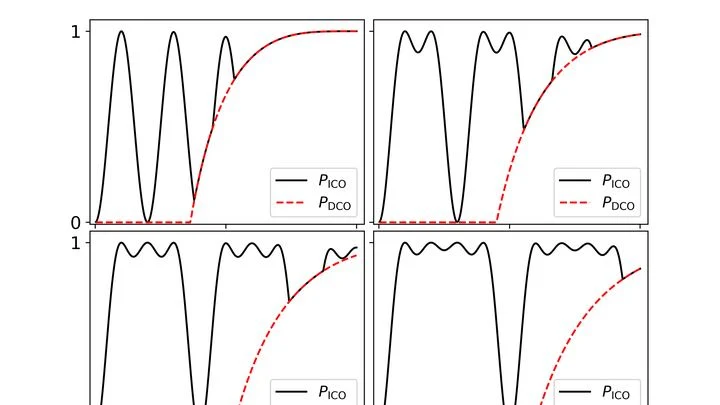
In quantum batteries, charging can be accelerated by shuffling the steps in time, like a deck of cards. Instead of a smooth energy climb, you get abrupt efficiency explosions, like microscopic supernovae inside atoms.
The quantum battery works like a sponge that absorbs light but won't release it without a forced squeeze. The inspiration came from bacteria's natural solar traps: capturing solar photons, they transfer energy almost losslessly, as proven by spectroscopy.
Two phones with identical batteries: one charges in a basement with a weak signal, and the process goes slower. The battery percentage here plays the role of a clock hand. Physicists applied the same logic to the quantum world. Their clock is a microscopic battery that stores energy. The charging rate depends on a hidden quantum 'mode'—like a switch.
A quantum battery is a device that stores energy in the quantum states of particles. In the new work, the battery was modeled as a pair of qubits — the tiniest carriers of information that can be in a "zero" state, a "one" state, or a mixture of both.
Ordinary computer memory constantly consumes energy to avoid forgetting what's stored. A superconductor could store data without loss, but it's hard to make it switch.
In the new work, a superconductor is sandwiched between two magnetic insulators.
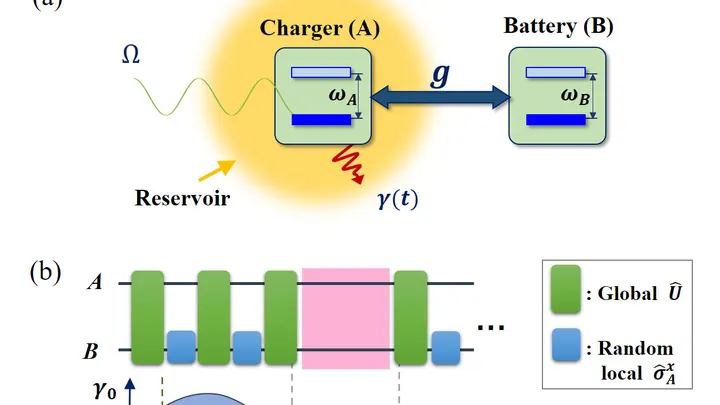
Quantum batteries lose energy due to entropy — the tendency toward disorder. Just as parallel wires pick up interference, the battery's contacts with the environment create leakage channels. The solution: braid the giant atoms, which act as both charger and storage, into a braid.
Atoms, like a swarm of fireflies, shine in unison. When they flash together, the light multiplies — a hundred atoms shine ten thousand times brighter than one. Physicists have turned this trick into a heat engine. A typical motor needs both a hot and a cold source, but here the atoms operate with just a cold one.
An orchestra without a conductor, where each musician hears only the hall's echo, can create a powerful melody. That's how a quantum battery works: many particles, immersed in a warm environment, don't dissipate heat but exchange it synchronously. Instead of chaos, an orderly charge emerges.
A quantum battery is not a box of electrolyte but a handful of atoms or superconducting loops, with energy stored in excited states. It can be charged in fractions of a second using collective quantum effects.