In quantum physics, the vacuum is not an empty void but the ground state of a quantum field, characterized by zero-point fluctuations. These fluctuations are a consequence of the Heisenberg uncertainty principle, which forbids a field from being exactly zero at all points. The vacuum can be manipulated, for instance through the Casimir effect or by coupling to entangled systems, to extract energy or information.
The vacuum state is defined as the lowest energy state of a quantum field. However, it still exhibits virtual particle-antiparticle pairs constantly popping in and out of existence. By introducing boundaries, strong electromagnetic fields, or entanglement, these vacuum fluctuations can be altered, leading to measurable effects like the Casimir force or spontaneous emission. In energy teleportation, entanglement shared between parties allows one to extract energy from the vacuum fluctuations of another's local region, effectively 'teleporting' energy without transporting particles.
In practice
Vacuum fluctuations are exploited in technologies like the Casimir effect in microelectromechanical systems (MEMS) and are a key consideration in quantum computing and communication, where they contribute to noise and decoherence.
Fun fact
The energy density of the quantum vacuum is theoretically so large that it would cause the universe to expand at an enormous rate, yet observations show a much smaller value, a discrepancy known as the cosmological constant problem.
A layered cake of molybdenum disulfide MoS2 sits on the lab bench. It is prepared in the usual way: adhesive tape peels off the top layers to obtain a thin sample. But beneath the tape remains an invisible cavity where the atomic floors are no longer pressed together. It is there that electrons begin to behave differently than in the crystal bulk.
Imagine a huge puzzle where each piece is a quantum particle. To complete the picture, you don't just fit the pieces together: you need to entangle them in a special way. Usually, this is done by carefully applying operations one after another, like assembling the puzzle strictly by the instructions, row by row.
Light escaping a massive body loses steam. Its frequency dips slightly, and its color shifts toward red. Physicists call this gravitational redshift. In classical theory, it's all clear, but the moment you bring quanta into the picture, trouble starts.
Previously, this shift was modeled as a kind of mode mixer — a device that entangles different states of light.
In a pot of boiling water, steam bubbles appear and disappear — a similar struggle takes place in two-dimensional materials. Here, electrons both create magnetism and try to extinguish it.
In the big world, there's a simple rule: energy density can't be negative, and its flow can't outrun light. In a café, that would look like this: a waiter can't deliver orders faster than he can run. Physicists call this restriction the energy dominance condition.
But in the microworld, where quanta rule and spacetime can bend, energy starts acting up.
At the center of nearly every galaxy lurks a supermassive black hole. Its gravity is so strong that it warps space itself. But few stop to wonder: what does it do to the very fabric of reality — the fields that permeate the cosmos?
One such field is the Higgs field.
Empty space is not as empty as it seems. According to quantum theory, the vacuum is filled with particles that constantly pop in and out of existence. In 1976, physicist Bill Unruh showed that if an observer moves with acceleration, this 'quantum soup' turns into a genuinely warm bath for them — the Unruh effect.
In a room, air touches the skin, and we feel its temperature. But if your body suddenly accelerated at a colossal rate, heat would come even from absolute emptiness. This is not fiction but a strict consequence of quantum field theory: for an accelerating observer, the vacuum becomes a warm bath.
A black hole is not just an abyss where everything falls. Right at its horizon, in the so-called quantum atmosphere, a faint glow is born — Hawking radiation. This is not calm light but a churning stream of particles that can influence the most delicate quantum connections.
The quantum world is often compared to a musical instrument. Each system, whether an atom or a chain of particles, sounds at its own frequencies, which physicists call energy levels. In chaotic systems, like an orchestra without a conductor, these frequencies usually fill the entire available range without gaps.
Two light rays meet at a point and then diverge. Their paths form two intersecting surfaces in spacetime — null hypersurfaces (boundaries along which light propagates). It is on such a pair of surfaces that physicists can set initial data for Einstein's equations. This is called the characteristic Cauchy problem.
Ever since Fritz Zwicky noticed that galaxy clusters were moving too fast, and Vera Rubin measured the rotation of spiral arms, dark matter has remained cosmology's greatest mystery.
In the first moments of the universe's life, there was not even a hint of dark energy — the very force that today pushes galaxies apart ever faster. But if you look deeper, down to the Planck scale (billions upon billions of times smaller than an atomic nucleus), spacetime ceases to be smooth.
Building a house on sand is a bad idea. In physics, it was long believed that a quantum theory of gravity could not be built on a fixed "sand"—a pre-existing spacetime.
A lone fold runs across a taut sheet — a sharp drop in height that doesn't spread out but moves as a whole. Physicists call such a fold a 'kink'. If you give the sheet a sharp tug in one spot, ripples will travel across it. But in some media, these ripples don't disperse; instead, they gather into a clump and tremble in place for dozens or hundreds of cycles. Such a clump is an oscillon.
The vacuum is not as empty as it seems. If an observer moves with acceleration, the vacuum around them heats up: this was predicted by William Unruh back in the 1970s. The effect is akin to black hole radiation, but in flat space.
Toss a handful of phosphorus into silicon, and at a certain impurity concentration the material suddenly starts conducting electricity. This is a metal-insulator phase transition, and it happens abruptly. But what exactly changes in the electron wave functions when an insulator becomes a metal?
In 1953, mathematician Alexander Grothendieck proved a theorem that became a cornerstone in the theory of tensor products. It states that for ordinary function spaces, two natural norms, the projective and the injective, are equivalent up to a universal constant. In other words, two ways of measuring the 'size' of combinations of vectors give similar results.
In a phone battery, there is always energy that cannot be extracted: it seems glued to the terminals. In the quantum world, this "glued" part is called bound energy. The authors showed that if you connect a helper particle to the battery (it only observes, but doesn't give up its own), bound energy ceases to be dead weight.
The key finding is a hard ceiling for this enhancement.
Gravitational-wave observatories are like a keen ear listening for distant rumbles of cosmic catastrophes. To catch the faint whisper of merging black holes, detectors of gravitational waves use specially prepared light — known as squeezed vacuum.
The early universe expanded at an unimaginable rate — faster than light could cross it. In this boiling cauldron, any region of space resembled an open can of paint: its boundaries continuously captured new 'vapor' from outside, while some of its own contents irrevocably escaped.
In the mountains, there is a saddle — a point where the trail from one valley crosses over into another. Standing exactly on it, you take a step and are already descending the new slope. In chemistry, such a place is called the transition state: a brief moment when atoms are frozen on the threshold of transformation.
A soap bubble hangs in the air, and its shape already contains everything needed to calculate the internal tension. A similar principle worked in a new study on quantum gravity. Physicists took a closed surface, an analog of such a bubble, and specified a few numbers on it: for example, the electric field strength and the curvature.
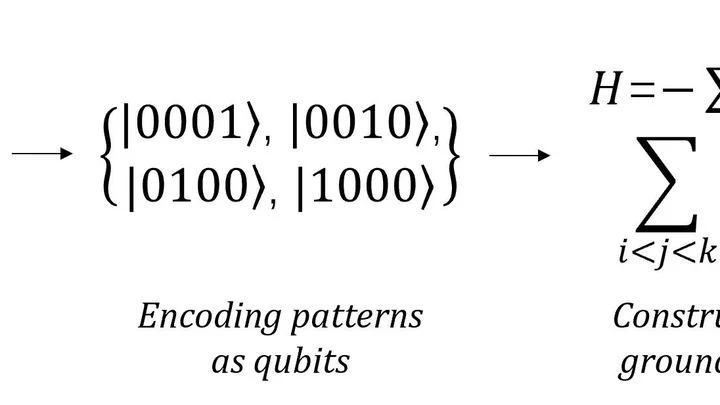
Conventional neural networks learn from thousands of examples, burning hours and gigawatts. Physicists have found a quantum workaround. As early as Max Planck showed the discreteness of energy, today this allows generation without training.
A superconductor carries current without resistance, like water running through a pipe without friction. The secret lies in electron pairs: two electrons stick together as one, even though they normally repel. In an ordinary superconductor, the spins of the electrons in a pair point in opposite directions: this is the singlet state.
For nearly a century, astronomers have watched galaxies spin as if held together by invisible mass. Fritz Zwicky first noticed it, and Vera Rubin precisely measured the speeds of stars at the edges.
The quantum world is usually drawn with points, but real instruments only see blurry spots. Heisenberg and von Neumann long suspected: precision is unattainable.
The universe is not a solid monolith, but a canvas of countless quantum threads. Spacetime doesn't flow like water, but vibrates like a tapestry in the wind. For a long time, physicists only saw the overall pattern, neglecting the tremor of individual threads.
Picture the Universe as a book with a finite number of pages. Its accelerated expansion, driven by dark energy, a mysterious substance pushing space apart, acts like an invisible binding: distant pages are forever glued together, becoming inaccessible chapters.
A quantum bit (qubit) is a delicate thing. Even a little heat destroys it, like a random nudge topples a crystal wine glass. To protect this fragile information, physicists have built a three-dimensional quantum structure resembling a Russian doll.
An ice cube in a glass of water doesn't just float: it gets pushed. Water molecules bombard it from all sides, and this bombardment gives rise to a force you can measure. In physics, there's a similar force, but it acts not on ice but on anything with mass, and it arises not from molecular jostling but from information. It's called entropic force.
Two thin sheets with honeycomb patterns were stacked and slightly rotated, creating a new pattern — a moiré, like the shimmer of silk. The electrons in the experiment behaved similarly: they arranged themselves into two layers, with one layer rotated exactly 30 degrees relative to the other.
On the surface of a tiny sphere live two invisible fields, like two kinds of ripples on a soap bubble. These fields don't just oscillate on their own: they constantly influence each other, like musicians playing in unison. In a new study, physicists derived exact equations that describe how this ripple changes over time, heats up, and descends into chaos.
In particle physics, it has long been taken for granted that the forces of nature (electromagnetism, the weak and strong interactions) obey a strict symmetry called gauge symmetry. It's like a set of rules by which particles exchange force carriers. But where do the rules themselves come from?
A fisherman casts a net into a quiet backwater. The longer the rope, the weaker he feels the faintest nibble — the wave fades along the way. But what if the signal didn't die out but grew stronger? That's roughly the trick described by the authors of a study on an ensemble of particles placed in a field with a special 'stepped' force gradient.
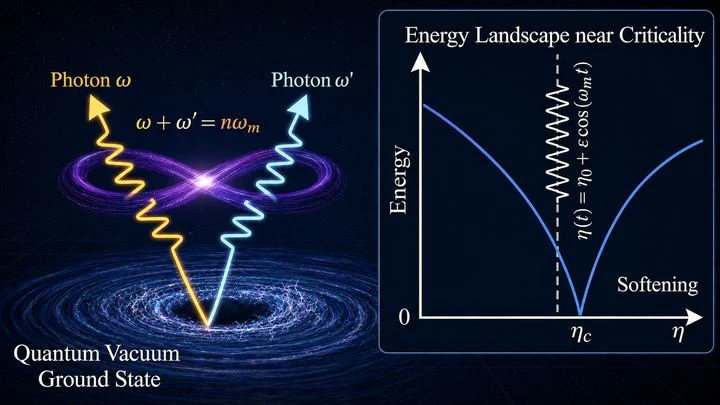
The quantum vacuum is not emptiness, but a tautly stretched string, where particles constantly appear and vanish. Abruptly changing conditions, like shifting the mirrors of a microcavity, causes the 'string' to emit real photons.
Two tiny dust grains hover at the crossing of laser beams. Each is held by its own 'tweezer'—a focused beam that keeps the particle from falling. Inside a mirrored cavity, light bounces between the walls, and its oscillations are coupled to the trembling of the grains.
An ultracold cloud of atoms trapped in laser light can 'breathe': it rhythmically contracts and expands, much like lungs. Physicists have long been able to observe this breathing, but only now have they realized that its amplitude is not just a pretty picture: it is a precise measure of hidden energy jitters inside the cloud.
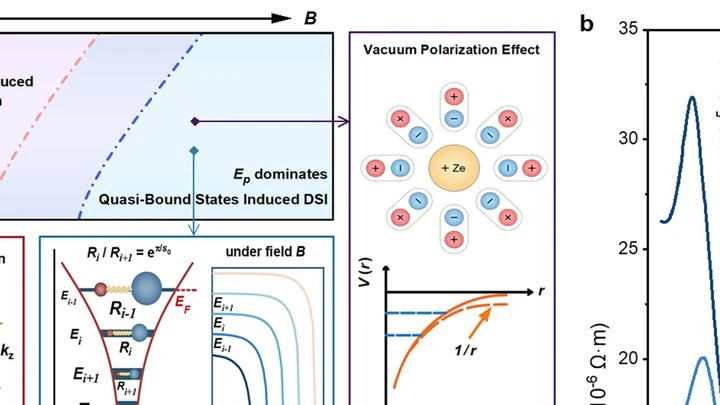
In the crystal HfTe5, electrons behave almost like light: their mass is so small that they obey the laws of relativity. If you place such a crystal in a strong magnetic field, the electrons start to circle in tiny orbits. Their energy then changes not smoothly but in steps, like floors in a building.