Gain is a measure of how much a system amplifies a signal, defined as the ratio of output power to input power. It is commonly expressed in decibels (dB), where a gain of 10 dB means the output is ten times more powerful than the input. Gain is a fundamental concept in electronics, optics, and acoustics, determining the sensitivity and performance of amplifiers, antennas, and detectors.
History
The term 'gain' has been used since the early days of radio engineering in the 1910s and 1920s. The decibel unit was introduced by Bell Labs in the 1920s to quantify signal loss in telephone lines and later applied to gain.
How it works
An amplifier takes a weak input signal and uses an external power source to produce a stronger output signal. The gain is set by the amplifier's design, such as the number of transistor stages or the doping level in a laser medium. In antennas, gain describes how effectively they focus energy in a particular direction compared to a hypothetical isotropic radiator. High gain means a more directional and efficient signal.
In practice
Gain is essential in designing communication systems, from cell towers to satellite links, and in scientific instruments like gravitational wave detectors that amplify tiny vibrations to measurable levels.
Fun fact
In gravitational wave detectors like LIGO, the total gain is so high that a mirror displacement smaller than a proton's width is amplified into a measurable electrical signal.
Catching light one particle at a time is like hearing a whisper in a roaring factory. An electron-multiplying camera (EMCCD) can do exactly that: it turns a single photon hitting a pixel into an avalanche of electrons that can be measured. These cameras are mounted on telescopes to spot a barely visible planet next to a dazzling star.
The cosmic dawn is hidden behind a dense veil of time. To see beyond it, you need to catch the radio signal from clouds of neutral hydrogen — the so-called global 21 cm signal. But it is so faint that the receiver's own noise drowns it out.
Imagine a smart antenna panel, a phased array, that steers radio waves traveling at the speed of light. It works like an orchestra: hundreds of tiny emitters, like musical instruments, shift their phase (the moment they 'join' the overall sound) on command via a variable voltage.
Traditional hearing aids resemble a chef who cooks from a recipe blindly. They analyze the sound chaos from the microphone and amplify speech based on it. In a noisy café, this approach often errs. The new system behaves like an experienced cook: first processes the signal, then samples the result.
Fiber optics transmit data with light of different colors. These beams race at nearly the speed of light. Normally, all signals go the same way, creating a jam and interference, like an orchestra where musicians are trying to outshout each other.
In pursuit of gravitational waves, ripples in spacetime left by black holes and neutron stars, detectors like LIGO pump their arms with light of dazzling intensity.
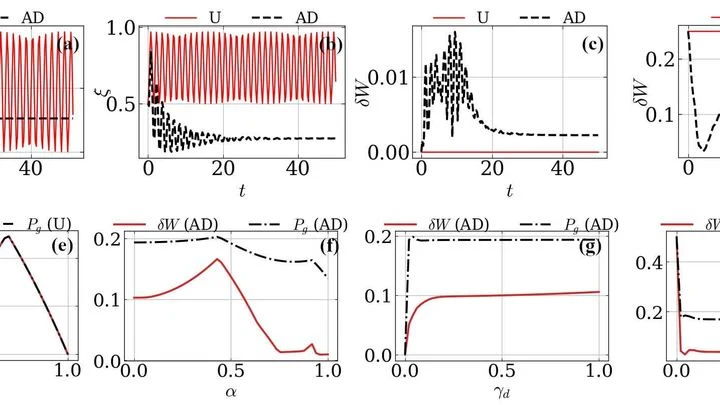
In a phone battery, there is always energy that cannot be extracted: it seems glued to the terminals. In the quantum world, this "glued" part is called bound energy. The authors showed that if you connect a helper particle to the battery (it only observes, but doesn't give up its own), bound energy ceases to be dead weight.
The key finding is a hard ceiling for this enhancement.
Two tiny mirrors in a vacuum are like figure skaters in a pairs routine. Their oscillations are synchronized by an invisible gravitational thread. When cooled to millionths of a degree above zero, this thread turns them into a single quantum link — the motion of one instantly echoes in the other.
A whisper in a noisy room is nearly indistinguishable. A conventional amplifier adds its own noise and drowns out the weak sound. A quantum amplifier works differently: it amplifies the signal while adding almost no extra noise, like a perfect ear. But even such an ear has its own problems.
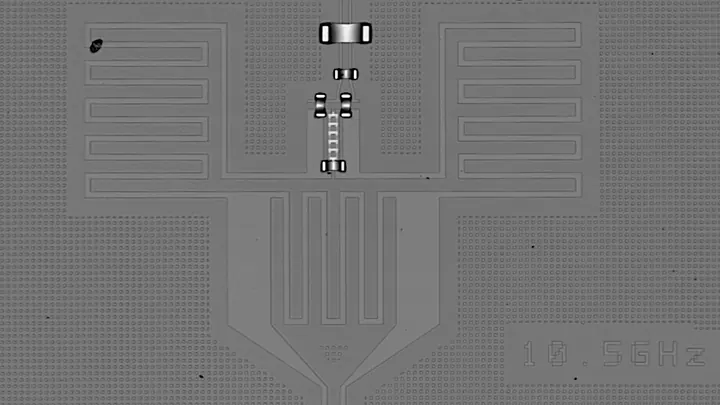
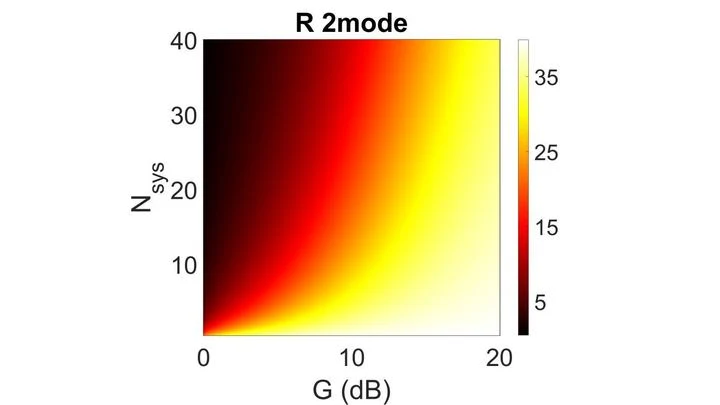
A quantum bit (qubit) is like a barely discernible whisper in a hum of voices. A regular amplifier makes the whisper louder, but along with it, the hum as well, making it harder to hear the essence. Physicists have created a clever device that generates two identical signal-whispers at different frequencies — the original and its echo.
An ordinary free-electron laser is like a musical instrument with a single string: it can play only one note until you change its design. To get a different wavelength, you have to retune magnets or accelerate electrons harder. That's expensive and bulky.
Gravitational waves are ripples in spacetime curvature that imperceptibly stretch and squeeze everything around. But the Moon, like a bell, catches these waves: as a gravitational wave passes through it, it makes our satellite vibrate.
In a dark room, a tiny diamond glows red when a green laser hits it. This glow isn't just for show: it's a signal: its brightness changes when a magnetic field is nearby. Inside the diamond sit defects — nitrogen atoms with an empty neighboring site. They act like sensitive needles that rotate under the influence of a magnet.
A laser beam is trapped between two mirrors, one of which trembles under an invisible force. Each vibration of the mirror changes the phase of the light, and from these changes you can infer the force. But the light itself pushes on the mirror, which is quantum backaction, and it imposes a fundamental limit on measurement accuracy.