Energy levels are the discrete, quantized values of energy that a bound quantum system, such as an atom, molecule, or artificial atom, is allowed to possess. Unlike classical systems, where energy can vary continuously, quantum systems can only occupy specific energy states, with transitions between them occurring via absorption or emission of photons or other quanta. These levels are fundamental to understanding atomic spectra, chemical bonding, and the operation of devices like lasers and qubits.
History
The concept of discrete energy levels was introduced by Niels Bohr in 1913 to explain the hydrogen spectrum, and later formalized by Erwin Schrödinger's wave mechanics in 1926, which provided a general method for calculating energy levels from the system's Hamiltonian.
How it works
The discrete energy levels arise from the wave nature of quantum particles. When a particle is confined, for example by the electrostatic potential of a nucleus, its wavefunction must satisfy boundary conditions that allow only certain wavelengths, corresponding to specific energies. The lowest energy state is the ground state, and higher states are excited states. Transitions between levels occur when the system absorbs or emits a quantum of energy exactly equal to the difference between the levels, as described by the Bohr frequency condition.
The energy levels of a hydrogen atom are so precisely known that their theoretical predictions match experimental measurements to better than one part in a trillion, making them one of the most accurate tests of quantum electrodynamics.
In the quantum world, particles sometimes behave like acrobats on invisible tightropes. An instanton field is a brief vortex that appears and vanishes in an instant. When a fermion (a particle like an electron) enters such a vortex, its energy does not stay put. Instead, it smoothly slides from one level to another, like a ball rolling down a hill.
The atomic nucleus is a natural spring of colossal power. When the protons and neutrons inside it rearrange, it enters a special long-lived state — a nuclear isomer. It stores energy like a spring compressed to its limit.
An ordinary battery in a phone stores energy in chemical bonds — slowly, with heat and wear. A quantum capacitor works differently: it charges not with matter but with rhythm. A swing that is pushed in time with its motion accumulates energy in the motion itself, without friction.
Steam rising from hot metal is a familiar sight in the kitchen. But if you use rubidium instead of water, that cloud becomes a battery. It doesn't run on chemical reactions but on the quantum coordination of atoms.
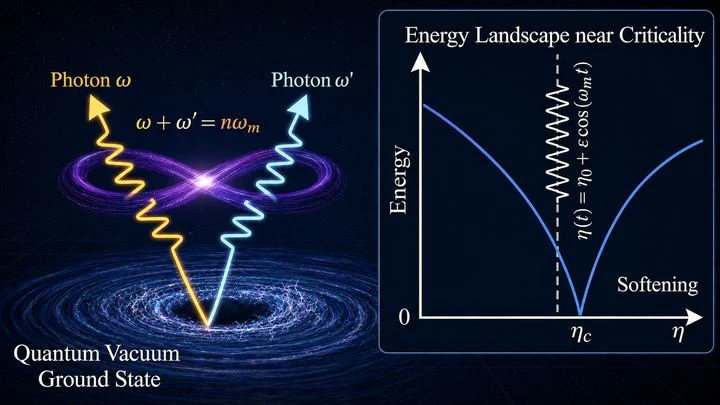
The quantum vacuum is not emptiness, but a tautly stretched string, where particles constantly appear and vanish. Abruptly changing conditions, like shifting the mirrors of a microcavity, causes the 'string' to emit real photons.
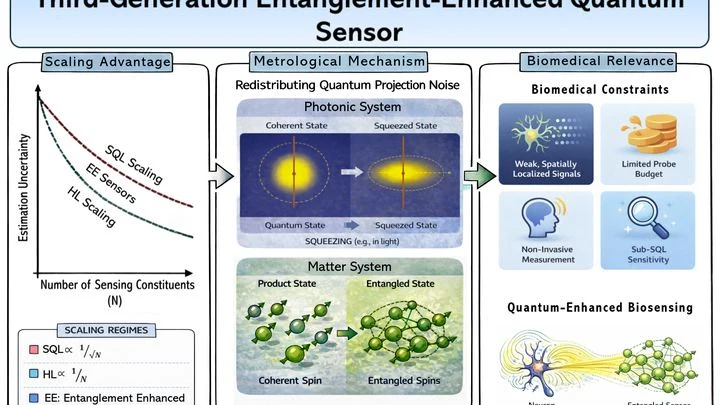
A modern hospital sensor is like a sensitive microphone in a noisy hall. It picks up a weak signal from the heart or brain, but along with it comes the hum of machines, footsteps, the breathing of neighbors. Separating the desired sound from the interference is a science in itself.
Two quantum dots are like two tiny pockets in a piece of silicon where an electron can sit, like a ball in a cup. When the pockets are far apart, each electron lives on its own, and its energy resembles the levels of a solitary atom.
A water molecule resembles a tiny dumbbell: two hydrogen atoms attach to an oxygen atom at an angle. This dumbbell doesn't stay still: it stretches, compresses, and rotates. Each such motion has its own energy, like steps on a ladder.
A quantum dot is a box so small that an electron inside cannot have just any energy, but only strictly defined values, like the steps of a staircase. Each step can accommodate several electrons, but exactly how many is the question. If a step is double, two electrons can stand on it; if single, only one.
Sunlight is a turbulent stream carrying inseparable pairs of droplets. That’s what quantum entanglement looks like: two particles are so connected that a fluctuation in one instantly resonates in the other. In the past, creating such pairs required a 'calm pool' — a perfectly tuned laser beam.
An orchestra without a conductor, where each musician hears only the hall's echo, can create a powerful melody. That's how a quantum battery works: many particles, immersed in a warm environment, don't dissipate heat but exchange it synchronously. Instead of chaos, an orderly charge emerges.
A quantum battery is not a box of electrolyte but a handful of atoms or superconducting loops, with energy stored in excited states. It can be charged in fractions of a second using collective quantum effects.