How the Nervous System Assembles Itself, Day by Day express
Assembling a nervous system is like building a city where each new house, a neuron, must connect to the road network at the right time. In the tiny worm C. elegans, this process can be seen in detail: it has only 302 neurons, and scientists have reconstructed their contacts at different developmental stages.
The authors created DevoTG, a temporal neural network that learns from two types of data. The first is the cell lineage tree: which cell came from which and when. The second is eight snapshots of the worm's brain taken with an electron microscope on different days of its life. DevoTG doesn't just see a static picture; it remembers the sequence of events, like a foreman who watches the construction from the foundation pit to the finished building.
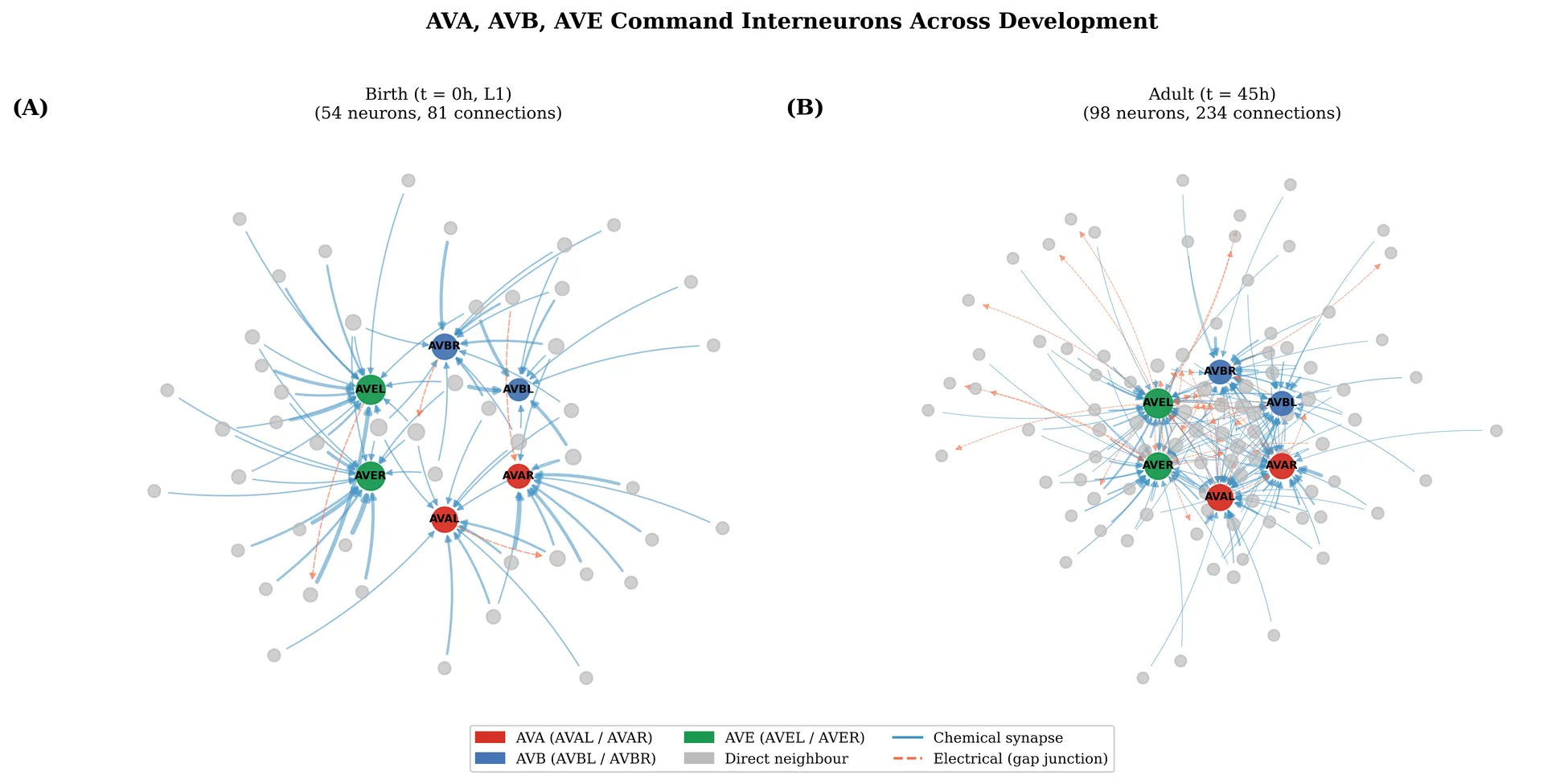
On the connection map, DevoTG identified three types of contacts. Some, stable, appear early and stay forever, like major highways. Others, temporary, are needed only during the growth phase, like scaffolding. The third type, variable, appear and disappear, like alleys that are repaved for new purposes. Especially interesting are the commander neurons AVA, AVB, and AVE: they take central positions early and only strengthen their role over time, accumulating connections.
This approach is not just an atlas but a movie about how the brain assembles itself. DevoTG's code is open, and it can be applied to other animals to reveal universal rules of neural construction.
The worm C. elegans has 302 neurons, and scientists know the complete wiring diagram of its connections: it's the only creature for which such a map has been made.