A neuron is an electrically excitable cell, the basis of the nervous system. The neuron's membrane uses ion channels to create a potential difference (resting potential around -70 mV). Upon excitation, sodium channels open, sodium ions enter, and the potential becomes positive—this is the action potential. It propagates along the axon at speeds up to 120 m/s. At synapses, the electrical signal is converted into chemical: neurotransmitters (e.g., glutamate) are released and bind to receptors of the next neuron, continuing the relay.
History
In 1873, Camillo Golgi developed a method for staining nervous tissue with silver nitrate (the Golgi stain), which made it possible to see neurons in their entirety. Santiago Ramón y Cajal, using this method in the 1880s, detailed the histology of the nervous system and formulated the neuron doctrine—the idea that the nervous system is composed of discrete cells. Their opposition to the reticular theory ended in the 20th century with the invention of the electron microscope, which confirmed the synaptic cleft. In 1952, Alan Hodgkin and Andrew Huxley created a mathematical model of the action potential in the giant squid axon, laying the foundations of computational neuroscience.
How it works
The functioning of a neuron is determined by the laws of electrochemistry. The membrane separates ions: more Na⁺ outside, more K⁺ inside. The sodium-potassium ATPase (Na⁺/K⁺ pump) actively transports 3 Na⁺ out and 2 K⁺ in, creating ion gradients. The resting potential is close to the potassium equilibrium potential, described by the Nernst equation: E_K = (RT/F) ln([K⁺]out/[K⁺]in). Upon stimulation, voltage-gated sodium channels open, Na⁺ enters, depolarizing the membrane; when the potential reaches a threshold (~-55 mV), more sodium channels open—a positive feedback loop generates the spike. Then sodium channels inactivate, potassium channels open, expelling K⁺ and returning the potential to rest. The refractory period ensures unidirectional impulse propagation. At synapses, the action potential activates calcium channels, Ca²⁺ enters, causing vesicle fusion with the membrane and release of the neurotransmitter. The neurotransmitter diffuses to receptors; excitatory neurotransmitters (glutamate) open sodium channels, inhibitory ones (GABA) open chloride or potassium channels, shifting the potential closer to the equilibrium. Synaptic plasticity (long-term potentiation) underlies memory.
In practice
Artificial neural networks, inspired by the work of neurons, recognize faces, translate texts, and drive cars. Understanding neurons has allowed treating epilepsy and Parkinson's disease through brainstimulation.
Fun fact
The conduction speed along some axons exceeds 400 km/h. And the total number of synapses in the brain is estimated at a quadrillion (10^15).
On day 5 after hatching, a fly with an overactive ERO1L gene in its neurons behaves as usual: it crawls along the wall, it does not suffocate from an excess of reactive oxygen species. But inside its nerve cells, a hidden restructuring is already underway.
Picture a long thread trapped inside a sphere with charged walls. The thread is the virus's RNA; the sphere is its protein shell. The thread tries to settle so that its charges sit as close as possible to opposite charges on the wall.
The orchestra starts playing, but each musician has their own tempo. If everyone plays at roughly the same speed, the music flows in a continuous stream. But if one group of instruments plays noticeably slower than the rest, the sound gathers into a dense clump that slowly moves forward.
Getting lost in a hall of mirrors is easy: every wall reflects another, and you feel like you've been here before. The brain gets similarly confused when surrounded by many similar places. Neurons responsible for the spatial map can fire the same signal for two different corners of a room. This is called spatial ambiguity.
Getting lost in a hall of mirrors is easy: every wall reflects another, and you feel like you've been here before. The brain gets similarly confused when surrounded by many similar places. Neurons responsible for the spatial map can fire the same signal for two different corners of a room. This is called spatial ambiguity.
A single DNA molecule, squeezed into a tiny metal slit, trembles and flickers under the laser. Its signal is not a clear string of letters but a chaotic mix of flashes and shadows. Deciphering this noise is like trying to make out a whisper in a crowded room.
The new neural network works like an attentive interpreter.
The dummy tips backward in its chair: its head hits the floor. Inside the head, in three Petri dishes, live human nerve cells. They feel the impact just as a real brain would during a fall.
The experiment is simple: the dummy was dropped from a sitting position at angles of 30, 60, and 90 degrees.
Epithelium lines our organs like tiles on a floor. At rest, cells cling to each other, and the tissue is elastic. But during embryonic development, wound healing, or tumor growth, this layer begins to flow like thick honey. What exactly triggers such softening?
A protein is like a tiny machine that switches on and off on command. The command arrives when another molecule sticks to it, like a key in a lock. The protein then changes shape and passes the signal along. But exactly how the signal travels inside the protein has long been a mystery.
If a smell seeps into a room through a slightly open door, you could stand in the middle and sniff. But the most accurate way to catch the moment the smell arrives is to stand right at the threshold. A cell behaves much the same way when it needs to measure the concentration of a substance around it.
Toss a handful of sand onto a table — the grains scatter equally in all directions. But if a magnet is hidden under the table and the sand is iron, the trajectories get trickier: an invisible structure overlays the chaos. That's roughly how molecular motion works inside a living cell.
A bell hidden in a thick box can be made to ring without opening the lid. Just send a sound wave through the walls, and the clapper will tremble. That's roughly how transcranial ultrasound works: sound passes through the skull bones and makes neurons deep in the brain 'ring'—generating electrical impulses.
In the long extensions of a neuron, the dendrites, tiny couriers are constantly bustling about. These are messenger RNA molecules carrying instructions for protein assembly. Their journey starts at the cell body and ends at synapses — contacts with other neurons.
Blood vessel cells were seeded onto a transparent film just 700 nanometers thick — a hundred times thinner than a human hair. Flat electrodes are hidden beneath the film. They send a weak alternating current and listen as the resistance changes.
A neuron transmitting a signal is like a tiny battery that quickly discharges and recharges. For nearly 70 years, it was believed that a special "potassium valve," opening with a delay, was responsible for the recharge phase. New work claims this current is a ghost.
A neuron transmitting a signal is like a tiny battery that quickly discharges and recharges. For nearly 70 years, it was believed that a special "potassium valve," opening with a delay, was responsible for the recharge phase. New work claims this current is a ghost.
A stadium packed with fans hears the announcer’s voice for the first time, and instantly the whole place erupts. The message sounds again and again. Only a handful of people in nearby rows respond. That’s roughly how neural networks behave in brain organoids — tiny lab-grown replicas of the brain.
A stadium packed with fans hears the announcer’s voice for the first time, and instantly the whole place erupts. The message sounds again and again. Only a handful of people in nearby rows respond. That’s roughly how neural networks behave in brain organoids — tiny lab-grown replicas of the brain.
The human mind is like a construction set that builds itself. New ideas don't die with their creators: they are passed on, mixed, and selected. This process is called cultural evolution: useful inventions stick, useless ones are forgotten. That's how a ratchet works — a mechanism that only turns forward.
But what exactly happens in the head when one thought displaces another?
A neuron receives thousands of signals on its branching processes — the dendrites. Some signals push the cell toward firing (excitation), others hold it back (inhibition). For a long time, it was thought that the neuron simply adds up all the 'fors' and 'againsts.' But in real dendrites, inhibition works differently: it can not subtract but divide the excitatory signal.
Every time a child with cerebral palsy is about to move their leg, a distinctive electrical blip appears in the brain — a slow voltage shift. Scientists call it a movement-related potential. A brain-computer interface (a system that reads intentions from brain signals) can pick up this blip and turn it into a command for a training device.
A city at night: lights on in some windows, dark in others. If you connect with lines the windows that light up simultaneously, you get a web of connections. Researchers studied such a web in tiny brain organoids — living clusters of nerve cells grown in the lab.
The meditating brain is an orchestra, and attention is the conductor. When you're focused on your breath, all instruments play in harmony. But suddenly, a thought-cello plays a false note: that's mind wandering. An experienced conductor doesn't panic: they instantly catch the dissonance and gently guide the orchestra back to the main melody — the breath.
After a stone is thrown, the circles on water vanish, but the liquid retains microscopic oscillations. The slightest gust, and ripples appear again. Neural networks behave similarly. When electrical signals quiet down, the memory of them remains in the contact points — synapses.
Data on gene activity usually looks like a long string of numbers, like a rainbow stripe (spectrum) with no visible connections. In the scVision model, these numbers are turned into a meaningful picture — not a list of ingredients, but a photo of a finished dish.
The modern standard approach to AI training is like a child locked in a library: he remembers millions of books but doesn't know that fire burns and falling hurts.
When biologists measure the activity of thousands of genes, they usually just see a list of coincidences, like two ingredients in a soup that often end up together. The standard method looks for such pairwise connections but doesn't show who influences whom.
A new approach, like a detector of dark matter, uncovers hidden threads of causation.
The railway overhead contact line resembles a galaxy: energy flows through it like gravity, with trains becoming planets. The more trains draw current simultaneously, the stronger the voltage fluctuations — gravitational waves ripple through the system, threatening blackouts.
A colony of cells resembles a squad blazing a trail through unknown terrain. In living tissue, this role is often played by chemotaxis — movement along a gradient of a chemical that the cells themselves secrete. Earlier models described homogeneous groups, but in reality, different cell types interact.
The classical neuron is a chamber musician, drawing only one note from each string: it takes a weighted sum of inputs, adds a bias, and passes it through a nonlinearity.
A neuron is like a complex musical instrument. To understand how it responds to a touch, you used to have to connect to each string directly — a delicate, slow procedure that only works for individual cells.
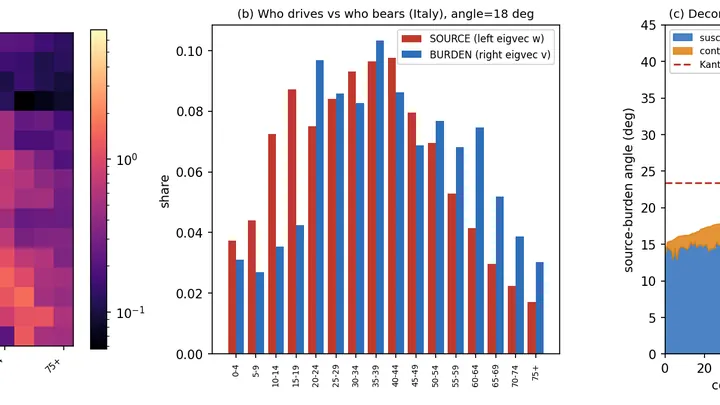
The orchestra plays without a conductor. We know the overall volume: that's the basic reproduction number R0, the spectral radius of the epidemic. But the score itself, the contact matrix between people of different ages, holds the melody: who spreads the infection and who takes the main blow.
In embryonic development, a cell resembles a musician in a vast orchestra: it must play its part, following a conductor — the gradient of signaling molecules. But the conductor is unreliable: morphogen concentrations constantly fluctuate. How then does a cellist not veer into a violin melody?
Studying distant exoplanets, scientists look for signs of life — for instance, water and carbon — and signs of technology: radio signals, megastructures. But between these clues there is a yawning gap. If intelligence hasn't created machines or they've vanished, we won't notice it.
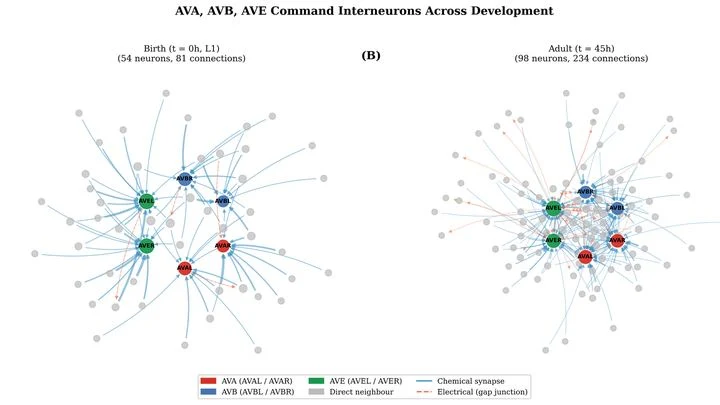
Assembling a nervous system is like building a city where each new house, a neuron, must connect to the road network at the right time. In the tiny worm C. elegans, this process can be seen in detail: it has only 302 neurons, and scientists have reconstructed their contacts at different developmental stages.
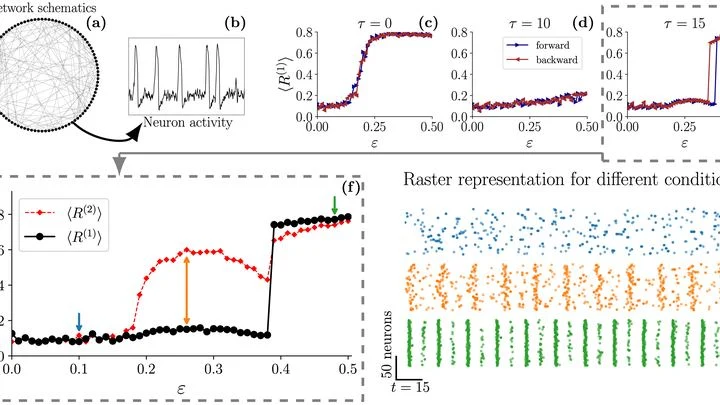
A neuron sends a signal to its neighbor. The neighbor doesn't respond immediately — the impulse travels along the process at a finite speed, like a letter delayed in transit. Usually, such a delay is considered a nuisance, but in this new work, it becomes the conductor.
When two excitable neurons are connected with a delay, a rhythm spontaneously emerges between them.
A neuron resembles an electrical circuit with batteries and variable resistors. The resistors are played by ion channels — protein pores in the membrane that open and close, letting charged particles through. Whether a nerve impulse fires depends on how fast and at what voltage these pores operate.
Inside every cell, a complex network of genes determines what it will become — a nerve cell, a muscle cell, or part of the skin. This choice often resembles flipping a toggle switch: two stable positions, and the cell decides which way to tip. But cells have a feature rarely considered in such models: they divide.
Inside every cell, construction never stops: molecules constantly cluster together and drift apart. Sometimes they form dense droplets, like oil in water, but without a membrane. These droplets act as temporary storage: they hold proteins, gene copies, or DNA repair tools.