instrument

cellular neural interface

Technologies interfacing with neurons or cells using light, electricity, or genetic delivery.
48 related articles

Description

Cellular neural interfaces are technologies that establish a communication link between electronic devices and biological cells, particularly neurons. These interfaces can be used to both record cellular activity and stimulate cells, enabling bidirectional communication. They are foundational to neuroprosthetics, optogenetics, and advanced biological research.

History

The concept of interfacing electronics with cells dates back to Luigi Galvani's experiments in the 18th century, but modern cellular interfaces emerged with the development of microelectrode arrays in the 1970s. Optogenetics was pioneered in the early 2000s with the discovery of light-sensitive ion channels.

How it works

These interfaces work by converting between electrical signals in electronic circuits and biological signals in cells. Electrical stimulation uses electrodes to deliver charge that can trigger or modulate neuronal firing. Optogenetic approaches use light-sensitive proteins introduced into cells via genetic delivery; shining light on these cells activates or inhibits them. Conversely, cellular activity can be recorded by detecting the electrical or optical changes that accompany firing.

In practice

Cellular neural interfaces are used in cochlear implants to restore hearing, in deep brain stimulation for Parkinson's disease, and in research to map neural circuits. They are also being developed for advanced prosthetics that can be controlled directly by the nervous system.

Fun fact

Optogenetics allows researchers to control individual neurons with millisecond precision using light, a technique that has been used to implant false memories in mice.

Concept graph →

Related articles · 48

Scales for Thoughts: How to Measure Whether a Neural Interface Really Speaks
In the 1980s, the DARPA speech recognition challenge settled the debate between statistical methods and hand-written rules, setting a common standard for the entire field.
Two Pendulums Behind Glass: How Fish Schools Synchronize at a Distance
In an aquarium the size of a dining table, two schools of black neon tetras swim in adjacent compartments separated by a transparent wall. They cannot touch each other, but they see every movement. And here's the surprising part: when one school decides to turn left, the other does the same a moment later. It's like two pendulums hanging behind glass, starting to swing in rhythm.
A Color Map of Wood: How Polarized Light Reads the 3D Architecture of Cell Walls
A thin section of eucalyptus lies under the microscope objective, and white light, passing through two polarizing filters, turns the wood into a mosaic of purple, yellow, and blue patches. These colors are not random: like letters on a map, they show the direction of the invisible cellulose threads inside the cell walls.
q-bio.GN2026-08-252 minarXiv:2608.90007
Chromatin's Aging Clock: How Brain Cells Keep Track of Time
Picture an old house where every room ages in its own way: in one, the wallpaper has faded; in another, the floorboards creak; and in a third, everything looks brand new. The brain ages much the same way: different cell types accumulate changes at different rates, and until recently we had no tool to peer into each "room" and measure its age separately.
Mesoscale2026-08-201 minarXiv:2608.20245express
Platinum Dots Bring Transistor Memory to Life
A plastic film as thin as a hair, and inside it — platinum dots smaller than a millionth of a millimeter. These dots sit at the boundary between two transistor layers and catch electric charge like a sponge catches water. As charge accumulates, the transistor changes its resistance, and remembers that state.
Neural Computing2026-08-191 minarXiv:2608.18569express
Brain vs. the Mirror Maze
Getting lost in a hall of mirrors is easy: every wall reflects another, and you feel like you've been here before. The brain gets similarly confused when surrounded by many similar places. Neurons responsible for the spatial map can fire the same signal for two different corners of a room. This is called spatial ambiguity.
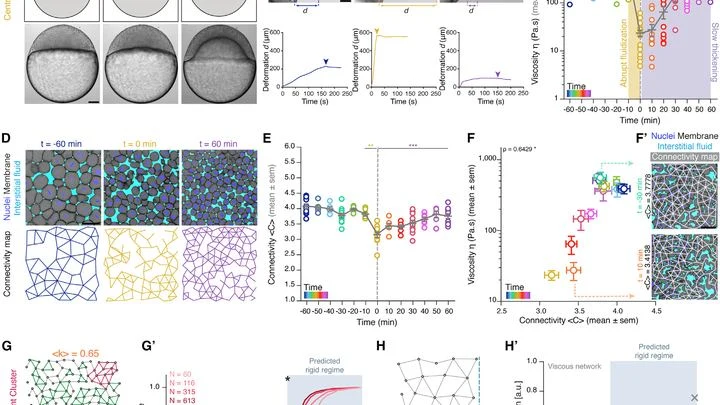
Four Conductors of the Cellular Orchestra: How Epithelium Chooses Its Path to Fluidity
Epithelium lines our organs like tiles on a floor. At rest, cells cling to each other, and the tissue is elastic. But during embryonic development, wound healing, or tumor growth, this layer begins to flow like thick honey. What exactly triggers such softening?
Medical Physics2026-08-062 minarXiv:2608.06321express
Sound Controls Neurons: A Digital Twin of the Brain
A bell hidden in a thick box can be made to ring without opening the lid. Just send a sound wave through the walls, and the clapper will tremble. That's roughly how transcranial ultrasound works: sound passes through the skull bones and makes neurons deep in the brain 'ring'—generating electrical impulses.
Colloids Learn to Breathe
A drop of water on glass trembles and shimmers: it seems to have a life of its own. Similar behavior can now be observed in the world of colloids: tiny particles suspended in a liquid. Researchers simulated particles that emit chemical signals. These signals, like scents in the air, spread around and cause neighbors to either draw closer or move apart.
Chemical Physics2026-08-032 minarXiv:2608.02865express
Weak Molecular Bonds Step Out of the Shadows
Inside every cell, things are constantly meeting and parting. Some pairs hold tight, like Velcro, while others barely touch, like pollen on the wind. These fleeting touches, where the binding strength is comparable to a grain of salt dissolving in a glass of water, govern many of the cell's signals and decisions.
Signal Processing2026-08-021 minarXiv:2608.01239express
A Chip That Listens to Cells Building a Barrier
Blood vessel cells were seeded onto a transparent film just 700 nanometers thick — a hundred times thinner than a human hair. Flat electrodes are hidden beneath the film. They send a weak alternating current and listen as the resistance changes.
q-bio.QM2026-07-182 minarXiv:2607.19417express
A Brain Cap That Skips the Long Setup
Every time a child with cerebral palsy is about to move their leg, a distinctive electrical blip appears in the brain — a slow voltage shift. Scientists call it a movement-related potential. A brain-computer interface (a system that reads intentions from brain signals) can pick up this blip and turn it into a command for a training device.
cs.ET2026-07-151 minarXiv:2607.13644express
q-bio.GN2026-07-151 minarXiv:2607.13994express
Invisible Connections in the Gene Network
When biologists measure the activity of thousands of genes, they usually just see a list of coincidences, like two ingredients in a soup that often end up together. The standard method looks for such pairwise connections but doesn't show who influences whom. A new approach, like a detector of dark matter, uncovers hidden threads of causation.
q-bio.QM2026-07-151 minarXiv:2607.14163express
Genes as a Dish: A Fresh Look at Cells
Data on gene activity usually looks like a long string of numbers, like a rainbow stripe (spectrum) with no visible connections. In the scVision model, these numbers are turned into a meaningful picture — not a list of ingredients, but a photo of a finished dish.
Signal Processing2026-07-141 minarXiv:2607.12518express
Cellular Echoes: How Your Phone Navigates Without GPS
A city signal bounces between walls like a ball, and your phone catches dozens of its 'reflections'—echoes. Each microsecond of delay adds 300 meters to the path. The signal's speed is constant, like that of light (speed of light).
OPhELIA: How an Entropy-Inspired Algorithm Speeds Up Neural Network Mapping
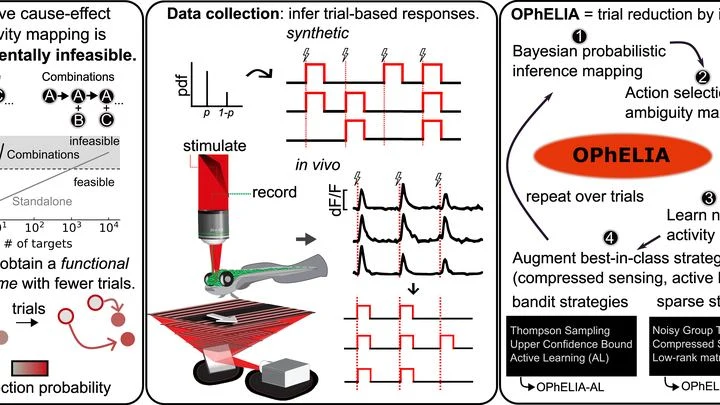
To understand how the brain works, you need a detailed map of neuron connections — the so-called connectome. The traditional approach is like trying to figure out a huge garden irrigation system by opening each tap one by one and watching where the water flows.
Neurons Reveal Their Secrets in Minutes, Not Hours
A neuron is like a complex musical instrument. To understand how it responds to a touch, you used to have to connect to each string directly — a delicate, slow procedure that only works for individual cells.
q-bio.MN2026-07-033 minarXiv:2607.03545
The Cellular Orchestra: How Genes Learn to Play in Tune with Chaos
In embryonic development, a cell resembles a musician in a vast orchestra: it must play its part, following a conductor — the gradient of signaling molecules. But the conductor is unreliable: morphogen concentrations constantly fluctuate. How then does a cellist not veer into a violin melody?
Popular Physics2026-06-261 minarXiv:2606.28437express
Traces of Mind: What We Miss in the Search for Aliens
Studying distant exoplanets, scientists look for signs of life — for instance, water and carbon — and signs of technology: radio signals, megastructures. But between these clues there is a yawning gap. If intelligence hasn't created machines or they've vanished, we won't notice it.
Machine Learning2026-06-202 minarXiv:2606.21940express
How the Nervous System Assembles Itself, Day by Day
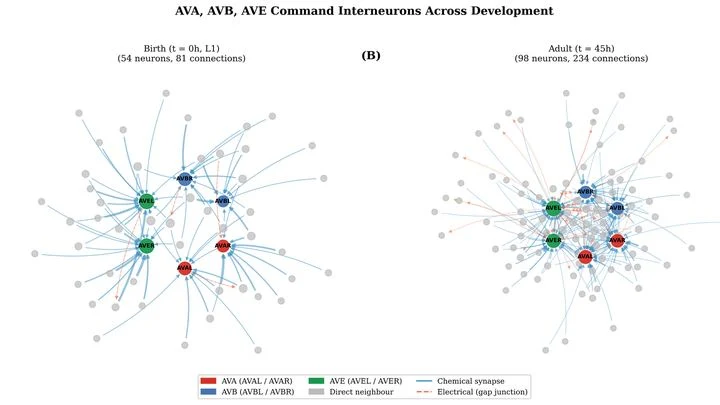
Assembling a nervous system is like building a city where each new house, a neuron, must connect to the road network at the right time. In the tiny worm C. elegans, this process can be seen in detail: it has only 302 neurons, and scientists have reconstructed their contacts at different developmental stages.
Neural Network Embedded in a Neuron Model
A neuron resembles an electrical circuit with batteries and variable resistors. The resistors are played by ion channels — protein pores in the membrane that open and close, letting charged particles through. Whether a nerve impulse fires depends on how fast and at what voltage these pores operate.
q-bio.TO2026-05-012 minarXiv:2605.01083express
How a Cell Transplant Can Set the Heart's Pace
After a heart attack, the dead section of heart muscle can be replaced with living cells grown from stem cells. But a common problem arises: the fresh transplant starts acting as its own pacemaker, and the heart falls out of its proper rhythm. Doctors see the arrhythmia on an ECG, but what exactly happens at the junction between 'self' and 'foreign' remains hidden.
Biological Physics2026-04-271 minarXiv:2604.23945express
Okra Gel Teaches Electrodes to Listen to the Brain Without Scarring
When a hair-thin electrode is implanted into the brain, the body treats it like a splinter. A scar of glial cells grows around it — a dense insulating sheath that muffles the signal like a wet rag dampens a guitar string. The electrode stops hearing neurons.
q-bio.OT2026-04-261 minarXiv:2604.23773express
Microbial network rewires when the host falls ill
The microbial community in the gut is like an orchestra: what matters is not only the musicians but how they play together. When disease strikes, it's not just the lineup of microbes that changes: their interconnections shift too. Researchers built interaction networks of microbial genes in healthy and sick individuals.
Optics2026-04-041 minarXiv:2604.03830express
Liquid Crystals Teach Light to Change the Rules
An ordinary lens always refracts light the same way. Its properties are frozen in glass forever. But now there's a surface that changes the game on the fly. Scientists made an ultrathin film with resonant elements and infused it with liquid crystals — the same stuff used in phone screens.
Materials2026-04-031 minarXiv:2604.03441express
Magnons and Excitons Open the Path to Quantum Communication
Quantum computers and sensors operate at microwave frequencies, but transmitting their signals over long distances is conveniently done via optical fibers, which use light.
q-bio.BM2026-03-241 minarXiv:2603.23775express
Diagnostics in the Palm of Your Hand: Electricity Instead of Optics
In a hospital, blood from a finger prick usually goes to the lab, and the result comes back the next day. The new method promises to cut that wait to a few minutes. Instead of catching light reflected off a sample, it reads the electrical voltage that arises at the boundary between two media, like the faint tingle you feel when you touch a battery with wet fingers.
How droplets inside cells shape membranes
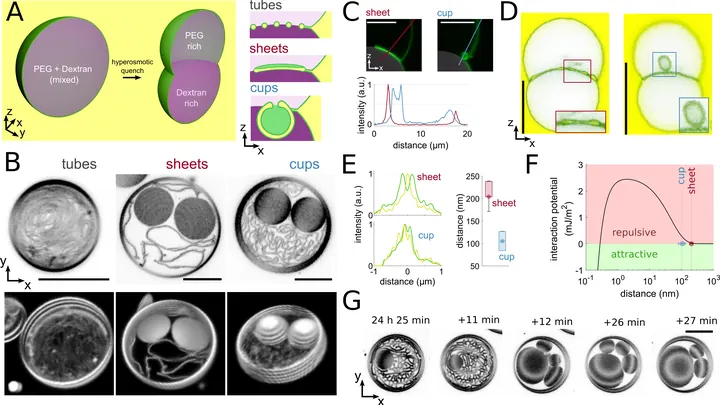
Inside a living cell, droplets float that don't mix with the surrounding fluid, like oil in water. These droplets aren't just passive clumps; they actively press on membranes and make them bend. Scientists observed this process in living plant cells, reproduced it in a test tube, and simulated it on a computer.
Applied Physics2026-03-072 minarXiv:2603.07243express
How Touch Sparks Electricity
When two different materials are pressed together and then pulled apart, a spark jumps between them. Anyone who has pulled off a wool sweater in the dark or gotten a shock from a doorknob knows the feeling. For a long time, it was thought that charges simply hop from one surface to another due to differences in material properties.
Optics2026-03-021 minarXiv:2603.02446express
Seeing the Invisible: A Clear View of Transparent Cells
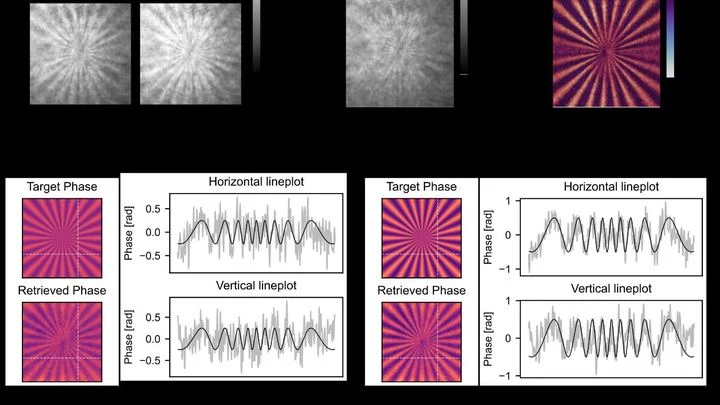
A glass marble in a glass of water is nearly invisible, but if you look through it at a checkered tablecloth, the lines behind it appear distorted. Transparent cells behave the same way: light passes through them but is slightly slowed and changes direction.
Optics2026-02-281 minarXiv:2603.00562express
Light in a Crystal Twists Itself
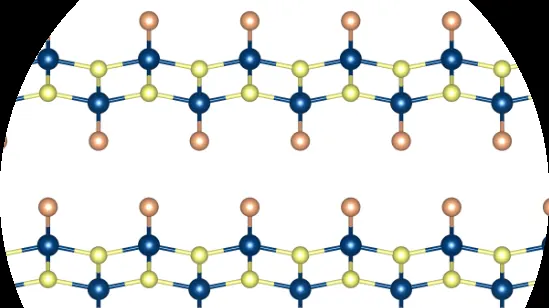
Light passing through a thin crystal can change color and the direction of its oscillations. In a molybdenum disulfide flake just hundreds of atoms thick, an infrared beam turns green, and its polarization, the way the light wave oscillates, obeys the crystal's geometry.
q-bio.CB2026-02-281 minarXiv:2603.00834express
How Skin Cells Close a Wound: A Dance of Division and Movement
When you cut your finger, skin cells start working in concert: some divide, others crawl toward the wound, and still others pause. But exactly how a cell decides what to do next depends on its internal "schedule"—the cell cycle.
Optics2026-02-261 minarXiv:2602.23246express
Layered crystal boosts light sevenfold
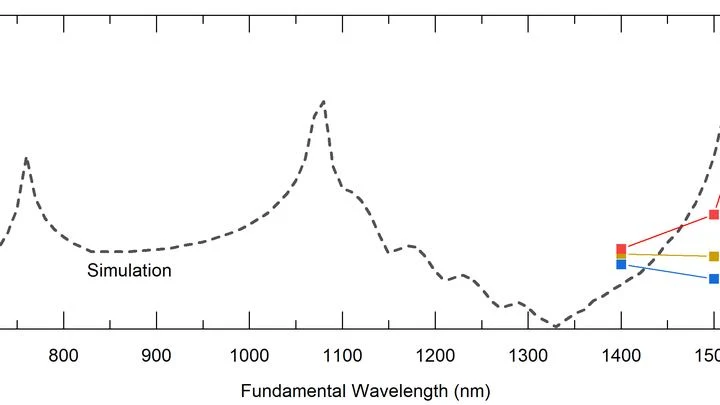
An ordinary piece of semiconductor weakly changes the color of light passing through it. For decades, physicists worked around this limitation by placing the crystal in clever surroundings, but the material itself remained the same. Now researchers have assembled a "sandwich" of alternating thin layers of gallium arsenide and aluminum gallium arsenide.
Machine Learning2026-02-211 minarXiv:2602.18769express
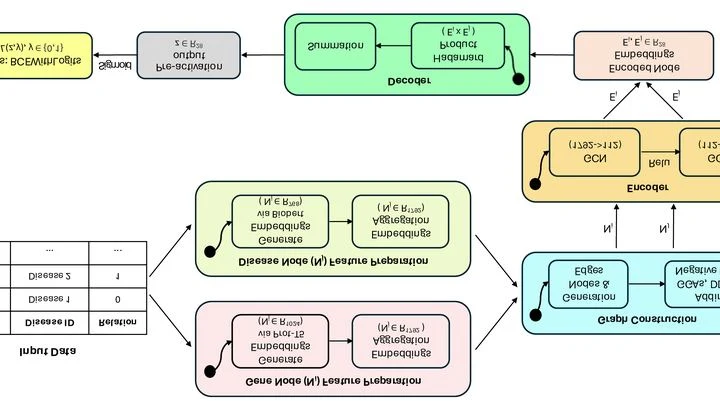
Mapping Disease: How to Link Genes and Ailments
Inside every cell, work is constantly underway: proteins communicate, genes turn on and off, and glitches in this system lead to disease. To find the culprit behind an ailment, scientists used to manually comb through research papers and databases, like a detective interviewing witnesses one by one. But there are so many connections that no one can handle it alone.
q-bio.GN2026-02-192 minarXiv:2602.17532express
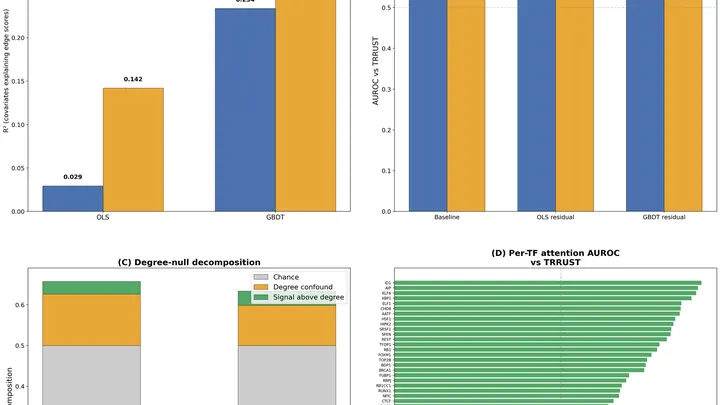
What Smart Cells Aren't Saying: Attention Without Payoff
Inside a cell, work is in full swing: thousands of genes switch on and off like lights on a huge display. Neural networks trained to read this display have learned to guess what will happen if you 'turn off' one gene or add a drug. But how exactly they do it is a mystery.
Optics2026-02-161 minarXiv:2602.14459express
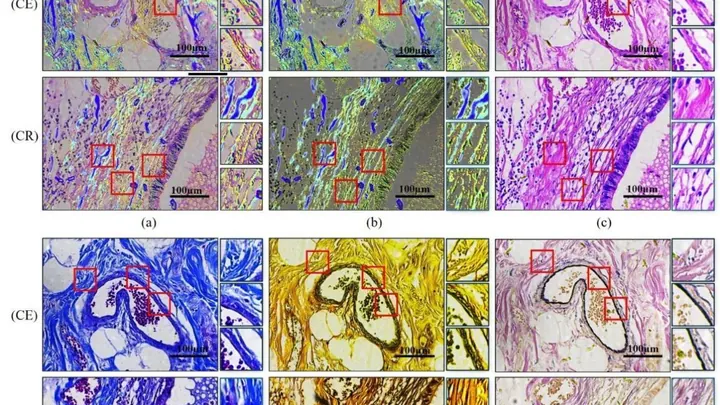
How Light Reveals the Fibers of Tissue
Inside our bodies, between cells, there is a support network — the extracellular matrix. It's like scaffolding made of proteins and carbohydrates that holds cells in place. When the fibers in this network change, it can be a sign of disease — for example, cancer or fibrosis. Usually, to see these fibers, tissue is cut into thin slices and stained with special dyes.
Mesoscale2026-02-141 minarXiv:2602.13827express
How to Cool Hot Chips
Electronics get hot. The more powerful the processor, the more heat you need to get rid of, or it will fail. One bottleneck is the boundary between two materials: heat hits it like a seam between tiles and slows down.
q-bio.TO2026-02-101 minarXiv:2602.09867express
Velcro Cells Build the Body
As an embryo grows, its cells don't just divide: they constantly touch their neighbors, like people in a crowded bus. The strength of these contacts determines where a cell moves and what shape the tissue takes. Scientists studied how cell 'stickiness' changes during the earliest stages of development.
Optics2026-01-301 minarXiv:2602.00363express
Glowing Heart Cells
A heart cell in a Petri dish contracts, and at that moment, an electrical wave sweeps across its surface. Previously, to catch that wave, you had to poke the cell with an ultra-fine electrode needle. Now, you just look at it under a microscope. The method is called electrochromic recording.