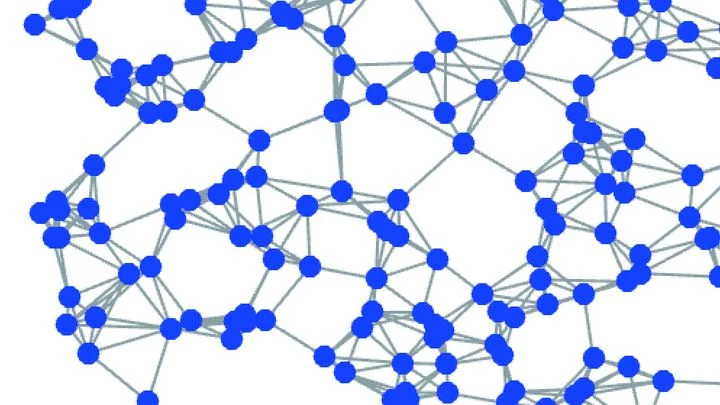
A phylogenetic network is a model of evolutionary relationships that, in addition to branching (speciation), accounts for reticulation events: horizontal gene transfer, hybridization, recombination. Unlike a phylogenetic tree, the network contains nodes with multiple parent ancestors, making it more suitable for describing the evolution of prokaryotes, viruses, and some plants.
History
The concept of phylogenetic networks arose in response to discrepancies between gene trees and species trees. In the 1980s, Walter Fitch realized the need to account for horizontal transfer, and in the 1990s, with the development of sequencing methods and computer power, the first algorithms for network construction appeared (e.g., the split decomposition algorithm of Bandelt and Dress, 1992). Pioneers of computational phylogenetics included David Swofford, Joseph Felsenstein, and later David Bryant, Daniel Huson, and others who developed modern methods.
How it works
Construction of a phylogenetic network begins with the choice of an evolutionarymodel and data (usually DNA sequences). Algorithms estimate distances or likelihoods and search for a topology that minimizes the number of reticulations or maximizes likelihood. Networks can be explicit — where reticulation nodes denote specific transfer events — or implicit, showing alternative evolutionary scenarios as intertwined structures (e.g., split networks). Validation and network selection are often performed using information criteria (AIC, BIC) and bootstrap.
In practice
Phylogenetic networks help track the spread of viruses (e.g., COVID-19) and identify hybrid plant species for breeding.
Fun fact
Up to 10% of the human genome may be of viral origin, and networkmodels help trace these unusual genetic connections.
Four old maps were lying in different desk drawers. Each one marked genes linked to cellular aging, but the maps did not match: different names, different scales, different legends. A scientist hunting for a gene to test had to cross-check them by hand, at the risk of missing an important mark.
SenSASP stitched those maps into one.
Dutch family archives hold marriage records going back to 1600. From these records, like entries in an old ledger, you can extract two columns: how many children a person had and how many years they lived. Evolutionary biologists have been arguing for half a century over whether these columns are connected.
Picture a wind map over a mountain range. The wind mostly blows downhill, following elevation changes. But if you look closely, in some valleys the air swirls into little eddies that keep the wind from simply flowing down. That is exactly what the mutation field in human DNA looks like.
A forest ages in different ways. In one spot the trees thin out gradually, as if they have grown tired of growing, while in another they cling stubbornly to life, spending their strength repairing damaged branches. The aging of the brain's cortex looks much the same when you view it through the lens of thousands of MRI scans.
In March 2020, France emptied out: people stopped going to work, school, and cafés, and the streets filled with silence. Epidemiologists stared at the graphs and understood that the virus was not spreading on its own, but through handshakes, conversations, and metro rides. But how could they predict how many contacts a person would keep if the government announced new restrictions?
A slice of eucalyptus a tenth of a millimeter thick is placed under a polarized light microscope, and the wood suddenly blooms: blue, yellow, and pink bands twist into spirals, forming rings and swirls. This is not paint but the play of light: the cellulose fibers that make up cell walls transmit light differently depending on their orientation.
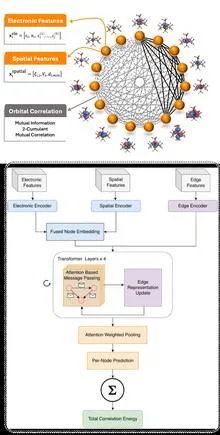
A cartographer who draws not mountains and rivers but invisible bonds between electrons: that's one way to describe the new neural network. Instead of atomic coordinates, it takes molecular orbitals and draws a graph where nodes are orbitals and edges are measures of their quantum entanglement.
A river drawn on a map is always a single line. But stand on the bank, and you will see that within the channel there are faster currents, eddies, and branches that merge and split. The cosmic web is like that river, but made of dark matter, and until recently astronomers drew it as a single line.
A river drawn on a map is always a single line. But stand on the bank, and you will see that within the channel there are faster currents, eddies, and branches that merge and split. The cosmic web is like that river, but made of dark matter, and until recently astronomers drew it as a single line.
On a crowded train, some passengers ride in silence while others push toward the exit, shoving their neighbors aside. In every person's blood, mutant cells appear with age, and their fate is much the same: most changes are neutral, like passengers who are simply along for the ride, but some give a cell an edge, and it starts dividing faster than the rest.
At the end of every chromosome sits a cap made of repeating DNA letters: the telomere. For a long time it was measured as an average length across all chromosomes, as if judging a library by the average thickness of its books. But in humans, three ends, 17p, 20q, and 12p, are consistently shorter than the rest, and they are the ones more often linked to genome damage.
Two daughter cells receiving equal shares from the mother: that's the familiar picture of division. But what if one gets almost everything and the other just crumbs? Stochastic modeling shows that sometimes unequal division is more advantageous.
Each cell stores a protective reserve that helps it weather hardships. During division, this reserve is distributed between daughters.
As you slowly turn the tuning knob of an old radio, the sound doesn't fade in gradually from the static: it bursts forth in a sudden jump, the moment the antenna hits resonance with the wave. Genes in a living cell behave much the same way.
A mail carrier delivers letters along one-way streets. As long as he only drives forward, the route is simple and predictable. But if U-turns are suddenly allowed, he'll start doubling back, crossing his own tracks, and the delivery pattern gets tangled. That's roughly how an infection behaves when people can get sick more than once.
A protein chain folds into a working tool in a fraction of a second, and almost never makes a mistake. For a long time, it was thought that evolution specifically polishes amino acid sequences so that a protein not only works but also easily finds its unique shape. New work turns this idea on its head.
A huge orchestra without a conductor. Each musician is a gene, and the melody is the cell's complex work. Previously, looking at a tissue photo, a computer tried to guess each instrument's part individually. It didn't know that violins usually play with violas, and trumpets with trombones. The program just output a list of notes, without sensing the harmony.
A web where lions eat zebras and hyenas finish the leftovers is not just a list of dinners. It's a survival map for an entire region. When the climate shifts, animals move, and the map tears. To understand where it will tear and where it will hold, you need to find its unchanging 'skeleton'—the connections that repeat across different places.
A bacterial biofilm is like a city made of slime. The houses are the microbes themselves. The streets and bridges are long polymer molecules that bacteria secrete outside. This whole construction is not static: the bridges are constantly breaking and re-forming.
The authors built a "toy" computer model of such a city.
Two ropes glued along their length naturally twist into a double helix. That's how DNA works — except the glue is hydrogen bonds between bases, and the stiffness comes from the chains themselves.
A sunbeam hits a leaf, and inside, a relay race begins. Energy hops from one molecule to the next until it reaches its goal. In photosystem II (a protein complex that kicks off photosynthesis), the runners are pigment molecules: chlorophylls and pheophytins.
A city at night: lights on in some windows, dark in others. If you connect with lines the windows that light up simultaneously, you get a web of connections. Researchers studied such a web in tiny brain organoids — living clusters of nerve cells grown in the lab.
Imagine a cookbook that gets rewritten from generation to generation. One day, the borscht recipe receives a secret ingredient from a pastry chef, and from that moment, the taste remembers not only ancestors but also a neighbor. In the Standard Model of evolution, genes behave the same way.
An ordinary road map with traffic is a heap of numbers. Sending them all as is takes too long. But you can reduce the volume without losing the gist. Researchers found a clever solution: first redraw the map so that streets become points, and intersections become bridges between these points.
When biologists measure the activity of thousands of genes, they usually just see a list of coincidences, like two ingredients in a soup that often end up together. The standard method looks for such pairwise connections but doesn't show who influences whom.
A new approach, like a detector of dark matter, uncovers hidden threads of causation.
Data on gene activity usually looks like a long string of numbers, like a rainbow stripe (spectrum) with no visible connections. In the scVision model, these numbers are turned into a meaningful picture — not a list of ingredients, but a photo of a finished dish.
In the web of life, predators and prey exchange carbon and water, and each act of eating slightly increases the universe's disorder. But the intrusion of disease turns this system into a giant seesaw. When a mid-level predator gets sick, its hunting abilities decline, and it becomes easy prey.
Evolution resembles not just a tree with diverging branches, but a woven tapestry. Threads of ancestry cross when species exchange genes — for example, bacteria pass drug resistance to each other, and plants crossbreed to produce hybrids.
The power grid is a galaxy, where massive generators, like stars, set the rhythm with their synchronous rotation. With the advent of green energy, "planets" appear — power converters. Some obediently circle in their orbits, while others try to become centers of attraction.
Every tumor writes its own cosmology. Its cells are galaxies, and mutations are stellar flares marking the branches of a genealogical tree. The key to its history is the rhythm of accumulating genetic typos.
A family tree becomes a tangle if you account for adopted children and remarriages. Evolution often resembles such a tangle: although the Standard Model, the traditional view of divergent evolution where species branch like a tree, paints a neat tree of species, in reality genes travel not only by inheritance but also directly between unrelated organisms — a process…
A desert where every step reshapes the terrain. Dunes settle, new slopes emerge, and the next step is dictated by what you've just trampled. That's roughly how "sandscapes" work — a mathematical model inspired by living systems.
A colony of cells resembles a squad blazing a trail through unknown terrain. In living tissue, this role is often played by chemotaxis — movement along a gradient of a chemical that the cells themselves secrete. Earlier models described homogeneous groups, but in reality, different cell types interact.
Molecules float in a pot of broth. Some copy themselves, others help their neighbors, and still others just get in the way. This isn't soup: it's a model of early life: a replicator system. Usually, we assume the rules of the game are fixed once and for all: whoever reproduces fastest wins. But the authors of this study proposed something different — the rules can change too, just very slowly.
DNA methylation consists of tiny chemical marks on our genes. Over the years, they change on a fairly strict schedule. Standard epigenetic clocks look at these marks and output a single number: biological age. But a number can't tell you how the pattern of marks rearranged day by day, year by year. The authors of this work decided to turn a static photograph into a continuous film.
In quantum physics, there are theories where everything follows clear proportions, like a musical rhythm that always returns to the beginning of the bar. But there are also 'irrational' theories where the rhythm breaks and predicting the next beat is nearly impossible. One such theory is the compactified boson: a particle lives on a circle, and its behavior depends on the radius of that circle.
The frost pattern on a windowpane doesn't spread uniformly: it sprouts branches, captures new areas, sometimes sealing off voids. This growth is not a smooth expansion but a series of leaps. This image resonates surprisingly with a mathematical model devised by Charles Loewner a century ago.
Why do some systems, from gene networks to air travel, preserve imprints of the past longer than others? For a long time, network science blamed topology: the number of connections, modularity, spectrum. But two networks with the same skeleton can remember and forget in completely different ways.
A person reaches out to a stranger across town. That stranger will never return the favor: they'll never meet. So why help? Biologists call this indirect reciprocity: kindness comes back not from the person you helped, but from someone else, down the line.
In a new study, two variants of this idea were pitted against each other.
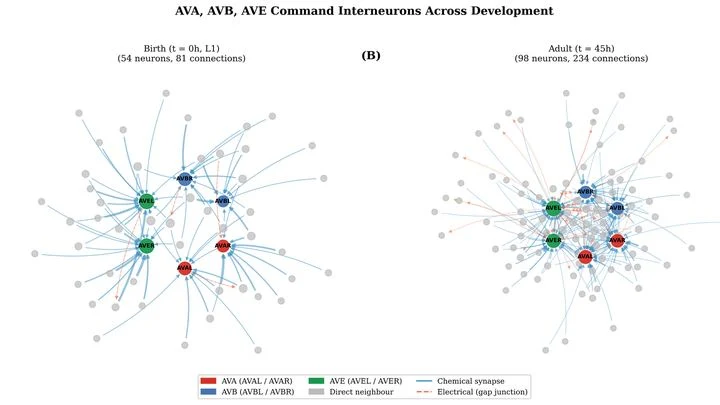
Assembling a nervous system is like building a city where each new house, a neuron, must connect to the road network at the right time. In the tiny worm C. elegans, this process can be seen in detail: it has only 302 neurons, and scientists have reconstructed their contacts at different developmental stages.
The immune system is like a tireless editor, revising antibody drafts to make them stickier to viruses and bacteria. This process is called antibody maturation: random typos (mutations) arise in the genes, and natural selection keeps those that improve target capture.