Gravitational Lens Catches Light of First Stars at z≈10 ✦
Original: "A Strongly Lensed Ultra-faint Arc at $$z \approx 10$$ with an F200W excess in Abell S1063"
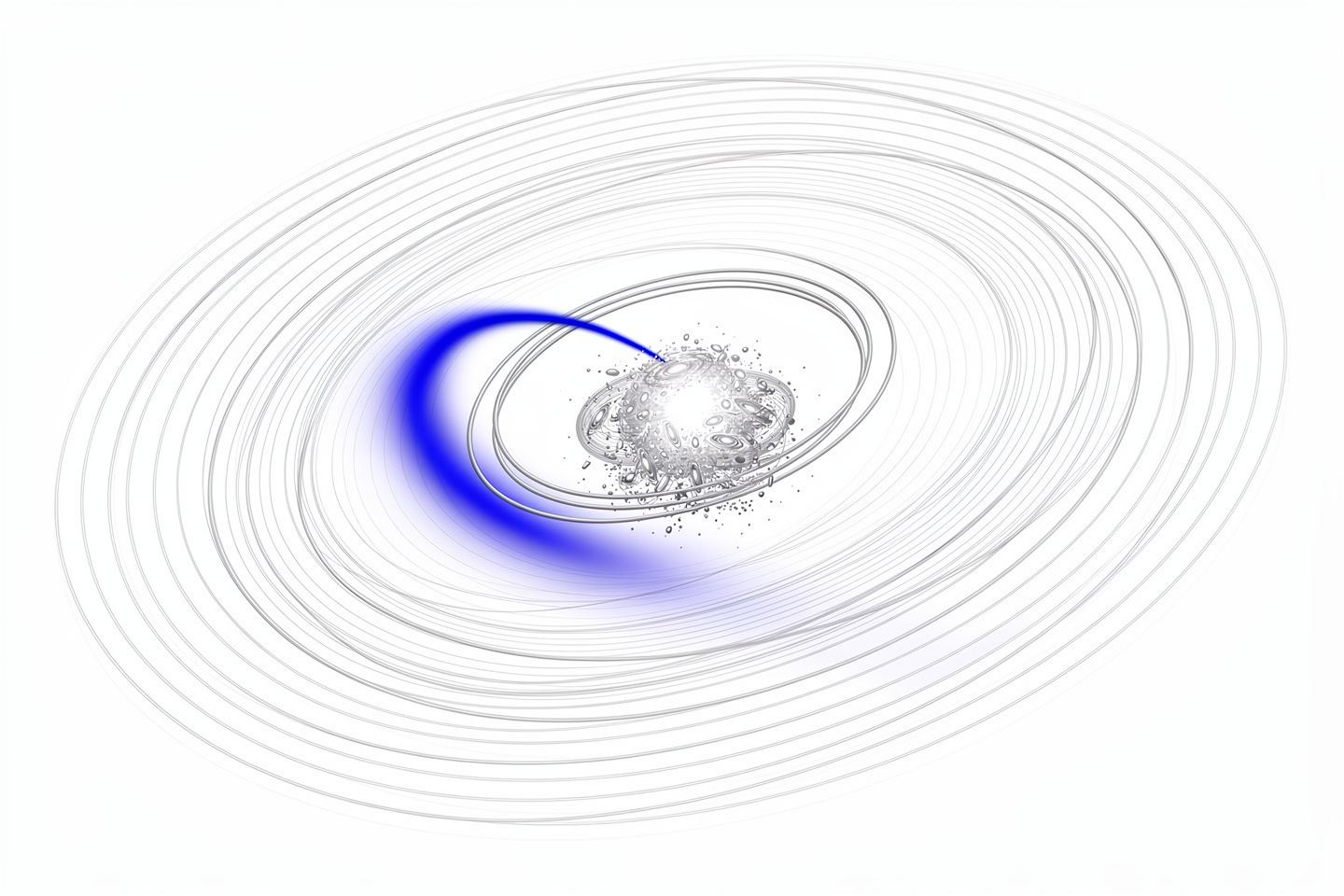
Astronomers have found a strongly lensed ultra-faint galaxy at redshift about 10, which could be home to Population III stars or be an extreme emission-line galaxy.
Links in the knowledge graph 1
A gravitational lens is not just a distortion but a time machine. Light from a galaxy at z≈10 has traveled 13 billion years to us, but without the Abell S1063 cluster we wouldn't see it. This faint arc might be the light of the first stars, made only of hydrogen and helium. If the Webb telescope confirms this, we'll for the first time see how the Universe lit up.
🎯 The Abell S1063 cluster acts not only as a lens but also as a time machine: photons grazing it are delayed in their journey by tens of thousands of years compared to a direct beam, so we see an even more ancient picture.
v = H_0 d
The recession velocity of a galaxy is proportional to its distance, reflecting the expansion of the Universe.
f_\lambda \propto \lambda^{\beta}
Flux per unit wavelength follows a power law with exponent β. The more negative β, the bluer the object and the fewer heavy elements it contains.
Scientists
Alan GuthAndrei LindeGeorges LemaîtreJames PeeblesAdam RiessBrian Schmidtgravitational lensing
galaxy
galaxy cluster
redshift
JWST
photometry
spectroscopy
star formation
metallicity
nucleosynthesis
big bangLaws
Friedmann equationsHubble's lawDoppler effectgravitational lensingmass–energy equivalenceEinstein field equations