We have retold 6 papers by this author. 1 of them with a full read. most often about: supernova, Reionization, supernova remnant. 30 co-authors across our retellings.
A massive galaxy cluster acts as a giant lens. Its gravity warps the fabric of space, and the light of distant objects, bending around this curvature, is amplified and split into multiple images.
Thanks to gravitational lens — an effect predicted by Fritz Zwicky, where a galaxy cluster acts like a magnifying glass — the James Webb Space Telescope spotted two red dots in a galaxy 800 million years after the Big Bang.
Light from a distant galaxy travels toward us for billions of years, but along the way it can run into a massive galaxy cluster. Its gravity acts like curved glass: it bends the path of rays, so instead of one image, we see several — sometimes arcs, sometimes points.
The James Webb Space Telescope peered into the galaxy cluster AS1063 and spotted tens of thousands of globular clusters — dense stellar "knots" scattered throughout the cluster. Their positions matched the map of invisible mass, which is constructed from the bending of light from distant galaxies.
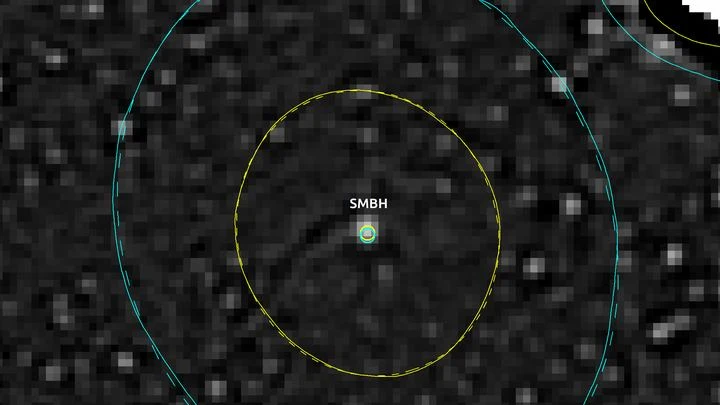
Astronomers used the infrared telescope and the old Hubble to discover a gaping void in the center of a galaxy in the Abell 402 cluster, as if an invisible tugboat had pulled billions of stars out of there. The missing mass equals two billion suns: it's not a cloud but a real lack of stars.
The giant galaxy cluster Abell S1063, lying 4 billion light-years away, works not just as a lens but as a gravitational well of time. Its mass bends space so sharply that photons from an era when the Universe was just 500 million years old slide along curved paths, like rays in slow motion, and converge on us magnified forty-three times.