Lensed Arc at z≈10: A New Window to the Era of the First Stars ✛ ✦
Context
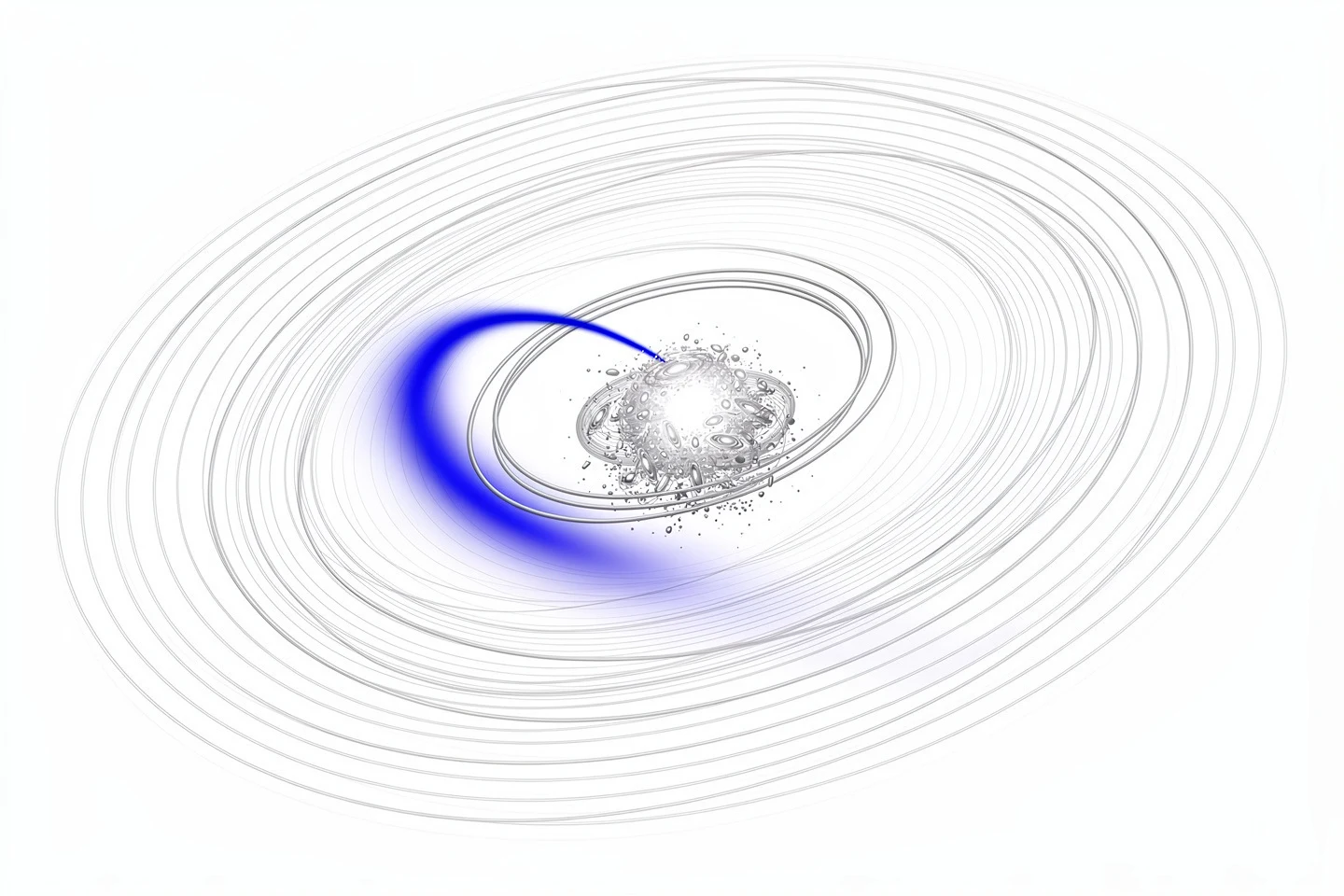
The era of cosmic dawn, a few hundred million years after the Big Bang (the birth of the universe), saw the appearance of the first galaxies. These objects ionized intergalactic hydrogen, ending the dark ages. Yet detecting such faint systems at high redshifts (a measure of distance) remains a daunting challenge: their light is too dim for direct observation. Here, gravitational lensing comes to the rescue—an effect predicted by Albert Einstein and developed by Fritz Zwicky. According to gravitational lensing, massive objects like galaxy clusters bend and magnify light from distant sources, offering a peek into an otherwise unreachable epoch.
Methods
The key instrument was the James Webb Space Telescope (JWST) with its NIRCam camera, which performed deep photometry (brightness measurement in different filters) of the Abell S1063 cluster in 11 bands from 0.9 to 4.8 µm. To separate the arc's light from a bright foreground galaxy, scientists used a special algorithm to subtract a model of isophotes (lines of equal brightness). Then, a gravitational lensing model of the cluster was built, which allowed estimating a magnification factor μ≈43. The redshift–distance relation is given by Hubble's law, discovered by Edwin Hubble. Finally, to interpret the data, Bayesian modeling of the spectral energy distribution (spectrum SED) was performed using the Prospector code, yielding two competing scenarios: an extremely blue continuum or strong emission lines.
Results
The analysis reveals that the source lies at a redshift z≈10.45–10.75 (depending on the model) and is magnified by the gravitational lens by a factor of 43–120, making it visible. In the first scenario, the excess in the F200W filter is explained by an extremely blue ultraviolet continuum with a slope β=-2.92, indicating a record-low metallicity (abundance of elements heavier than helium)—less than 0.03% of solar. This allows for the presence of Population III stars—the very first lights, made only of hydrogen and helium, which kicked off nucleosynthesis (the creation of heavier elements). In the second scenario, the excess is caused by strong emission lines of HeII, CIV, and CIII], emerging from a very young (1–3 Myr) compact region of star formation with hard ionizing radiation. The object's intrinsic stellar mass is no more than a few million solar masses, making it a typical dwarf galaxy.
Implications
The discovery of GAR10 shows that already 500 million years after the Big Bang, very low-mass galaxies with extreme properties existed. If the Population III scenario is confirmed, it would be the first direct observational evidence for the existence of metal-free primordial stars that initiated nucleosynthesis. In any case, the object underscores the importance of dwarf systems for ionizing the universe, since even a single such galaxy can pack a powerful ionizing punch. This forces a revision of star formation models at the dawn of cosmic history.
Future development
Future observations with JWST's NIRSpec spectrograph will deliver high-resolution spectra and precisely measure lines, breaking the ambiguity. Moreover, new gravitational lensing data and improved cluster mass models will help find even fainter arcs at even higher redshifts. Down the road, next-generation telescopes like the Extremely Large Telescope will be able to directly study the chemical composition and kinematics of such objects, ushering in an era of detailed archaeology of the first galaxies.
Impact
This work will influence theories of star formation in the early universe, models of chemical evolution, and estimates of the contribution of ultra-faint galaxies to reionization. It also spurs the development of analysis methods for spectra of extremely metal-poor systems and the refinement of metallicity models in extreme environments.
Next steps
The top priority is to obtain a spectrum of GAR10 with JWST/NIRSpec to detect the HeII and CIII] lines and determine which scenario is real. In parallel, the lensing model must be refined, accounting for the dark matter distribution in the cluster for a more accurate magnification estimate. A systematic search for similar systems at high redshifts will reveal whether GAR10 is a unique object or one of a large population.
Key open problems
GAR10 is directly tied to several unsolved questions in modern cosmology: what is the nature of the first ionizing sources that drove reionization; how do the very first stars form in mini-halos of dark matter; and what role do dwarf systems play in the overall evolution of the universe. Studying it could help define the boundary between Population III stars and early enriched stars, as well as understand feedback mechanisms at small galactic scales.
The knowledge machine's view
This section is addressed to the author of the paper and their colleagues. Neighbouring works were found by meaning-based search across our archive, not by word overlap. We do not review: we show the field around the work.
What the work does
This work focuses on the gravitationally lensed arc GAR10 at z≈10 in the field of Abell S1063. The authors used deep JWST/NIRCam photometry in 11 bands, a lensing model to estimate the magnification, and Bayesian SED modeling. They propose two possible explanations for the unusually blue continuum: extremely low metallicity or strong emission lines from young star formation.
Where its strength is
A key strength is the use of strong gravitational lensing to detect an ultra-faint source at a record redshift, opening a window into the epoch of the first stars. The combination of deep photometry and careful SED modeling allows them to propose specific scenarios for the object's nature.
Where it could go next
- It might be interesting to compare GAR10 with the population of faint galaxies responsible for reionization, as in the study of the invisible architects of dawn. This could help estimate the contribution of such objects to the ionization of the universe.based on: Dim Architects of Dawn: How Invisible Galaxies Lit Up the Universe arXiv:2607.01129v1
- A related study of compact objects in the early universe, which may resemble GAR10 in the emission-line scenario, is nearby. Comparing their properties could refine the interpretation of the F200W excess.based on: Red Lanterns of the Cosmos: What Compact Objects from the Early Universe Conceal arXiv:2606.03522v1
- It may be useful to consider GAR10 in the context of studies of the first Population III stars, since one scenario involves extremely low metallicity. This could provide an additional test of the hypothesis.based on: First Stars: Fireworks Seen by Webb arXiv:2601.02469v2
Worth trying
- Check whether GAR10 is consistent with the luminosity functions of faint galaxies at z~10 from the reionization study.
- Compare the observed properties of GAR10 with those of compact objects with strong emission lines to distinguish between the scenarios.
- Assess whether GAR10 could host Population III stars using criteria from the first stars study.
Why this may matter
If GAR10 turns out to be a galaxy with extremely low metallicity or strong emission lines, it would provide direct constraints on the properties of the first ionizing sources. Such objects could be key to understanding the end of the dark ages and the onset of cosmic dawn.
Nearby works in our archive
- Red Eyes: Cosmic Lens Reveals a Pair of Black Holessimilarity 0.64
- Einstein’s Cosmic Cross Unveils the Secrets of Dark Mattersimilarity 0.63
- Red Lanterns of the Cosmos: What Compact Objects from the Early Universe Concealsimilarity 0.62
- Why Some Galaxies Are Blue and Others Redsimilarity 0.62
- A Galaxy That Slept for Half a Billion Yearssimilarity 0.62
- Cosmic Neon Sign: Gas Glows Brighter Than Starssimilarity 0.62
- Dim Architects of Dawn: How Invisible Galaxies Lit Up the Universesimilarity 0.61
- First Stars: Fireworks Seen by Webbsimilarity 0.61
The closest work in the archive sits at 0.64 by meaning — the usual level for our corpus.
Original abstract
as written by the authors arXiv:2606.23869
Strong gravitational lensing provides a powerful route to probing intrinsically faint galaxies during the first few hundred million years of cosmic history. In this Letter, we report the identification of GAR10, a highly magnified F115W-dropout galaxy at $$z\approx10$$ in the Abell S1063 cluster field, using deep JWST/NIRCam imaging from the GLIMPSE and GO-1840 programs. The source shows an unusually blue ultraviolet (UV) continuum and a significant F200W excess relative to adjacent bands. Under our high-magnification lensing solution, we infer a median magnification of $$\mu=43^{+78}_{-20}$$, corresponding to an intrinsic UV magnitude of $$M_{\rm UV}\approx-15.8$$. We use exploratory Prospector SED modeling to examine two physically motivated interpretations of the observed photometry. In Case I, GAR10 is described by an extremely metal-poor, continuum-dominated stellar population at $$z=10.75_{-0.34}^{+0.41}$$, with a blue UV slope of $$\beta=-2.92\pm0.12$$ and a low metallicity of $$\log(Z/Z_\odot)=-3.56_{-0.85}^{+0.65}$$, consistent with an extremely metal-poor or Pop III-like continuum-dominated interpretation under the adopted priors. In Case II, GAR10 is interpreted as an extremely young (1--3 Myr), high-ionization galaxy at $$z=10.45_{-0.21}^{+0.11}$$, in which the F200W excess is produced by intense rest-frame UV emission lines, including CIV, HeII, and CIII]. Both cases can partially reproduce the current photometry within the adopted priors, but they imply distinct ionizing sources, enrichment histories, and possible contributions to cosmic reionization. GAR10 therefore represents a rare laboratory for studying ultra-faint galaxy formation at cosmic dawn. Future JWST/NIRSpec spectroscopy will be essential to distinguishing between the steep continuum and emission-line origins of the F200W excess.
Gravitational lensing is sometimes compared to a natural telescope: a massive galaxy cluster acts like a giant magnifying glass, boosting a distant object's brightness by tens of times. Without this effect, GAR10 would be 40 times fainter and would have remained invisible even to Webb.
Key numbers
- redshift z: 10.45–10.75
- lensing magnification μ: 43 (from 23 to 121)
- UV continuum slope β: −2.92±0.12 (for scenario I)
- metallicity: log(Z/Z⊙) ≈ −3.56 (0.0003 solar)
- stellar mass: ~106–107 M⊙