Gravitational Lens Catches Light of First Stars at z≈10 ✛ ✦
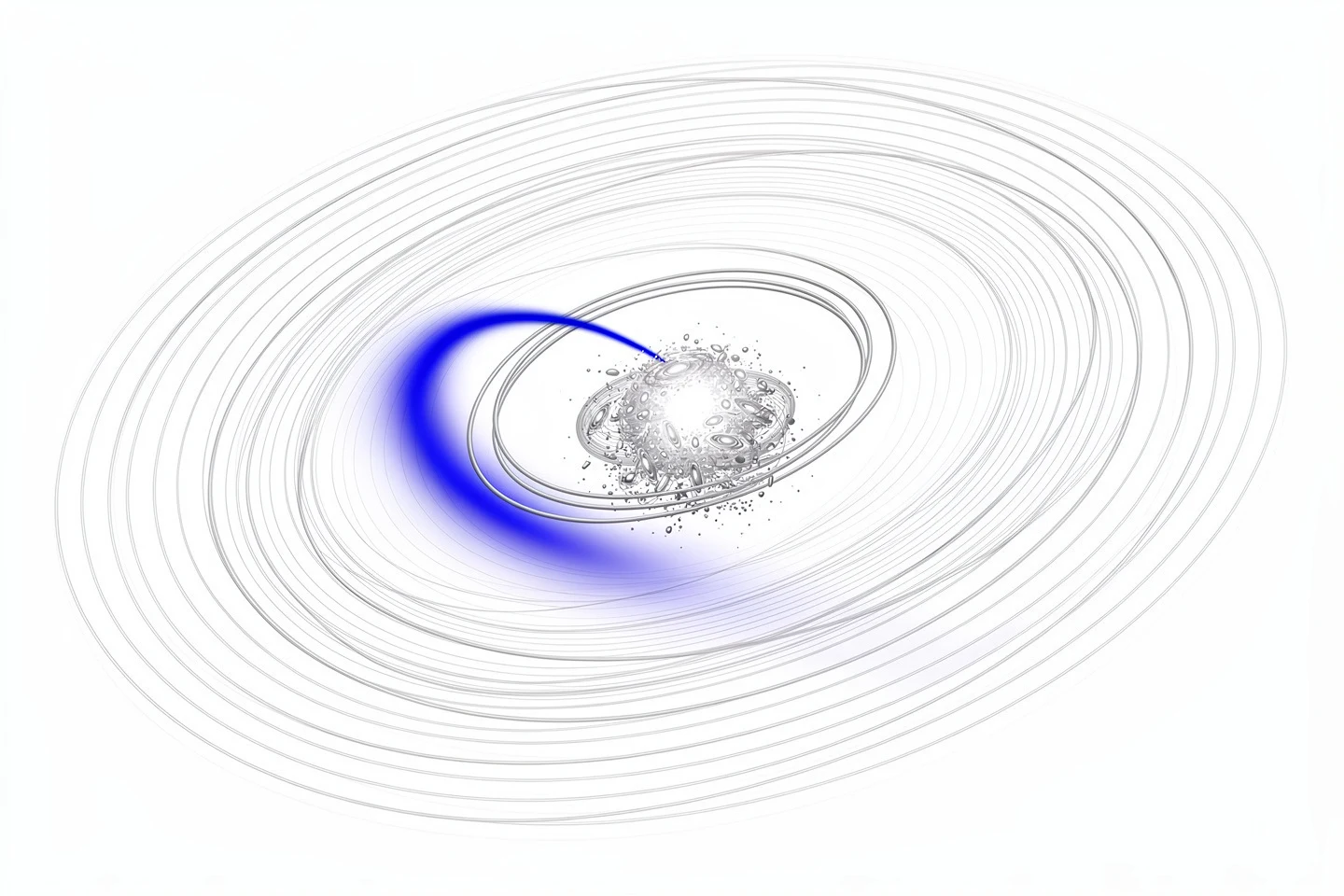
The giant galaxy cluster Abell S1063, lying 4 billion light-years away, works not just as a lens but as a gravitational well of time. Its mass bends space so sharply that photons from an era when the Universe was just 500 million years old slide along curved paths, like rays in slow motion, and converge on us magnified forty-three times. In one of these arcs, named GAR10, the James Webb telescope plucked from the darkness an object at redshift z≈10 — a ghostly light kindled at the very dawn of time. Decoding this message is like a detective story with two dazzling versions.
The first version paints a virginally pure world: the ultraviolet spectrum of GAR10 has a slope β=−2.92 — extremely blue emission, almost free of heavy elements. Such steepness is a direct indication of metallicity less than 0.03% of the Sun's, as if space itself hasn't yet learned to make dust. These are perfect conditions for Population III stars — the first suns, born from primordial gas and firing up nucleosynthesis, the forge of chemical elements. The second version is no less intriguing: the excess brightness in the F200W filter could be explained by powerful emission lines of ionized helium and carbon, betraying a very young (1–3 million years) star-forming region with hard radiation. Then GAR10 is a tiny dwarf galaxy of a few million solar masses, furiously birthing stars at the very start of cosmic history.
Whatever the verdict, GAR10 already forces a reassessment of the role of dwarf systems in the reionization of the Universe. Even a single such galaxy can pump out enough ionizing photons to punch a hole in the neutral hydrogen that shrouded the cosmos after the Big Bang. Future observations with the NIRSpec spectrograph aboard James Webb will cut this Gordian knot, and next-generation telescopes like the Extremely Large Telescope will allow detailed study of the chemistry and dynamics of these distant islands of light. We stand on the threshold of the archaeology of the first galaxies, where every gravitational lens becomes a window into the era when the first stars ignited and the Universe began to take on its familiar features. Ponder this: the light we register today left GAR10 before a single atom of gold had managed to form in our Galaxy.
The Abell S1063 cluster acts not only as a lens but also as a time machine: photons grazing it are delayed in their journey by tens of thousands of years compared to a direct beam, so we see an even more ancient picture.