Hao Zhang

9 articles · 30 co-authors · latest: 2026-08-15
121 citations · h-index 6 · 14 papersData: Semantic Scholar

We have retold 9 papers by this author. 1 of them with a full read. most often about: magnetic field, spectroscopy, microlensing. 30 co-authors across our retellings.

Links in the knowledge graph
Quantum Physics2026-01-311 minarXiv:2602.00679express
A 25-Point Magnetic Mosaic
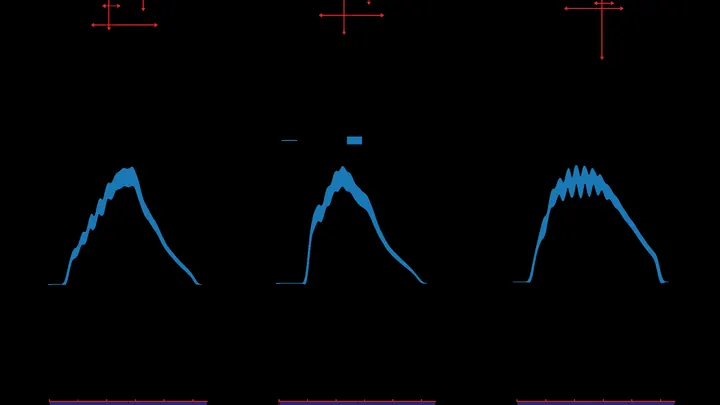
A magnetic field is invisible, but you can make it 'glow' using tiny defects in diamond — nitrogen-vacancy centers. Each such defect acts as a miniature compass, telling you which way the field points. The problem is that there are many of these compasses, and reading them all in sequence is like transcribing every letter in a thick book by hand.
Instrumentation2026-02-192 minarXiv:2602.17205express
How to See the Invisible in Space
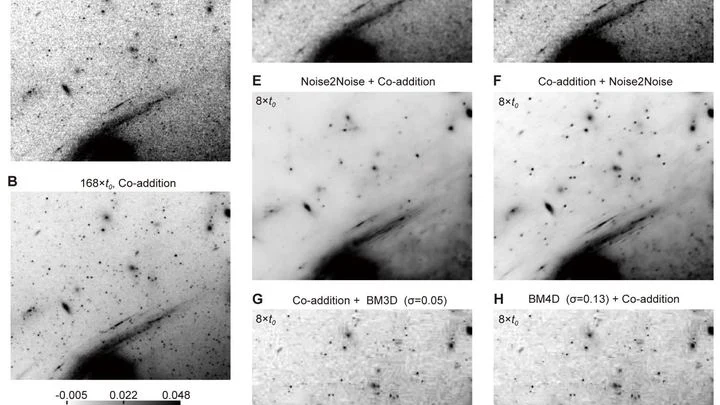
The night sky in a telescope image looks like a photo taken through a fogged-up window: bright stars are visible, but everything faint drowns in a murky haze. That haze is noise — random interference from electronics, heat, and the atmosphere itself.
physics.acc-ph2026-03-161 minarXiv:2603.15996express
Laser Printing of Electron Bunches
A typical accelerator is like an assembly line where electrons are the workpieces. To get the desired X-ray pulse, the workpiece is fine-tuned after it's already on the line: squeezed, filtered, corrected. In the new work, engineers decided to take a different approach — shaping the workpiece before it even hits the conveyor. At LCLS-II, electrons are knocked out of a metal by a short laser pulse.
Nuclear Experiment2026-04-271 minarXiv:2604.24220express
Stretching a Deuterium Nucleus with Light
A drop of water stretches in a strong electric field. The deuterium nucleus, a bound pair of a proton and a neutron, behaves the same way, except here the field comes from a passing gamma ray, and instead of just stretching, the nucleus can simply fall apart.
Strongly Correlated2026-05-052 minarXiv:2605.03448express
Magnetic dances in a nickel crystal
The La3Ni2O7 crystal resembles a layered pie, where the filling of nickel and oxygen atoms alternates with lanthanum layers. At ambient pressure, it does not conduct without resistance, but squeeze it or grow it as a thin film, and high-temperature superconductivity emerges.
Mesoscale2026-06-031 minarXiv:2606.04544express
Radio Barcode for the Quantum World
Reflecting off a nanowire, a radio wave, like a barcode scanner beam, instantly reads its state, offering hope for stable quantum processors.
Galaxies2026-06-223 minarXiv:2606.23869
Gravitational Lens Catches Light of First Stars at z≈10
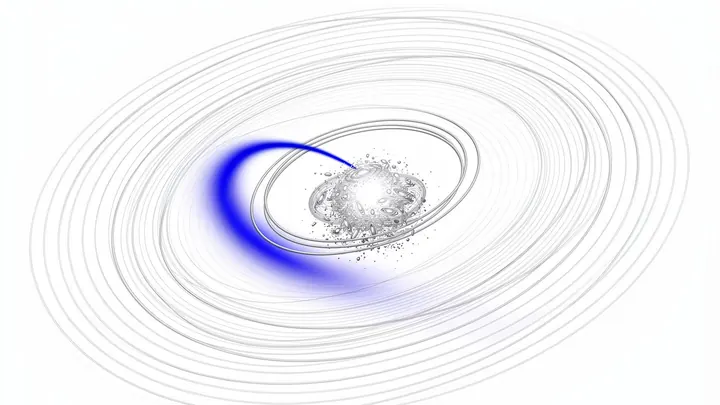
The giant galaxy cluster Abell S1063, lying 4 billion light-years away, works not just as a lens but as a gravitational well of time. Its mass bends space so sharply that photons from an era when the Universe was just 500 million years old slide along curved paths, like rays in slow motion, and converge on us magnified forty-three times.
eess.AS2026-07-131 minarXiv:2607.11157express
Clean Sound: Why Volume Matters More Than Phase
Cleaning speech from noise is like tuning an old TV: twist the contrast knob too far, and faces become unnatural. Researchers separately adjusted the 'volume' and 'time shift' for each frequency of sound, as if splitting it into a rainbow — a method known as spectroscopy. It turned out the key knob is volume, not phase synchronization.
Quantum Physics2026-08-151 minarXiv:2608.15130express
Atoms in a Light Beam Make Noise Like Commuters at a Station
A laser beam passes through a glass cell filled with cesium vapor. The atoms in the vapor dart around chaotically, like a crowd at a train station: each one enters the beam, spends a moment there, and flies back out. Their internal state, something like the orientation of a tiny magnet, changes under the influence of light. If all atoms were identical and stationary, the signal would be steady.