Cosmic Lens Unveils a Baby Galaxy at the Edge of the Universe ✛ ✦
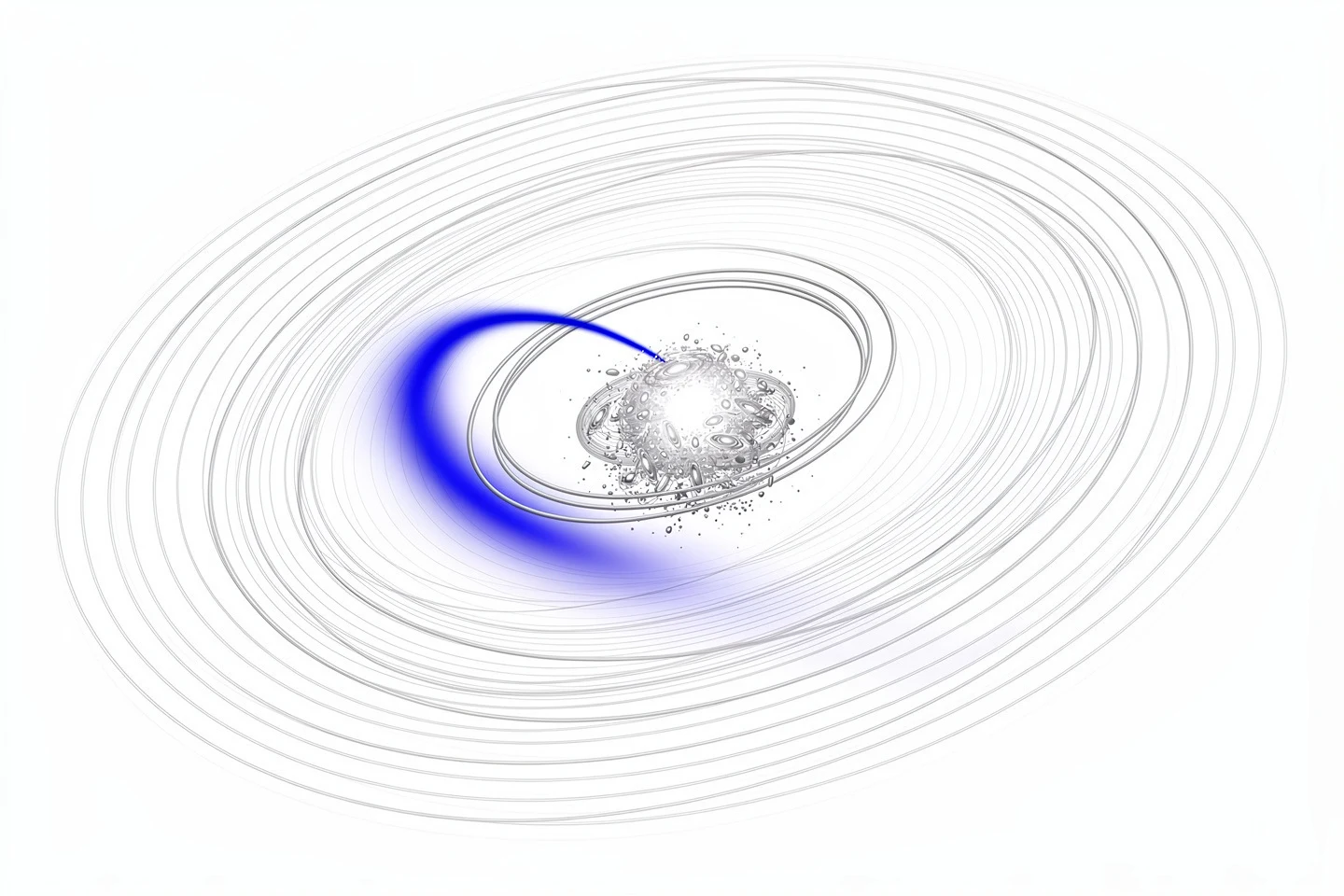
The James Webb Space Telescope has spotted galaxy GAR10—it appeared just 500 million years after the Big Bang. On its own, the galaxy is way too faint, but it was given away by a massive cluster of galaxies that acted like a giant natural lens. The cluster’s mass bent and boosted the light, just like a magnifying glass. This gravitational lensing effect was predicted by Albert Einstein, and Fritz Zwicky figured out that galaxy clusters could work this way.
By measuring the galaxy’s brightness in different colors, this is photometry, astronomers noticed it’s unusually blue. Spectroscopy split its light into a rainbow and revealed: inside, there may be furious star formation underway — some of the very first stars are being born, with almost no heavy elements (astronomers call this low metallicity). These elements are forged through nucleosynthesis inside stars. This galaxy is mostly hydrogen and helium, like a scrap of the Universe that hasn’t had time to accumulate even carbon.
If not for gravitational lensing, galaxy GAR10 would be 40 times fainter and would have remained invisible even to the Webb telescope.