Simple

The Chameleon Star: Where Did Theta Eridani's Brightness Go? ⚡ экспресс

Original: "The forgotten bright star: Theta Eridani as a millenary stellar transient observed by Hipparchus, Ptolemy and al-Sufi"
· Idel Waisberg, Boaz Katz
arXiv:2606.30748 · 2026-06-29 · CC BY 4.0 · ⏱ 1 min · Stellar History and Philosophy of Physics
Ancient astronomers saw Theta Eridani blazing, but today it’s barely visible. The answer lies in a cosmic dance between two stars.
Abstract

Ancient astronomers saw Theta Eridani as one of the brightest stars, but today it is nearly 10 times dimmer. It turns out it's a binary system where the stars are so close they almost merge — as if in a cosmic dance. This closeness temporarily heated the star, creating the illusion of super-brightness. What else are the stars hiding?

Links in the knowledge graph 1

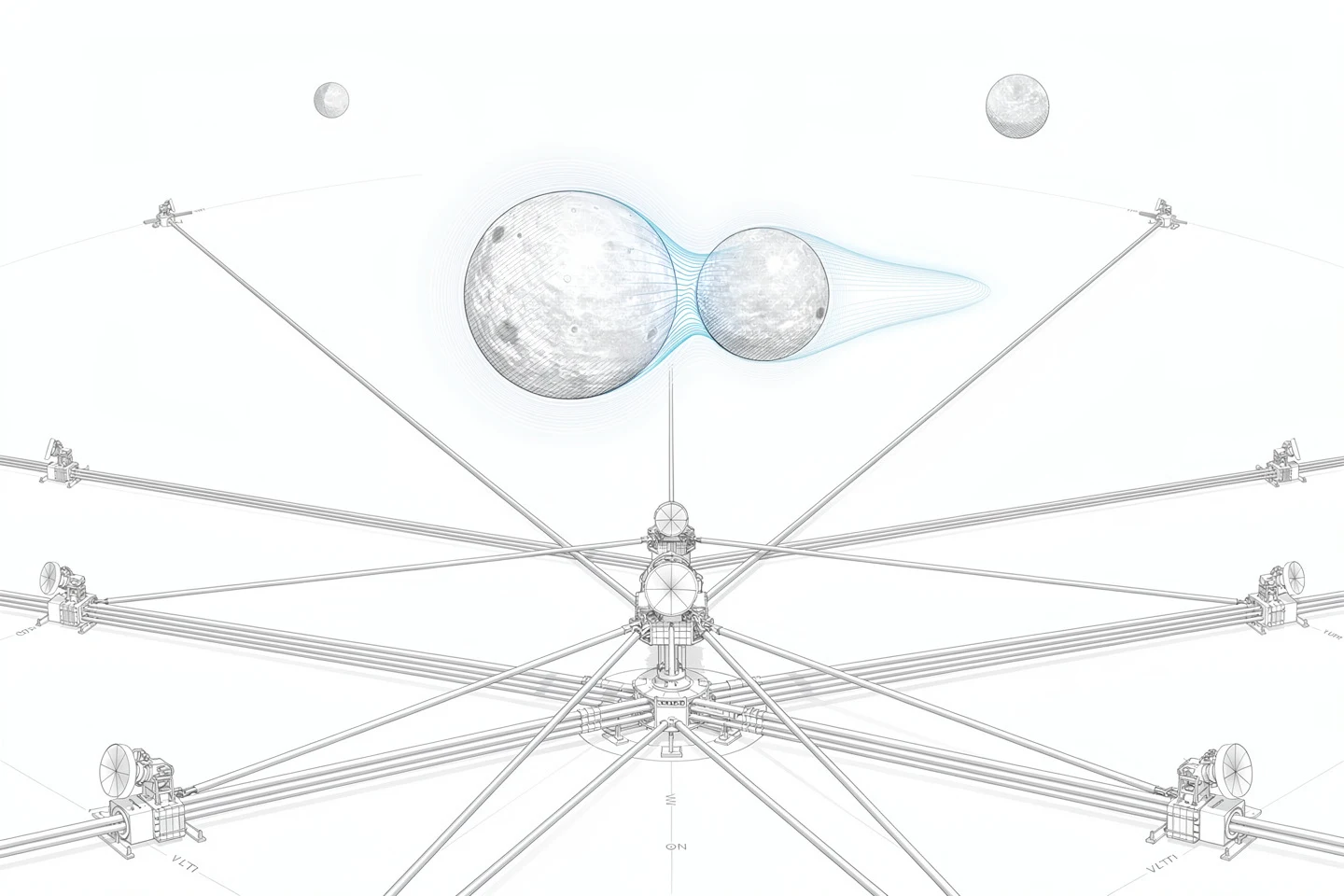
Thousands of years ago, the star Theta Eridani shone brightly in the sky, but today its light has almost vanished. For a long time, it seemed like ancient astronomers had made a mistake, but the real reason is a cosmic dance between two stars. Modern instruments—spectroscopes, which split light into colors, and photometers, which measure brightness—revealed: Theta Eridani is not a single star but a tight pair. Each star, twice as heavy as the Sun, orbits so close that they’d fit inside Mercury’s orbit. When one exhausted its hydrogen and bloated, it swirled its companion in a gaseous shroud. Like dancers tangled in a shared scarf, they became wrapped in scorching gas. Friction inside this “scarf” made the system flare up dozens of times brighter for a few centuries. Then the shroud dispersed, and the star dimmed again. Now scientists realize that ancient records of sudden flares might not be mistakes, but traces of episodes like this. And perhaps this pair will end their dance by merging into a single star.

🎯 At its peak brightness, Theta Eridani rivaled Vega, one of the main stars of the summer sky.

Scientists
Christian DopplerD. B. McLaughlinDidier QuelozMichel MayorR. A. RossiterCharles-Augustin de Coulomb
Tags
hydrogen spectroscopy photometry Sun
Laws
Doppler effectCoulomb's lawMaxwell's equationsPlanck's lawPlanck–Einstein relationWien's displacement law
Original: arXiv:2606.30748 · CC BY 4.0 · bridge42worlds