Cepheids are a class of pulsatingvariable stars that rhythmically expand and contract, causing their brightness to oscillate over periods ranging from a few days to months. Their defining trait is a tight, predictable relationship between the pulsation period and the star's intrinsic luminosity: the longer the period, the brighter the star. This makes them 'standard candles' — by measuring how long a cepheid takes to pulse and comparing its apparent brightness to its known true brightness, astronomers can calculate its distance with remarkable precision.
History
The period-luminosity relation was discovered by Henrietta Swan Leavitt in 1908 while studying variable stars in the Magellanic Clouds. Edwin Hubble later used cepheids to demonstrate that the Andromeda Nebula lies far beyond the Milky Way, establishing the scale of the universe.
How it works
The pulsation is driven by a feedback loop involving the opacity of the star's outer layers. Helium in the envelope becomes partially ionized during the contractionphase, increasing opacity and trapping radiation, which heats the gas and causes it to expand. As it expands, the helium recombines, opacity drops, and the star contracts again, repeating the cycle. The period of this cycle depends on the star's mean density, which in turn scales with its mass and luminosity — hence the period-luminosity relation.
In practice
Cepheids are the primary rung on the cosmic distance ladder, used to calibrate distances to nearby galaxies and to measure the Hubble constant, which describes the expansion rate of the universe.
Fun fact
The North Star, Polaris, is a cepheid variable whose pulsationamplitude has been shrinking over the past century, puzzling astronomers.
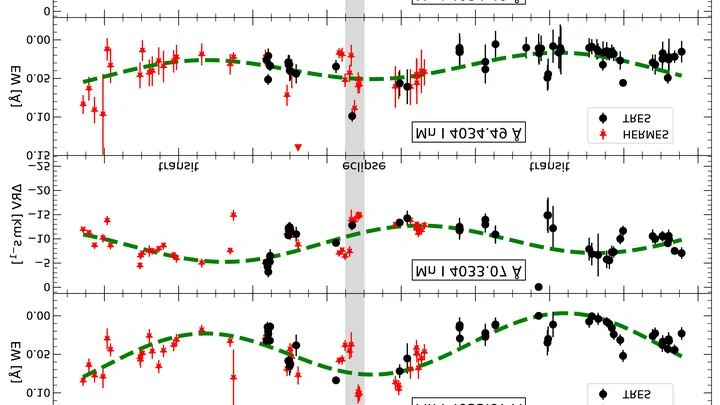
The family album of this stellar pair has been filling up for 45 years, but the pictures were blurry and the captions contradictory. Now astronomers have pulled out the old photographs, taken new sharp shots, and put everyone back in their proper places. Gamma Cephei is a bright star visible to the naked eye, and it has an invisible companion that orbits it every 70 years.
Cepheids are stars that pulsate with remarkable regularity: their brightness changes like a lighthouse beam, and the pulsation period is linked to the star's average density. In binary systems where a Cepheid is eclipsed by its companion, astronomers can precisely measure the star's radius and mass.
The Sun is constantly struck by blows — magnetic reconnection in the plasma releases energy, making the corona flare up. After each such blow, magnetohydrodynamic waves linger in the plasma loops, like the fading ring of a bell.
Two thousand years ago, a brilliant beacon shone in the constellation Eridanus, recorded in the registers of ancient astronomers. Hipparchus in 129 BCE noted it as a first-magnitude star, Ptolemy confirmed its brightness in the Almagest, and the Persian scholar Al-Sufi still saw it among the brightest in 964.
Long-period radio transients (LPTs) are a mysterious class discovered only recently. Their pulses last minutes or hours, and their nature was completely unknown. ASKAP J1745-5051, caught by the Australian telescope ASKAP, became the first to get a full explanation.
The cosmological orchestra doesn't tune to a single tuning fork. There are two groups of instruments: one listens to the hum of the young universe — the cosmic microwave background, while the other reads notes from mature galaxies and supernovae.
Some red giants (huge, old stars) change brightness very slowly: one cycle can last more than a year. Astronomers have long been puzzled about why. One idea: an invisible companion orbits nearby, periodically blocking part of the light. Another: the star itself pulsates, like a heart, but very leisurely: its outer layers alternately contract and expand.
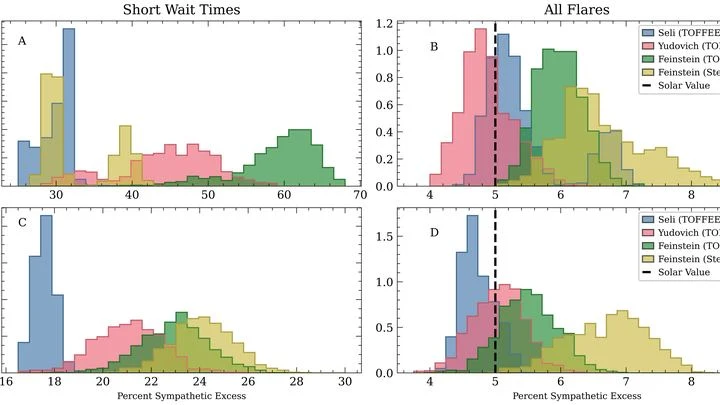
The Sun occasionally produces flares — powerful bursts of energy that last from minutes to hours. Most are random, like raindrops hitting a roof. But sometimes one flare seems to ignite another: the second begins almost immediately after the first, even though they occur in different locations. Astronomers call these sympathetic flares.
In Andromeda's stellar stream, a long ribbon of stars ripped from a small galaxy during a collision with a larger one, astronomers spotted a star that outshines all its neighbors. It pulsates, swelling and contracting every 89 days, like a heart beating in rhythm. Such stars are called Type II Cepheids, and this one is the brightest known.
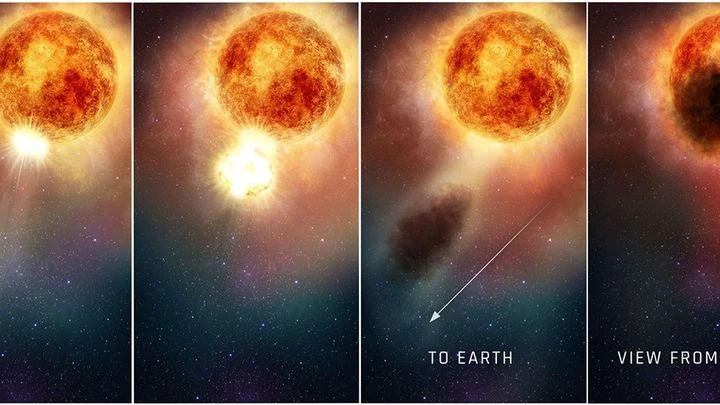
In 2019, Betelgeuse suddenly dimmed, sparking rumors of an imminent explosion. But clouds of cosmic dust turned out to be the culprit. Now, the Gemini North telescope has discerned a minuscule companion star in its dazzling glare, just as calculations had predicted.
Betelgeuse is a giant star ready to explode as a supernova. But it may not be alone: a small companion star, Sivarkha, circles in a tight orbit. Every 2000 days, it plunges through Betelgeuse’s outer layers, like a boat cutting through water, leaving waves of superheated gas.
Scientists have described a new type of invisible star that behaves like a breathing lens. Such a star is made of ultralight boson particles (not yet discovered). Its gravity causes spacetime curvature — this is the lens, which rhythmically expands and contracts, as if breathing.
The cosmological community has been living in a state of quiet civil war for several years. Two camps measure the expansion rate of the Universe and get different answers. Planck, peering at the cosmic microwave background, says 67.4 km/s/Mpc. SH0ES, climbing the distance ladder from Cepheids to supernovae, insists on 73.2.