Magnitude is a logarithmic scale used to measure the brightness of astronomical objects. It originated with the ancient Greek astronomer Hipparchus, who classified stars into six groups by apparent brightness, with first magnitude being the brightest and sixth the faintest visible to the naked eye. The system was formalized in the 19th century by Norman Pogson, who defined a difference of five magnitudes as exactly a factor of 100 in brightness, making each magnitude step a factor of about 2.512.
History
The system was formalized by Norman Pogson in 1856, who established the logarithmic relationship that a five-magnitude difference equals a brightness ratio of 100.
How it works
The apparent magnitude of an object depends on its intrinsic luminosity and its distance from Earth. A lower magnitude number means a brighter object; for example, the Sun has an apparent magnitude of about -26.7, while the faintest objects detected by the Hubble Space Telescope are around magnitude 31. The scale is logarithmic, so a difference of one magnitude corresponds to a brightness ratio of the fifth root of 100, approximately 2.512. Astronomers also use absolute magnitude, which normalizes brightness to a standard distance of 10 parsecs, to compare the true luminosities of objects.
In practice
Magnitude is used universally in astronomy to catalog stars, galaxies, and other celestial objects, and to measure their variability, such as the changing brightness of stars like Betelgeuse or the unpredictable brightness evolution of Starlink satellites.
Fun fact
The brightest object in the night sky, Venus, can reach an apparent magnitude of about -4.9, which is bright enough to cast shadows on Earth.
The cosmic dawn is hidden behind a dense veil of time. To see beyond it, you need to catch the radio signal from clouds of neutral hydrogen — the so-called global 21 cm signal. But it is so faint that the receiver's own noise drowns it out.
Two thousand years ago, a brilliant beacon shone in the constellation Eridanus, recorded in the registers of ancient astronomers. Hipparchus in 129 BCE noted it as a first-magnitude star, Ptolemy confirmed its brightness in the Almagest, and the Persian scholar Al-Sufi still saw it among the brightest in 964.
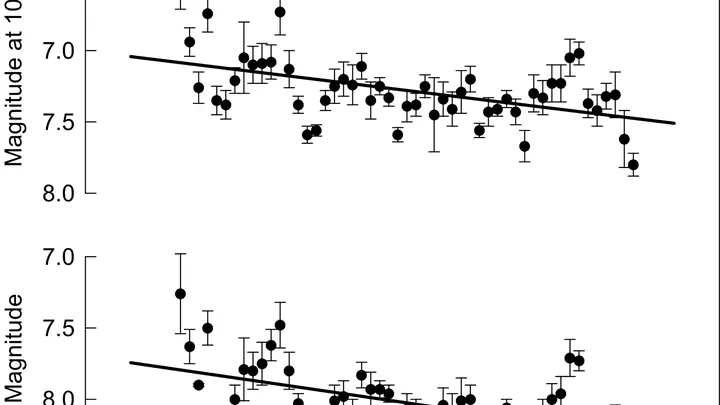
For five consecutive years, the automated MMT9 observatory measured the brightness of Starlink and OneWeb satellites using photometry (precise light measurement). The results were surprising: VisorSats, equipped with visors to reduce glare, became brighter by 0.6 magnitudes, while OneWeb, on the contrary, dimmed by 0.4.
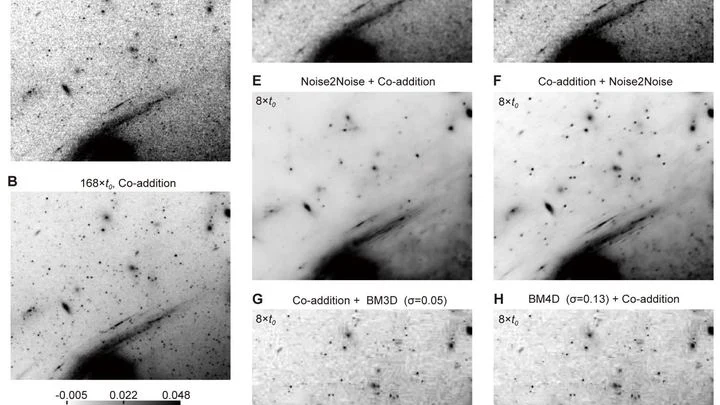
The night sky in a telescope image looks like a photo taken through a fogged-up window: bright stars are visible, but everything faint drowns in a murky haze. That haze is noise — random interference from electronics, heat, and the atmosphere itself.
When a distant star explodes, its light travels toward us for billions of years. Astronomers measure how dim it appears and use that to calculate the distance. Usually, this involves complex models with dark energy and other mysteries.
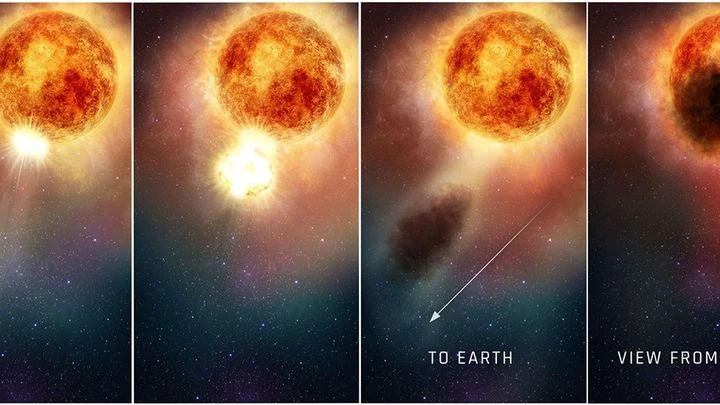
In 2019, Betelgeuse suddenly dimmed, sparking rumors of an imminent explosion. But clouds of cosmic dust turned out to be the culprit. Now, the Gemini North telescope has discerned a minuscule companion star in its dazzling glare, just as calculations had predicted.
The Universe is expanding, and every galaxy cluster takes part in a grand dance. The tempo of this dance is set by the Hubble constant, first measured by Edwin Hubble nearly a century ago. Pinpointing the number is tough because you need a ruler that spans billions of light-years.