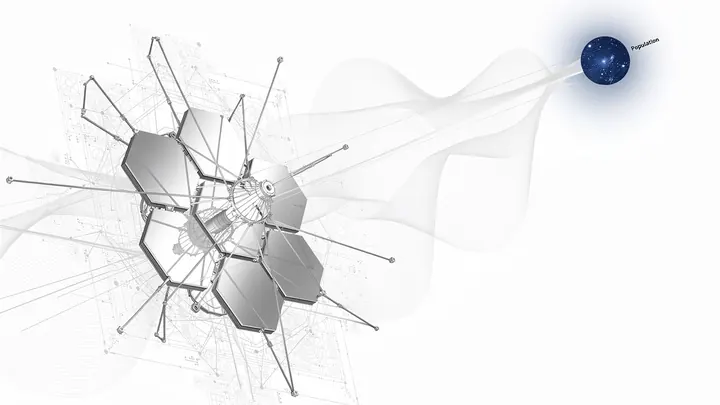
First stars, also known as Population III stars, are the earliest generation of stars formed in the universe, emerging from primordial gas composed almost entirely of hydrogen and helium, with trace amounts of lithium. Because they formed before any heavy elements existed, they are thought to have been much more massive than typical stars today, potentially hundreds of times the mass of the Sun. These stars are crucial for understanding the early universe because they produced the first heavy elements, which then seeded subsequent generations of stars and galaxies.
History
The concept of Population III stars was introduced in 1967 by astrophysicist Robert Wagoner, who proposed that the first stars formed from primordial material and would have distinct properties. The term 'Population III' was coined by Neville Woolf in 1967.
How it works
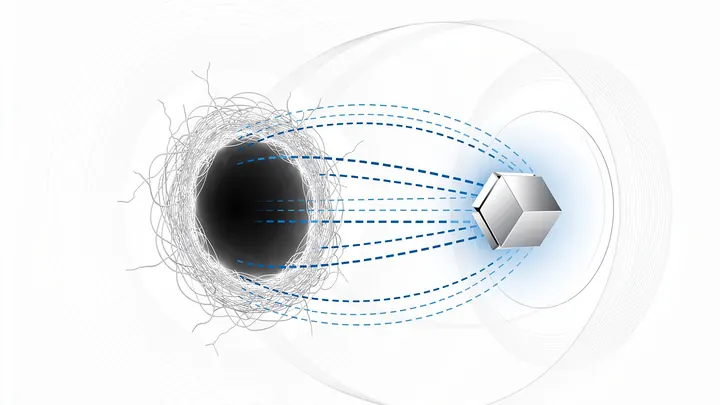
The primordial gas, lacking elements like carbon and oxygen that efficiently radiate heat, could not cool easily. This meant that gas clouds had to be very massive to collapse under gravity, leading to the formation of extremely massive stars. These stars burned hot and fast, lived only a few million years, and likely ended in powerful supernovae or even direct collapse to black holes, dispersing the first heavy elements into space.
In practice
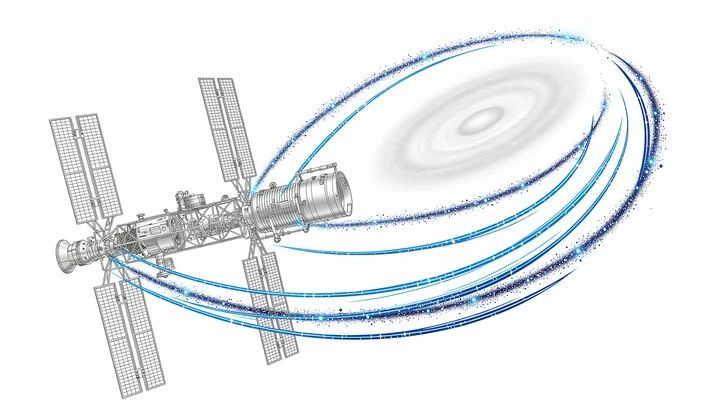
Observations with the James Webb Space Telescope are actively searching for signatures of first stars in the most distant galaxies, and theoretical models of their formation are used to predict the early chemical enrichment of the universe.
Fun fact
Some theoretical models suggest that the most massive first stars could have lived for hundreds of millions of years if they had very low metallicity, potentially surviving to the present day as 'zombie' stars.
Forty light-years away lives a star that went unnoticed for a long time: TRAPPIST-1 emits two thousand times less light than the Sun. But it turned out to have seven Earth-sized planets, three of which orbit in the zone where water could remain liquid. Yet little was known about the star itself, about its chemical kitchen.
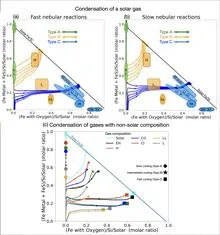
Three cabinets full of rocks. In one, metallic grains and the gray mineral enstatite; in the second, the same grains but with rusty streaks; in the third, layered clays swollen with water. All three sets were pulled from meteorites that fell to Earth: chondrites. They were born in the same gas-and-dust disk around the young Sun, yet somehow turned out so different.
An interpreter gets distracted by every rustle in the hall, and a one-hour meeting stretches into two. A neutron star compresses a solar mass into a sphere the size of a city, and the matter in its core is denser than an atomic nucleus. Physicists cannot probe its structure in the lab: the required pressures are unattainable.
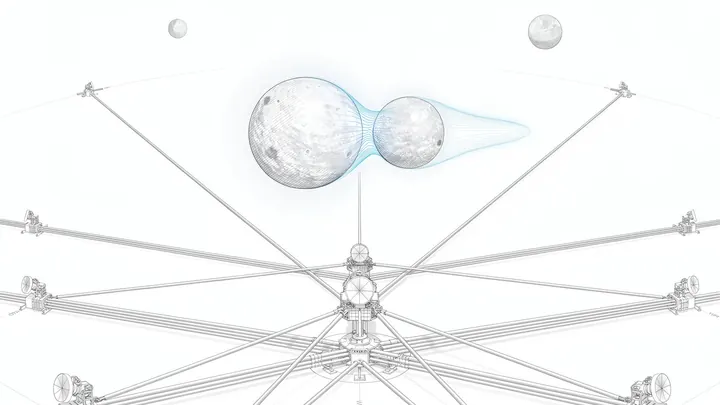
Two spinning tops whirl so close they nearly touch. One is scorching blue, the other dim white. Together they complete a full orbit in twenty hours. This is the pair Feige 64: a blue star with a mass of just a third of the Sun's, and a white dwarf, the cooled core of a former star, one and a half times heavier than our Sun.
The blue star seems too hot for its mass.
Two stars circle each other like dancers who come together and drift apart. Over time, one swells, and its outer layers spill onto its neighbor. The star that receives foreign matter looks no different from a single star, but its surface remembers everything.
In the first moments after the Big Bang, matter and antimatter should have been created in equal amounts. But today, everything around us is ordinary matter, and antimatter is almost nowhere to be found. Where did it all go? The standard answer: a tiny imbalance in favor of matter wiped out almost all antimatter.
A star is not just a distant sun. It's a cradle for planets, and its light carries the birth story of the entire system. The chemical composition of a star is its DNA. Astronomers peer into this DNA to understand why some stars host rocky worlds like Earth, while others host gas giants.
The most massive stars are like overinflated balloons: their envelope stops stretching and instead begins to furiously vent material. At a certain stage, the mass loss becomes so intense that the star stops growing in size. Astronomers see this moment as a kink in the diagram where stars are sorted by luminosity and temperature.
In the black depths of space, on the surfaces of tiny icy dust grains, a quiet construction is underway. There, where temperatures drop to near absolute zero and harsh radiation abounds, the ordinary amino acid glycine, the simplest protein building block, links up with itself.
Galaxy NGC 4254 lies 1.5 million light-years from the center of the Virgo cluster. It drags a long stream of cooling hydrogen — a sign that it's plowing headlong into the hot gas. Losing cold fuel quenches the birth of new stars.
A young star cluster resembles an orchestra before a concert: each instrument tunes up in its own way, and the overall hum seems like chaos. But if you listen closely, you can pick out individual notes.
In the early universe, just a few hundred million years after the Big Bang, astronomers see strange objects — little red dots. They are compact, red, and in their spectra, broad Balmer lines scream the presence of supermassive black holes. But how did the hole manage to accumulate millions of solar masses in such a short time?
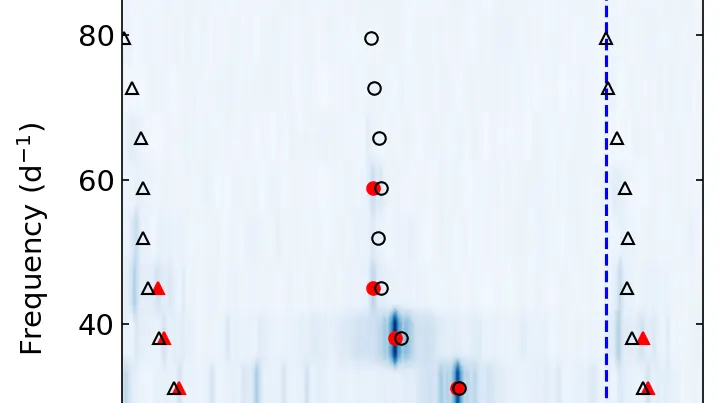
It takes the stellar pair J05+50 nearly two months to complete one orbit around their common center. From Earth, it appears as a faint point in the constellation Hercules — 4625 parsecs away. Photometry of the binary star only captures a steady flicker of brightness, like the pulse of a giant heart.
In 2016, astronomers saw something incredible: a distant star, named Icarus, flared up for several weeks, crossing the abyss of space. Gravitational lensing, an effect predicted by Einstein, had kicked in: a massive object bends spacetime and focuses light like a giant magnifying glass.
The Orion Nebula is a showcase of astrophysics, a laboratory for studying star formation right in our backyard. For over a century, its light has been split into spectra, and each forbidden line whispers its own version of how many electrons per cubic centimeter.
In 1981, Alan Guth proposed a scenario of cosmological inflation — a lightning-fast expansion of space that stretched quantum fluctuations to the scale of entire galaxies. Since then, cosmologists, like archaeologists, have been excavating this event from the structures of the Universe.
In a giant cosmic cradle, the Tarantula Nebula, astronomers took a close look at 122 massive stars, each at least 30 times heavier than the Sun. They measured the nitrogen abundance in their atmospheres, and the picture turned out to be unexpected.
Imagine an ancient manuscript, where a new story is written over an old text. Over time, the upper layer wears thin, and lines of the past show through. That’s exactly how globular clusters, the oldest stellar systems in the Universe, are structured, like a palimpsest.
The standard cosmological model ΛCDM, where dark matter and dark energy act as the chief architects of the cosmos, has predicted astronomical data with Swiss-watch precision for decades. Its foundation was laid by three geniuses.
Two thousand years ago, a brilliant beacon shone in the constellation Eridanus, recorded in the registers of ancient astronomers. Hipparchus in 129 BCE noted it as a first-magnitude star, Ptolemy confirmed its brightness in the Almagest, and the Persian scholar Al-Sufi still saw it among the brightest in 964.
Right after the Big Bang, the Universe was a chemical desert — only hydrogen and helium, not a hint of metals. But moments passed (by cosmic standards), and the birth of the first stars — Population III — began.
Imagine a forest planted in a single day. At first glance, all trees look alike, but their cross sections tell different stories: some grew on clean soil, others on the ashes of ancient fires.
At the center of a galaxy, gravity condenses dark matter into a dense 'spike.' Such a dark spike resembles a funnel of invisible particles around a massive body. But if both the center and the particles are primordial black holes, the picture breaks down.
Lenticular galaxies are the cosmic quiet types: they have a disk but no bright spiral arms. For a long time, their origin remained a mystery. A team of scientists ran the Hydrangea computer simulation and traced the fate of each galaxy from its youth to the present day.
On the mass–size diagram, these galaxies line up in a V shape.
Stars are born in cold clouds of cosmic dust and hydrogen. Inside these cocoons, protostars — the cores of future suns — were long thought to be just hot clumps. But it turns out many of them are powerful accelerators: they shoot out narrow jets of gas that, slamming into surrounding matter, produce invisible gamma-ray light.
Previously, Uranus and Neptune were considered ice giants because of assumed thick layers of frozen water, methane, and ammonia. New calculations paint a different picture: deep inside them hides an ocean of hot magma, which under immense pressure has absorbed a colossal amount of hydrogen.
The galaxy NGC 1277 is like an old book that no one has opened for billions of years. It formed quickly at the dawn of the Universe and has barely changed since — no collisions with neighbors, no new layers added.
The James Webb Space Telescope peered into a disk of gas and dust around a young star where planets are born, and for the first time spotted ice made of heavy water. This water is not ordinary: in its molecules, regular hydrogen is replaced by deuterium, its heavier sibling.
The Universe is singing. Not in the usual sense: its symphony is recorded in tiny density variations from which galaxies and ourselves grew. After the Big Bang, space was almost uniform, but quantum fluctuations during inflation left a faint pattern — slightly more matter here, slightly less there.
Elliptical galaxies are quiet stellar metropolises in retirement. By all rights, their light should be calm, reddish, like a sunset. But their spectra scream otherwise: in the far ultraviolet, these old-timers blaze like holiday lights. For three decades, astronomers have puzzled over this 'ultraviolet upturn' (UV upturn).
In the heart of the Milky Way, in the cloud G+0.693, astronomers caught a sweet signal — emission lines of erythrulose, a simple sugar with four carbon atoms and four oxygen atoms.
The Universe is a genius chef, and the Big Bang is its perfect recipe. Hydrogen rose fluffy, helium melted tender, but lithium-7 seems oversalted: theory predicts three times more than astronomers find in the oldest stars. This imbalance, the 'lithium problem,' has spoiled cosmologists' appetite for decades.
In the silent theater of the cosmos, a star’s life plays out over billions of years. But sometimes an invisible director sneaks onto the stage — a primordial black hole.
In an orchestra, each musician plays their own part, but at a certain moment all instruments pause on a single note. Cosmic rays behave somewhat like this — particles flying toward us from distant stars.
In the heart of the Eagle Nebula, about 7000 light-years away, three giant pillars of gas and dust rise — the Pillars of Creation. Their shape is familiar to many from Hubble Space Telescope images. Now, Webb's infrared camera has allowed us to peer inside these dense cocoons where stars are born.
The cosmic accounting has hit a snag. The bookkeeper is balancing the books: in one column, all the planets astronomers have counted in the galaxy; in the other, the stockpile of building material in the dusty cocoons of newborn stars. The numbers don't line up. Even if you gathered every last grain of dust and molded it into planets, there wouldn't be enough material.
For a long time, a void yawned in the family of ultra-dense remnants of dead stars. Neutron stars, swift city-sized tops, rarely weigh more than two Suns. Black holes start at about five solar masses. Between them lies a 'gap' where for decades no object could be found.
Just after the Big Bang, clumps weighing as much as a trillion Suns and with an electric charge of colossal strength, like trillions of electrified balloons, could have drifted through space.
In the crowded center of the galaxy, two stars orbit so close together that one strips the outer layers off the other, like wind blowing off a coat. What remains is a hot helium core, a star without a hydrogen envelope.