Apparent magnitude is a measure of how bright a celestial object appears from Earth, on a logarithmic scale. It is a historical yet still widely used system in astronomy to compare the brightness of stars, planets, and other objects as seen by an observer. The scale is inverted: lower numbers mean brighter objects, with the brightest stars having negative magnitudes and the faintest detectable objects having magnitudes around 30.
History
The system was formalized by the Greek astronomer Hipparchus in the 2nd century BCE, who classified stars into six brightness classes. It was later given a mathematical basis by Norman Robert Pogson in 1856, who established the logarithmic relationship that is still used today.
How it works
The scale is defined such that a difference of 5 magnitudes corresponds to a brightness ratio of exactly 100. Each magnitude step is a factor of the fifth root of 100 (about 2.512) in brightness. The apparent magnitude depends on both the object's intrinsic luminosity and its distance, as well as any interstellar absorption. It is calibrated using standard reference stars, and modern measurements use photometric filters to define specific wavelength bands.
In practice
Apparent magnitude is used in observational astronomy to catalog stars, plan telescope observations, and estimate distances via the distance modulus when combined with absolute magnitude.
Fun fact
The Sun has an apparent magnitude of about −26.7, while the faintest objects observed by the James Webb Space Telescope have magnitudes around 30, making the Sun about 10^22 times brighter than the faintest detectable objects.
Cosmic rays aren't rays in the usual sense: they're fast particles bombarding Earth from all directions. Mostly they're protons and atomic nuclei. Their energies vary widely, from modest to fantastically huge. When such a particle heads our way and the Moon or Sun gets in its path, it gets absorbed.
Two figure skaters on a lake frozen to the horizon. They are so far apart that their silhouettes turn into dots, and their mutual attraction becomes almost an article of faith. By Newton's law, they should circle in an unimaginably slow waltz. But telescopes see otherwise.
A spotlight blazes straight into your eyes, and a few steps away a tiny firefly flickers. That's roughly what it's like hunting for an Earth-like planet around a neighboring star: the planet is a hundred million to ten billion times fainter than its star, and in the sky they almost merge into a single point.
Two thousand years ago, a brilliant beacon shone in the constellation Eridanus, recorded in the registers of ancient astronomers. Hipparchus in 129 BCE noted it as a first-magnitude star, Ptolemy confirmed its brightness in the Almagest, and the Persian scholar Al-Sufi still saw it among the brightest in 964.
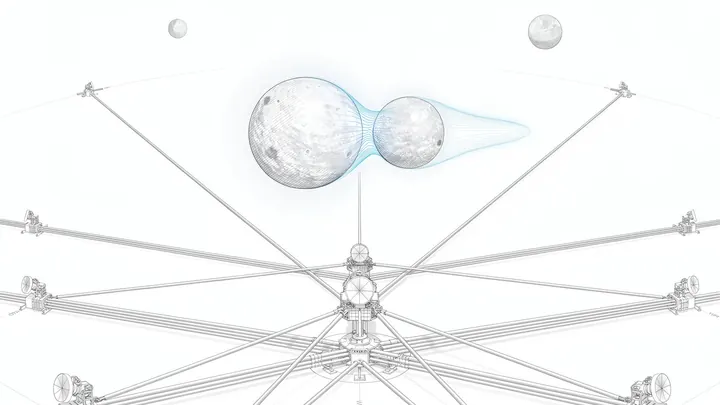
In the boundless night of space, galaxies come together in a slow gravitational dance, merging into one. Such collisions are not head-on impacts but rather like fingers moving slowly through water, leaving swirls and tails behind.
Interstellar space is not a cosmic desert, but a super-fast highway. Trillions of asteroids and comets from other systems race past us, yet camera-telescopes only catch a few. Imagine a night highway: the headlights of a distant car flash brightly, but if it zooms by too fast, the camera shutter can't click in time.
Edwin Hubble and Georges Lemaître discovered the expansion of the Universe nearly a century ago. One way to test it is the surface brightness test: in an expanding cosmos, the light of a distant galaxy should fade like a pattern on a stretching film.
A stone falls into a pond, and the ripples on the water tell for a long time where it sank. With a black hole, it would seem, things are different: everything that crosses the horizon (the boundary from beneath which not even light can escape) vanishes without a trace.
At the edge of the solar system, far beyond Neptune, hundreds of icy chunks circle the Sun. Some of them move as if an invisible hand had aligned their orbits like compass needles. Ten years ago, this led astronomers to suspect that a massive planet, about ten times heavier than Earth, is hiding there.
Astronomers occasionally spot interstellar objects — rocky chunks or comets from other star systems. Most look ordinary, but some puzzle us with their shape, speed, or shine. To stop guessing, scientists applied the Loeb scale: from 0 (plain rock) to 5 (technosignature — an artificial signal from space).
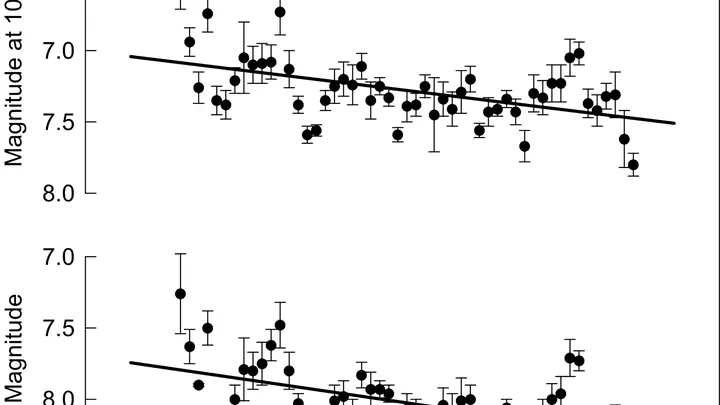
For five consecutive years, the automated MMT9 observatory measured the brightness of Starlink and OneWeb satellites using photometry (precise light measurement). The results were surprising: VisorSats, equipped with visors to reduce glare, became brighter by 0.6 magnitudes, while OneWeb, on the contrary, dimmed by 0.4.
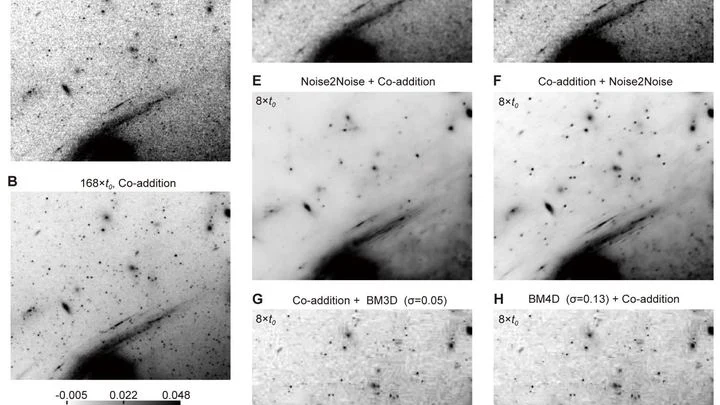
The night sky in a telescope image looks like a photo taken through a fogged-up window: bright stars are visible, but everything faint drowns in a murky haze. That haze is noise — random interference from electronics, heat, and the atmosphere itself.
In distant galaxies, old stars swell and redden. Among them are two groups that act like lighthouses: some have just ignited helium burning, while others are already burning carbon and oxygen.
Light from a streetlamp passing through blinds flickers: the stripes shift, and brightness rises and falls. From that rhythm, you can guess how wide the lamp is. The new method for measuring stars works similarly: instead of capturing a sharp image, astronomers monitor the "twinkling" of light collected by two or more telescopes simultaneously.
A galaxy cluster's gravity warps spacetime, acting like a colossal lens: it focuses and amplifies light from distant objects, as predicted by Einstein. Such lenses are rare, but they let us glimpse what lurks at the edges of the cosmos.
When a distant star explodes, its light travels toward us for billions of years. Astronomers measure how dim it appears and use that to calculate the distance. Usually, this involves complex models with dark energy and other mysteries.
The merger of two neutron stars is like a strike on a gong: a ripple in space, a gravitational wave, spreads through the universe. Detectors on Earth catch this ripple and, from its strength, calculate the distance to the source.
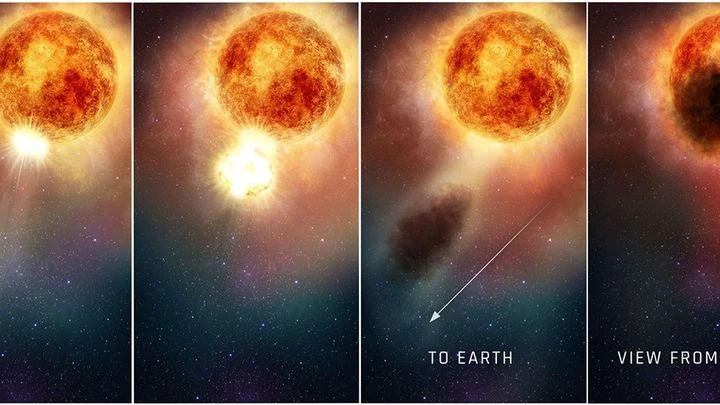
In 2019, Betelgeuse suddenly dimmed, sparking rumors of an imminent explosion. But clouds of cosmic dust turned out to be the culprit. Now, the Gemini North telescope has discerned a minuscule companion star in its dazzling glare, just as calculations had predicted.
Astronomers have found an invisible object in the Universe weighing just a million Suns — for cosmic scales, that’s a mere trifle, a hundred times lighter than anything they’ve been able to “weigh” at such distances. The object itself doesn’t shine, but it gave itself away by bending the light from an even more distant galaxy.