Helium is the second element of the periodic table, a colorless and odorless noble gas. Its atom contains two protons (the He-4 isotope has two neutrons, He-3 has one). The filled electron shell makes helium chemically inert. Under normal conditions, it is a monatomic gas (atoms do not form molecules) with very low density. When liquid helium-4 is cooled to 2.17 K, it transitions to a superfluid state: it flows without friction and has enormous thermal conductivity.
History
In 1868, Pierre Janssen and Norman Lockyer independently discovered a bright yellow line in the solar spectrum; Lockyer suggested it belonged to a new element — helium. In 1895, William Ramsay isolated helium from the mineral cleveite, and Per Teodor Cleve and Nils Langlet determined its atomic mass. In 1908, Heike Kamerlingh Onnes first obtained liquid helium; superfluidity in He-4 was discovered in 1937 by Pyotr Kapitsa, with theoretical explanation provided by Landau and others.
How it works
Superfluidity of helium-4 is explained by Bose-Einstein condensation: a macroscopic fraction of atoms transitions to the ground state with zero momentum. Quantum coherence of the condensate over large distances leads to dissipationless flow. For He-3, superfluidity arises from the formation of pairs with antiparallel spins (analogous to Cooper pairs), described by the Ginzburg–Landau equation. In astrophysics, helium is synthesized in stellar interiors (proton-proton and CNO cycles) and during primordial nucleosynthesis after the Big Bang.
In practice
Used in breathing mixtures for deep-sea diving, in helium-neon lasers, and for cooling superconducting magnets in medical tomographs.
Fun fact
Helium is the only simple substance that remains liquid at absolute zerotemperature (at normal pressure); quantum fluctuations prevent it from freezing.
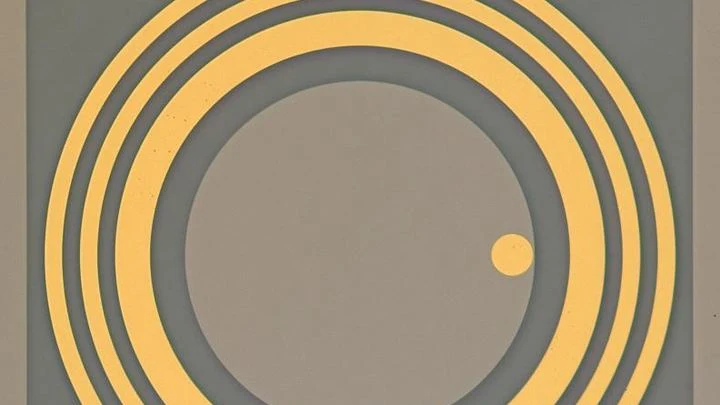
A transparent film of bismuth tungstate sits on a substrate and does not conduct electricity. Three minutes in a cloud of nitrogen plasma, and it turns black, with resistance dropping by a factor of a billion.
The neutron is a particle that usually sits in the atomic nucleus and doesn't disappear. But some theories suggest that occasionally it might transform into its invisible twin — a particle that ordinary detectors can't catch.
In the layered crystal CrSBr, the magnetic moments of atoms are arranged like notes in a score: within each layer they point in the same direction, but between layers they point in opposite directions. This antiferromagnetic melody plays up to 132 kelvin, beyond which thermal motion destroys the order.
The helium atom is like a tightly stretched string: every note it plays is strictly predicted by theory. But in recent years, precise measurements of one such "note"—the energy needed to strip an electron from an excited helium atom — have started to sound slightly higher than they should.
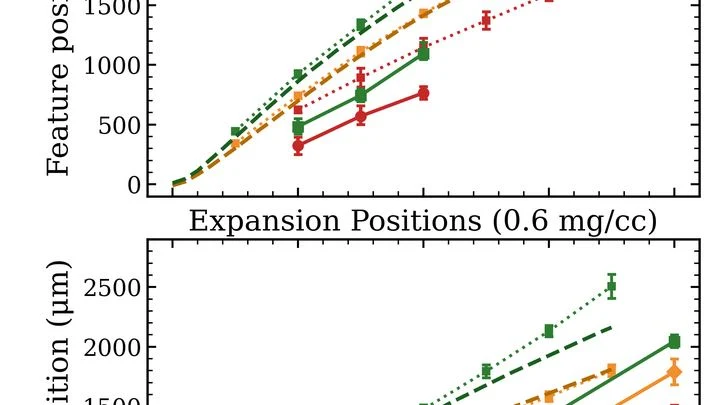
A copper plate the size of a coin vaporizes under the laser's strike in billionths of a second. The hot copper cloud slams into cold helium like a jet of steam into frosty air. The images show a distinct bubble with thin filaments at the edges — the plasma doesn't expand uniformly but breaks into fibers as thin as a human hair.
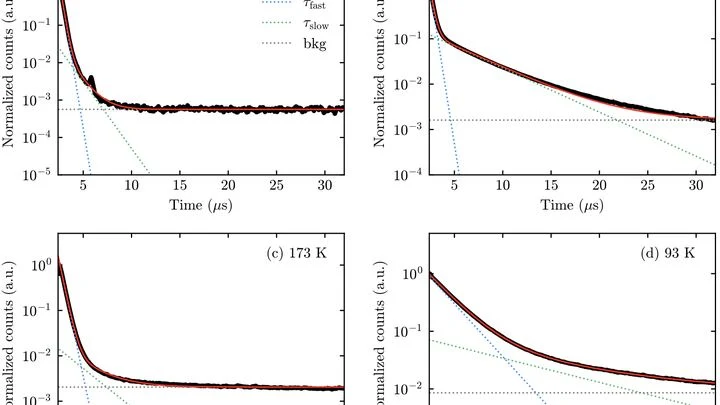
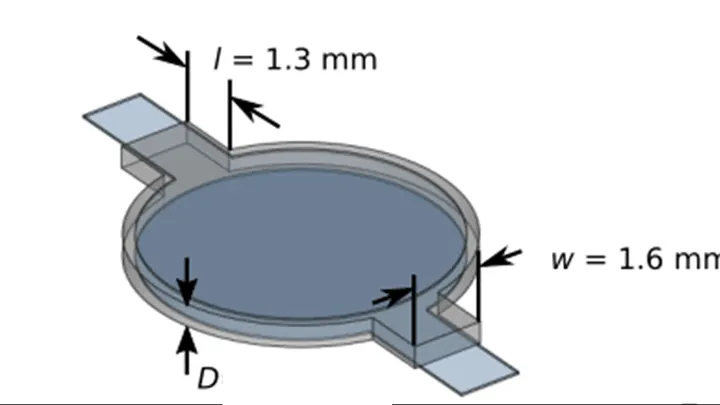
A sodium iodide crystal doped with thallium is like photographic film for invisible particles. When a gamma ray or a hypothetical dark matter particle hits it, it flashes with faint light. Two silicon photomultipliers pressed against the crystal's ends catch the flash from both sides.
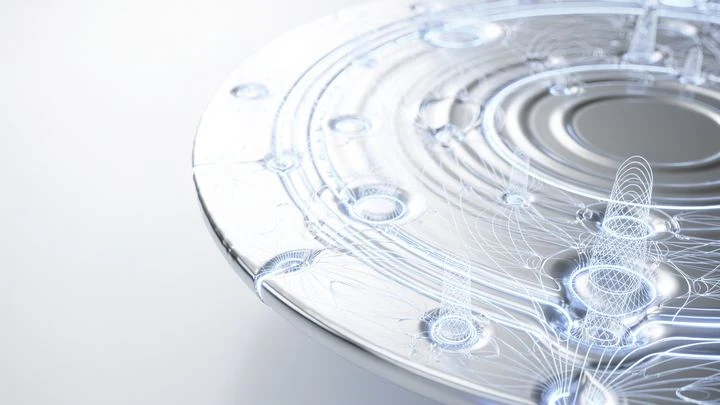
A bridge where pedestrians and cyclists flow together without getting in each other's way. That's roughly how hybrid systems of superconductors and semiconductors work: the former carry current without loss, the latter control that current.
The five-hundred-meter FAST radio telescope picked up a signal at the 21-centimeter wavelength — the telltale glow of cold hydrogen. The signal came from a cloud named Cloud-9. It hangs in space near the galaxy M94, but it contains not a single star.
The first three minutes after the birth of the world are a cosmic kitchen where nature cooked the lightest atomic nuclei. The recipe is set by gravity: it controls the cooling rate of the hot 'broth' of particles. If gravity worked differently than we are used to, the dish would have turned out different — with different amounts of helium and deuterium.
In 2024, the team led by David Charbonneau pointed the Magellan telescope with the WINERED spectrograph at LHS 1140. During transit, high-resolution spectroscopy caught the absorption line of metastable helium at 10833 Å.
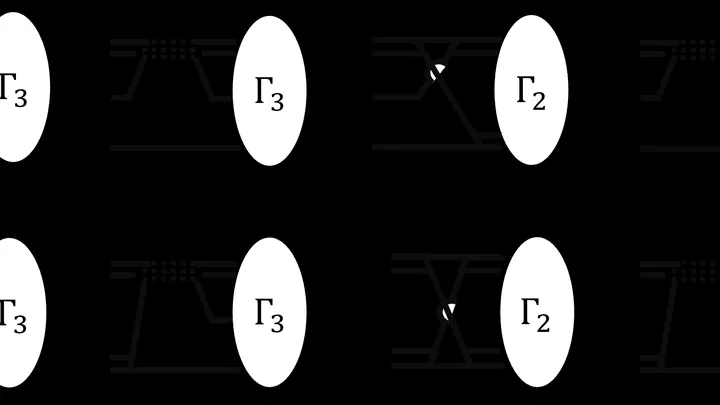
In the scorching core of a star, two helium nuclei approach each other like two dancers on a crowded stage. Their dance is alpha scattering, the basis of stellar helium burning. How smoothly they twirl determines how quickly the star burns its fuel.
Previously, this dance was described in simplified terms.
Imagine: superfluid helium-3 in a thin film receives a sudden heat shock. In that instant, a whole orchestra of collective oscillations awakens within it — like striking an invisible drum produces a multi-voiced chord. The Kibble–Zurek mechanism, familiar from the cracking of ice during rapid freezing, here acquires a quantum elegance.
In boiling water you can see a prototype of a quantum trick: if part of the liquid turns into long-lived vapor bubbles, the main mass cools down. This is exactly what happens when you sharply jolt a system of interacting electrons: doublons flare up — pairs of particles that absorb excess energy and don’t decay for an astonishingly long time.
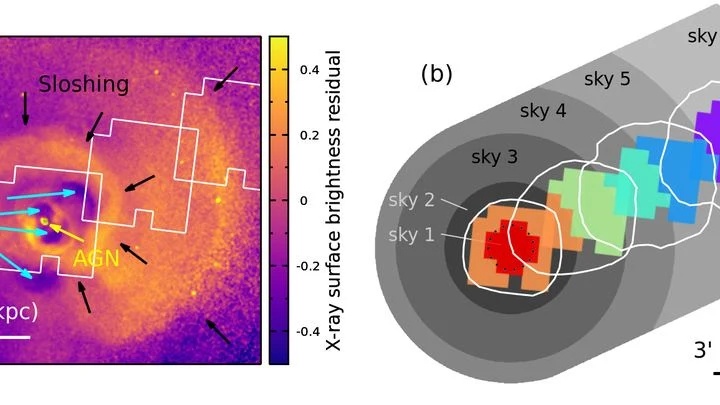
The Perseus galaxy cluster is a giant metropolis of thousands of star islands, bathed in an invisible ocean of scorching gas. Like urban smog, this gas preserves traces of all the chemical factories that have operated in galaxies for billions of years: supernova explosions that scatter freshly forged atoms across the surroundings.
Three floats on water bob chaotically. But three helium atoms cooled to near absolute zero behave differently, as if obeying an invisible law of similarity. Their mutual attraction is so weak that the atoms form a loose cloud.
In the crowded center of the galaxy, two stars orbit so close together that one strips the outer layers off the other, like wind blowing off a coat. What remains is a hot helium core, a star without a hydrogen envelope.
A match flares from both ends. First the head ignites, and a moment later the flame engulfs the wooden stick. Something similar may happen in some Type Ia supernovae — except the match is a white dwarf (a star the size of Earth), and the flame is a thermonuclear explosion.
In superfluid helium, friction disappears — the liquid flows like a mountain stream, but without a single eddy. A short laser pulse rippled this smooth surface, and scientists using spectroscopy captured the spreading ripples — quantum waves with many speeds.
A pot of water on the stove: the hotter the burner, the faster ice turns to water, and water to steam. Heat destroys order. But sometimes nature pulls a trick, and heating makes a liquid freeze, like a puddle turning to ice on a frosty morning.
Light from a distant star seeps through a planet's gaseous envelope, and astronomers try to guess what that envelope is made of. That's how we study the atmospheres of worlds we can never touch. When a planet passes in front of its sun's disk, its gaseous veil briefly intercepts some of the rays.
A detector filled with superfluid helium-4 is like a perfectly still lake. The liquid doesn't slosh or bubble: it's frozen in a single quantum state. An invisible guest, a dark matter particle, flies through it. It doesn't shine or leave a track. But sometimes it nudges a helium nucleus.
An alpha particle is a helium nucleus that flies out when heavy atoms decay. When it hits a gallium nitride crystal, it deposits its energy and creates an electrical pulse. The pulse height tells you how much energy the particle had.
When a hair-thin electrode is implanted into the brain, the body treats it like a splinter. A scar of glial cells grows around it — a dense insulating sheath that muffles the signal like a wet rag dampens a guitar string. The electrode stops hearing neurons.
In superfluid helium, a vortex is like a tornado in a bottle, but instead of water, it's a quantum liquid that flows without friction. Such a vortex doesn't dissipate on its own, so the question of where its energy goes has long remained open.
In a dark room, a flashlight only illuminates what falls within its beam. That's roughly how physicists study atoms: a short flash of light knocks out electrons, and by tracking their paths, you can figure out how the atom is built. But helium has states that don't fall into the ordinary 'beam'—they hide in the shadows.
A frictionless liquid that flows forever: that's superfluidity. Helium-3 only achieves it at thousandths of a degree above absolute zero. The theory of this state was developed by Lev Landau and Richard Feynman.
The helium-5 nucleus is like an overtightened string: touch it, and it falls apart into helium-4 and a neutron. Catching such a decay and measuring its rate is no easy task. Standard calculation methods stumble over mathematical noise.
The researchers took a reliable approach to describing nuclear forces and added a clever trick — analytic continuation.
Niobium is a metal that, when cooled to a few degrees above absolute zero, conducts electricity without resistance. In labs, it is deposited as thin strips onto a substrate, like frosting on a cake. But during deposition, oxygen from the special mask seeps into the metal, and it spoils the superconducting properties.
400 million years after the Big Bang, the James Webb Space Telescope noticed a bright spot near the galaxy GN-z11 — like a distant lighthouse whose light pushed through the primordial darkness.
A beam of carbon ions strikes the tumor precisely, like a surgeon who can only see the skin. Inside the body, the beam stops, and exactly where used to be a mystery. Now, helium is mixed into the same beam: it passes through the body like an X-ray, and its trail shows where the carbon went.
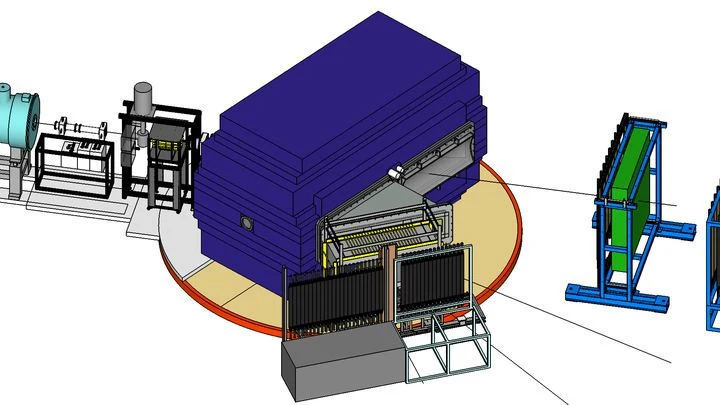
A high-speed collision knocked a neutron out of a helium-8 nucleus, and for an instant a helium-7 nucleus appeared, like an overloaded shelf shedding three books at once. This fleeting 'sound' of decay was captured for the first time: three neutrons flew apart, leaving behind an ordinary helium-4 nucleus.
Ordinary soldering doesn't work for quantum circuits: when cooled to liquid helium temperatures, metal cracks, and the contacts themselves introduce noise. Engineers from the research group tried something different — a drop of gallium alloy that stays liquid at room temperature, like mercury in an old thermometer.
A liquid that flows without friction is superfluid helium-4, a strange state of matter at temperatures below two kelvins. In a large volume, the transition to superfluidity occurs at the lambda-point temperature, but in narrow channels everything changes.
Silicon is like a universal building block: it goes into the chips in your phone, solar panels, and lasers. But if you squeeze it with immense force, the atoms rearrange into new patterns: these forms are called allotropes. One of them, Si-XIII, was first spotted more than twenty years ago, but its exact pattern remained a mystery.
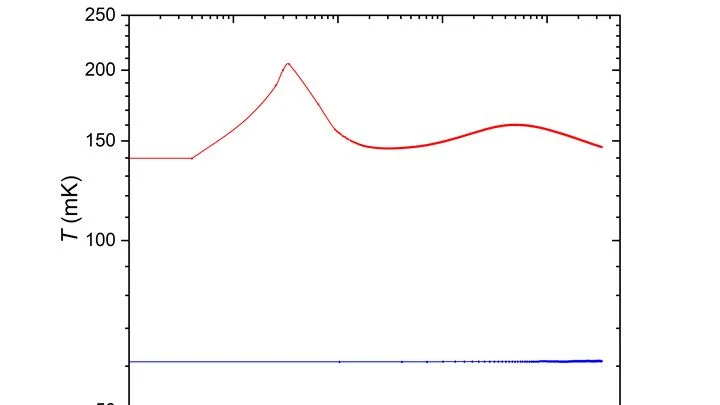
At 0.1 K, just three-tenths of a degree above absolute zero, matter stops following the usual rules. Helium becomes superfluid: it flows without friction, seeps through cracks, and behaves like one giant quantum liquid. Seeing what happens inside such cold is a challenge at the edge of possibility.
When a star like the Sun runs out of hydrogen, it swells into a red giant, and helium piles up in its core. At some point, the helium ignites — in a few seconds, it releases as much energy as the star had radiated over thousands of years. This is a helium flash.
Radio telescopes are like ears listening to space. Usually, there's just one ear: it picks up a signal from a single tiny spot in the sky. That's slow. The Parkes telescope in Australia now has 72 ears working at once.