The Number Carousel: Spinning Without Trial and Error ✛ ✎
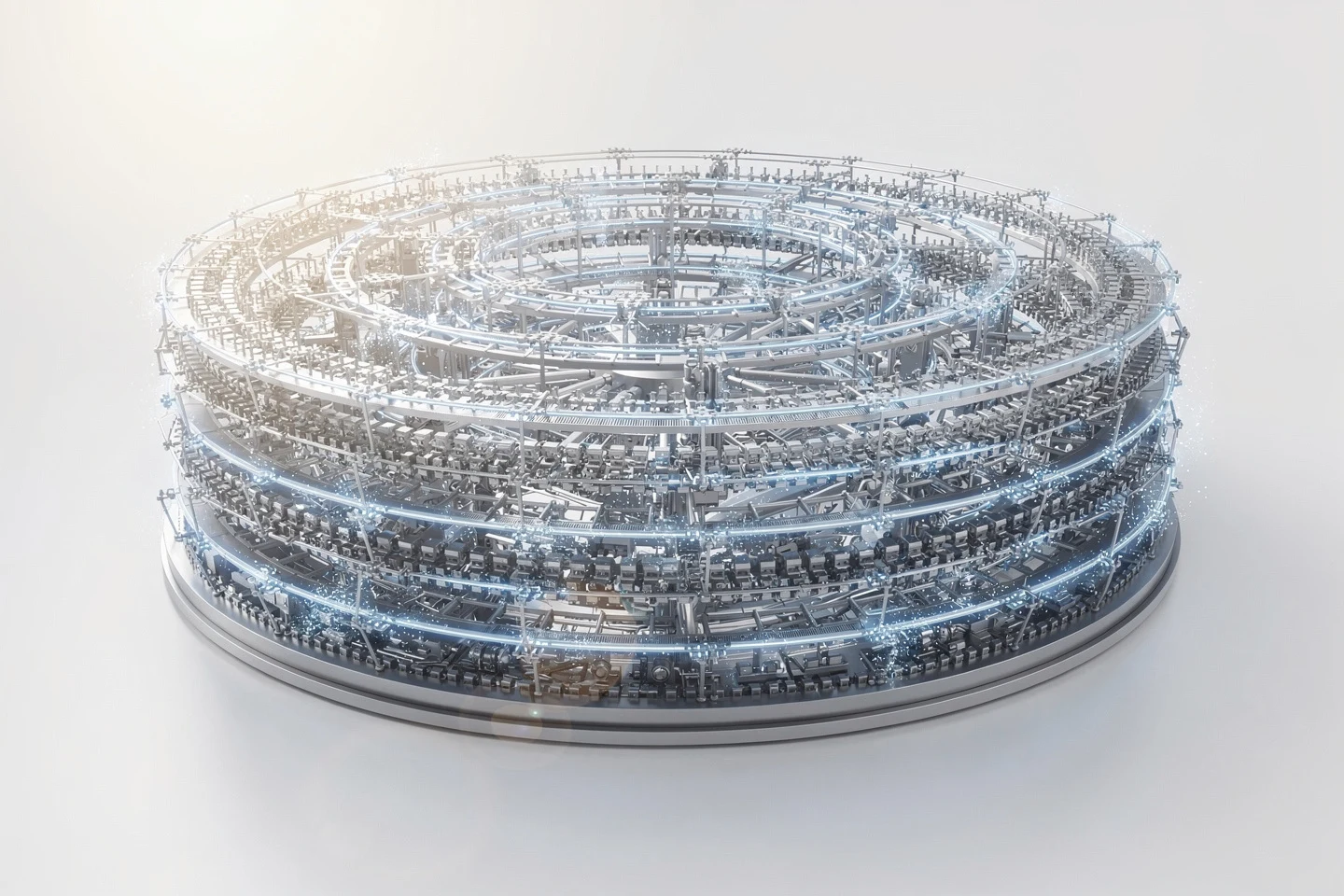
Mathematical fields can be not only infinite, like the ordinary numbers, but also finite — with a limited set of elements. Such a system can be compared to a carousel. When we raise an element to the power q, all elements shift in a circle: each one moves to the next seat, and the last one jumps to the first. This smooth rotation was discovered by Carl Friedrich Gauss, and Joseph Fourier later showed how similar ideas work in the analysis of oscillations. This motion is called the Fourier analysis.
To keep the carousel spinning without a hitch, you need the right starting order — a numerical simulation. It used to be chosen manually or at random, like searching for a winning ticket among a million. The new method works differently: it doesn't search blindly, but instantly computes all invalid t values. The family of candidates $β_t$ = (θ − t)⁻¹ is almost entirely suitable, with only a few duds — at most n(n−1) of them. To weed out the duds, it's enough to compute the Spectral Analysis once — a special polynomial whose roots point to the defective cases.
Such an approach is optimization, with no randomness at all. It guarantees the carousel will start perfectly. Along the way, the computation of signal processing improves, which comes in handy in Graphs and coding. As a result, information theory gets reliable keys, and complex computations become reproducible. The number carousel finally spins without a glitch.
For a field with 100 elements, the number of unsuitable t is at most 10 thousand. For modern computers, that's a breeze. But the method's main advantage isn't brute-force speed — it's the elegant transformation of a geometric problem into an algebraic one: the dud tickets are found as the roots of a single polynomial.