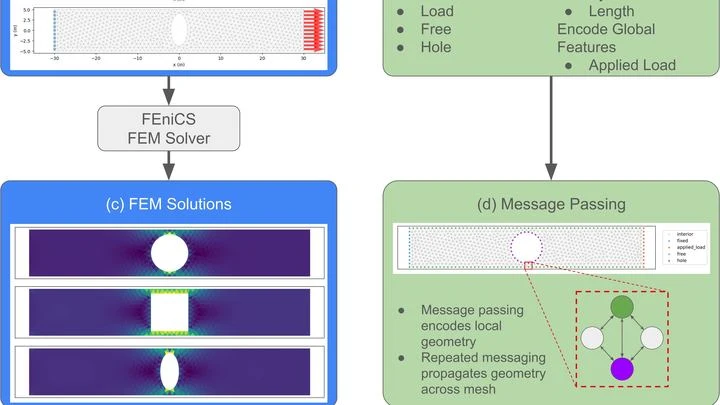
The finite element method is a mathematical strategy for approximate solution of differential equations on complex domains. The continuous problem is replaced by a discrete one: the domain is divided into simple subdomains (elements — triangles or tetrahedra), and the solution is approximated by piecewise polynomial functions. Engineers love it for its ability to handle irregular geometry and various materials. From car crash tests to blood flow in arteries — FEM turns elegant differential equations into computations that yield clear, useful results.
History
Early ideas date back to the 1940s: A. Hrennikoff used lattice analogies, and R. Courant used piecewise polynomials. The term 'finite element' was introduced by R. W. Clough in 1960. Rapid development took place at aerospace centers like Boeing and the University of California, Berkeley. The mathematical foundation (connection with Sobolev spaces, convergence proofs) was laid in the 1970s by Babuška, Brezzi, and others.
How it works
FEM transforms a differential equation (e.g., from elasticity theory) into a weak form by multiplying by test functions and integrating. The domain is covered with a mesh, and the unknown field is approximated by a sum of shape functions on each element. Substitution into the weak form yields the system Ku = f, where K is the stiffness matrix (sparse, symmetric, positive definite in many problems). Boundary conditions are applied, and the system is solved iteratively or directly. Post-processing computes deformations, stresses, fluxes. Adaptive mesh refinement improves accuracy where gradients are large.
In practice
Without it, the design of safe airplanes, skyscrapers, and medical implants is impossible: virtual tests for strength, heat, and vibration weed out weak spots before production.
Fun fact
The largest FEM simulation of Earth's mantle convection uses a mesh of more than a billion elements and runs for months on supercomputers, helping to understand the movement of tectonic plates.
If you pour honey into a colander with a hundred small holes, it will drip in thin streams, but each stream will swirl around the edge of the hole. Engineers need to understand such swirls: they affect how quickly water filters, how oil comes out of a reservoir, or how a drug seeps through tissues.
A laser beam can do more than heat things up: it can also calm motion. When light enters a mirror trap, it exerts pressure on the mirrors, and if you tune the beam's color just right, that pressure becomes a gentle braking force. This is how tiny mechanical vibrations are cooled to nearly absolute zero.
Cut a spin chain, and particles without an energy gap appear at the edges. They are called zero modes, and they live only at the boundary. Previously, they were counted using complex topological invariants, but now there is a simpler way.
Every atom in a magnet is like a tiny compass needle. These needles can point in different directions, and their collective dance determines the material's properties. But calculating this dance directly, atom by atom, is a task too heavy even for supercomputers.
The new model, named STEP, takes on the role of a conductor.
Many natural processes are described by differential equations, but scientists often have only fragmentary data — a sort of torn map. The new computational method works like a cartographer who reconstructs a complete map of the terrain from a few landmarks.
In fast-moving vehicles, mobile internet slows down: the signal, traveling at the speed of light, blurs like the scenery outside the window. Engineers have found a way to pack data more densely without letting them mix up. It's like a multi-lane highway where packet-cars drive not with a safe interval, but almost bumper-to-bumper.
Apply power, and the Frobenius carousel springs to life: each element of the finite field morphs into its q-th descendant, while the coordinates slide around the ring.
The number −0.000459 is no random guest in the Blasius equation. It's the coefficient of η⁵, defining the boundary layer on a flat plate — a thin whisper of air friction against metal. Standard numerical methods like Runge–Kutta yield only an approximate curve. Physics-informed neural networks (PINNs) try to guess the entire solution. Often — unsuccessfully.
In the world of logic, there is a bridge. It spans the chasm between a rule's admissibility and its derivability from axioms. As long as rules involve only a finite number of premises, the bridge holds firm — for classical logic, anything that doesn't violate truth is already contained in the syntax. But add infinite premises, and the supports start to tremble. The bridge, alas, is not all-powerful.
A network of tiny magnets seeks the state with the lowest total energy: that's roughly what the quantum Max Cut problem looks like, one of the toughest in physics. Scientists have been hunting for its solution since the days of Werner Heisenberg.
Many cutting-edge physics calculations hit a brick wall — not for lack of ideas, but because of arithmetic. We're talking about integrals that express particle collision probabilities or the shape of gravitational wave bursts.
Designing machines is like cooking: you need to know exactly where the 'dough' will tear. Old computer simulations check every point on a part for hours, like measuring the entire pot to make sure the handle doesn't fall off.
An engineer building a bridge cannot strengthen one beam without affecting the load on adjacent ones. Drug development works similarly: a molecule must fit snugly into the 'pocket' of a target protein, like a key in a lock, while also being safe, stable, and convenient to administer.
Imagine a factory where hundreds of tiny assembly lines run nonstop. Each line is a molecular motor that converts chemical fuel into motion. To make the motor go faster or in the right direction, an engineer tweaks the settings — the shape of parts, the strength of interactions.
Any light measurement runs into a fundamental limit: photons hit the camera sensor unevenly. This natural ripple (shot noise) blurs fine details, like trying to pick out a quiet instrument in an orchestra through the noise of the hall.
You taste a fruit smoothie through two different straws. One lets through only the big chunks, the other only the liquid. Individually, the sensations are misleading, but together they give you the key: here, it seems, is banana, and here, strawberry.
Quantum annealing works like a smart way to find a path through a maze: instead of checking every dead end, it uses quantum effects to find the exit faster. But this maze has a quirk: the numbers that describe the walls and corridors must be roughly the same size.
Creating a new material, like a tough alloy, requires thousands of computer experiments. Usually, a scientist manually writes instructions and hunts for errors. AutoMOOSE is a robotic kitchen: say 'I want a light and strong metal,' and five software chefs whip up a recipe, launch the synthesis, and adjust if something goes wrong.
Alzheimer's disease begins quietly: deep in the brain, two proteins, tau and amyloid-beta, start to accumulate. They behave like weed seeds: one clump that appears causes neighboring cells to produce similar clumps. Gradually, the proteins spread along nerve fibers, like water through the capillaries of a paper towel, and invade new areas.
Light can be more than just a stream of particles; it can be a wave with a specific shape over time. Sometimes this shape changes so rapidly that capturing it is like photographing a bullet in flight. Scientists have devised a way to measure such fleeting quantum states of light.
For this, they use a device called a balanced homodyne detector.
Inside a battery, like a layered cake, different solid layers sit side by side. The meeting point, the interface, behaves capriciously: stresses concentrate there, and over time the battery ages. To understand these processes, we need computer models that see every atom. But accurate calculations are too expensive, and fast ones are too crude.
Inside a tiny accelerometer, gas behaves nothing like the air in a room. There are so few molecules that they rarely collide with one another, and the familiar laws of viscosity and thermal conductivity stop working.
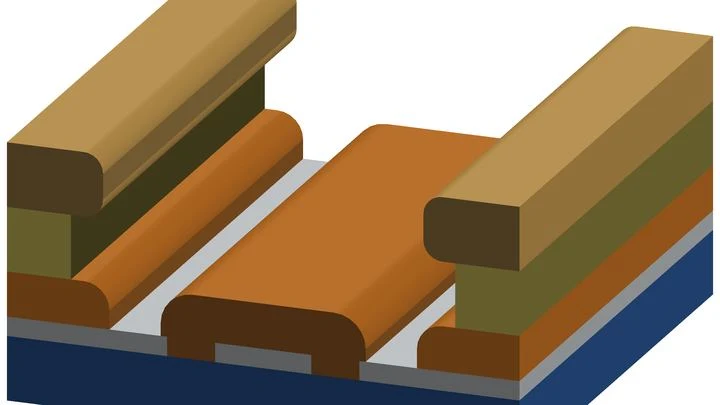
In microchips, wires usually lie flat on the surface, like rails on the ground. But sometimes one wire needs to leap over another without touching it. For that, engineers build air bridges — thin metal arches suspended above the chip.
Previously, such a bridge was assembled in several stages: deposit a layer, expose it, etch it, repeat. Each stage is a chance to mess something up.
Inside a tokamak, a giant magnetic donut, plasma is heated to hundreds of millions of degrees. It doesn't touch the walls; it floats in a vacuum, held by invisible magnetic fields. But plasma is finicky: a slight change in current or pressure and its shape starts to wobble like jelly on a plate.
Drug design is like picking a lock: the drug molecule must fit precisely into the target protein. But the lock is submerged in water, and the fluid’s friction alters the fit. Classical calculations account for this by modeling the key dissolving into the solvent for hours per attempt.
An optician turns the frame, adjusts the focus, and a blurry spot becomes a sharp image. The new algorithm GOAL works much the same way: it rotates the data cloud, compresses redundant dimensions, and brings into focus what truly matters.
A wave travels westward, reflects off the coast, and returns six months later to alter temperatures along the eastern Pacific. This journey of Rossby and Kelvin waves Mori-Zwanzig formalism turns into an equation with memory. Previously, climatologists added delays to El Niño models by intuition, relying on physical insight.