Quantum Bridge Between Nodes
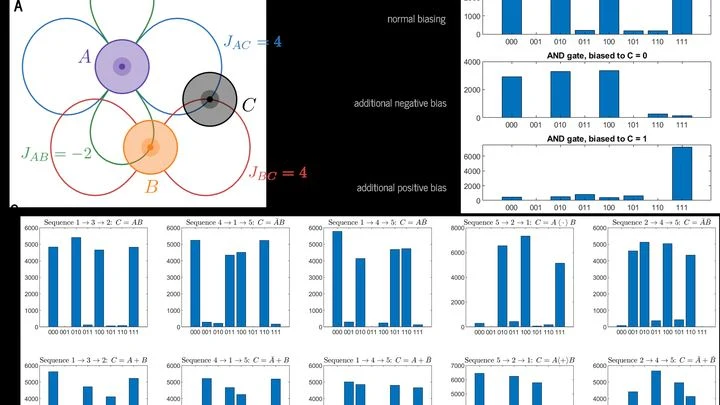
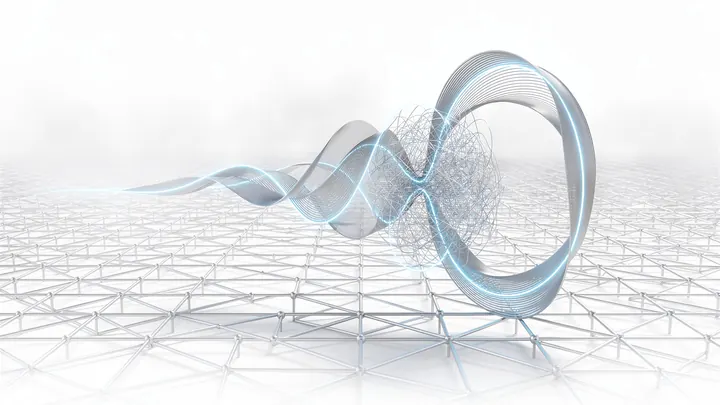
An ordinary random network is like a road map: to connect four cities with a complex interchange, you need to lay down many highways. In the quantum world, things are different.
The lack of pattern or predictability in events, essential for secure cryptographic applications.Randomness, in the context of physics and information theory, refers to the absence of predictable patterns in a sequence of events or data. True randomness is a fundamental property of quantum mechanics, where measurement outcomes are inherently probabilistic, unlike classical deterministic processes. This intrinsic randomness is a valuable resource for cryptography, as it ensures that encryption keys cannot be predicted by an adversary. Quantum random number generators (QRNGs) exploit this property to produce bits that are provably unpredictable, offering a higher level of security than classical pseudo-random number generators.
The concept of quantum randomness was formalized in the 1920s with the development of quantum mechanics, particularly through the Copenhagen interpretation. The first practical quantum random number generator was demonstrated in the late 1990s, and the field has since grown with advances in photonics and integrated circuits.
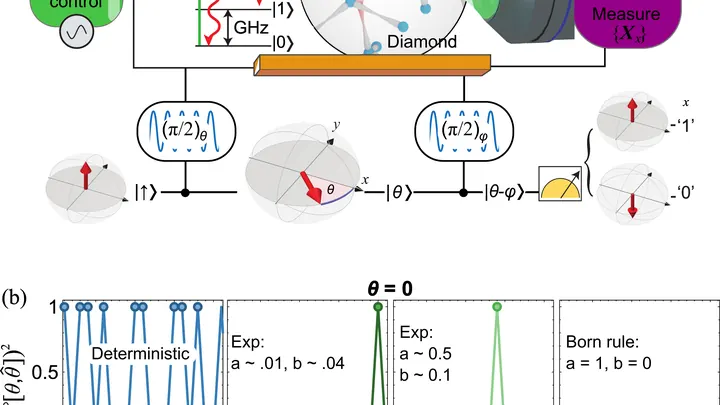
Quantum randomness arises from the collapse of the wavefunction upon measurement. For example, a photon impinging on a beam splitter has a 50% chance of being transmitted or reflected; each outcome is fundamentally random and cannot be predicted, even with perfect knowledge of the initial state. A QRNG typically uses such a process, converting the detection of photons into a stream of bits. To ensure the output is truly random, the raw data is often processed through a randomness extractor, which removes any biases or correlations introduced by the measurement apparatus.
Quantum random number generators are used in secure communications, cryptographic key distribution, and in scientific simulations that require high-quality randomness, such as Monte Carlo methods.
The randomness of quantum measurements is so fundamental that it has been proposed as a test of the 'free will' of particles, and it underpins the security of quantum key distribution, where any attempt to eavesdrop inevitably introduces detectable disturbances.