Smoldering Giant: Methane and Haze over a Dead Star
Original: "Aerosols and hydrocarbons in the atmosphere of a white dwarf planet"
JWST's spectrum revealed for the first time that a planet surviving a star's death breathes methane, is blanketed in aerosols, and glows with its own heat.
Links in the knowledge graph 1
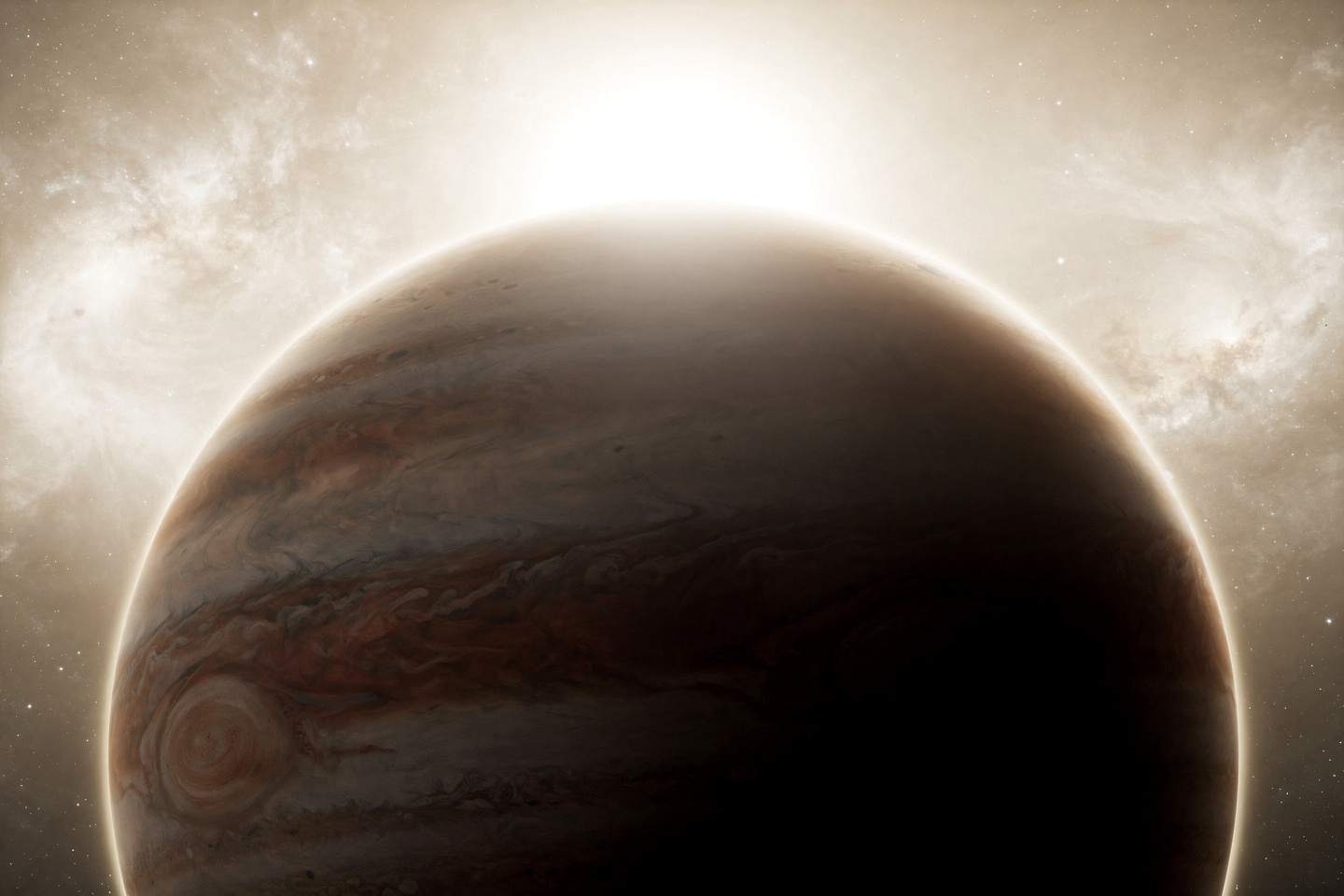
Amid the stellar ashes where suns die, a smoldering giant spins. WD 1856 b — a planet that survived the hell of a red giant — now glows with its own infrared light. Its atmosphere is saturated with methane, like smoke from a dying campfire. The discovery proves that even after a star's death, the life of planetary systems continues. Peering into this world's spectrum, we read for the first time the chemical chronicle of cosmic survival. Soon, more such beacons will appear — and the finale of stellar evolution will cease to be a mystery.
🎯 Despite the planet's equilibrium temperature being only 160 K, its nightside radiates like a body heated to 400 K. This internal heat is an echo of its turbulent migration.
T_{\rm eff} = \left( \frac{1}{\sigma_{\rm SB}} \int F_{\rm p,surf,\lambda} \, d\lambda \right)^{1/4}
Temperature of a blackbody emitting the same total power per unit surface area.
\Delta_\lambda = \frac{A_{\rm p}^{(\rm top)} - \int_{A_{\rm p}} T_\lambda \, dA}{\pi R_*^2} \times \left( \frac{1}{1 + \frac{R_{\rm p,(night),\lambda}^2}{R_*^2} \frac{F_{\rm p (night),surf,\lambda}}{F_{*,\rm surf,\lambda}}} \right)
Transmission coefficient corrected for nightside photons that dilute the star's signal.