How to Grow an Unstable Pattern express
A gardener wants to grow a rare flower. Watering and fertilizing can't be done haphazardly; it must follow a strict schedule: a bit more warmth in the morning, a bit less moisture in the evening. Otherwise, the bed will be overrun by common weeds. Molecules on a metal surface behave in much the same way.
When organic molecules settle on a metal, they assemble into patterns, like pieces of a mosaic. One pattern might conduct electricity better, another worse. But the most coveted pattern often turns out to be unstable: give the system freedom, and it will rearrange into a simpler, "weedy" structure. Catching the right moment and locking in the fragile pattern is a problem with many unknowns.
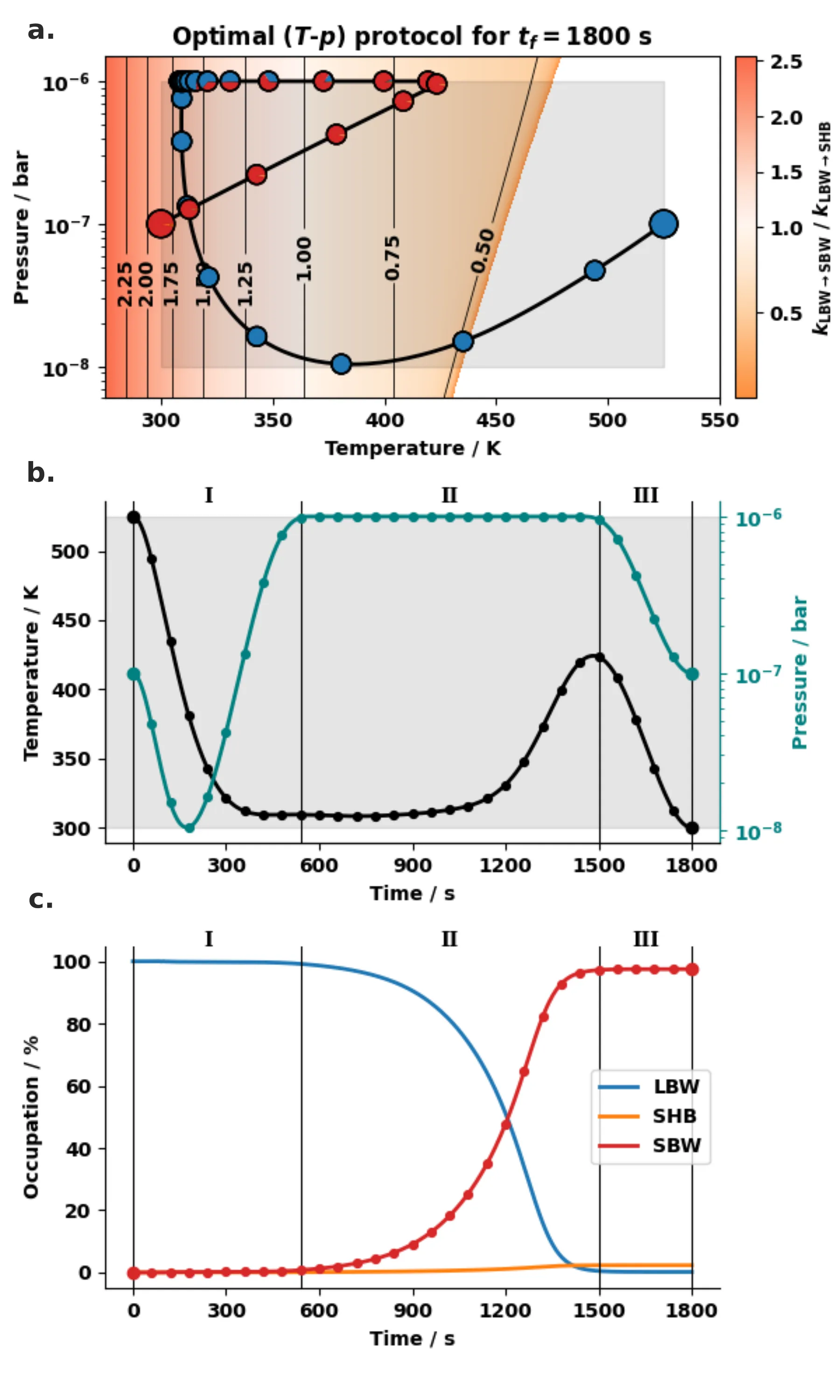
The calculations showed that if you change the conditions not in steps but smoothly, along a clever trajectory, you can dodge the traps and push the yield of the desired pattern to 97%. Manual tuning of a three-step protocol gave only 73%. The difference is like that between craftsmanship and an assembly line.
This approach is not tied to specific substances. It resembles a universal remote control for crystal growth — from sensors to solar cells. The gardener gets not just a watering can but a precise watering schedule for each rare flower.
Original abstract
as written by the authors arXiv:2607.03371
The reliable growth of a desired target structure remains a central challenge for organic-inorganic interfaces. Specific interface structures can exhibit properties that are superior compared to those of other possible interface structures, but identifying growth conditions that selectively produce a given surface structure is difficult, particularly when the target structure is thermodynamically metastable. Here, we demonstrate how time-dependent temperature and pressure protocols can be optimized to promote the high-yield formation of a metastable surface polymorph. To this end, we combine kinetic Monte Carlo simulations with a parameterized nucleation-and-growth model and apply optimal control theory to predict growth recipes that maximize the yield of the desired target structure. Applying this approach to a prototypical model of an organic molecules adsorbed on a metal surface, we identify experimentally plausible protocols that guide the system through phase space while avoiding kinetic growth regimes in which formation of the thermodynamically stable structure is favored. Compared to a manually optimized three-step protocol, the optimized control trajectory increases the yield of the desired metastable phase from 73 % to 97 % for the same total protocol duration.
The 24% difference between manual and automatic optimization is comparable to a situation where out of every hundred parts, only 3 are defective instead of 27—almost perfect production.