Pattern formation is the study of how ordered spatial structures emerge spontaneously from natural processes. Examples include the hexagonal patterns of frost heaving in soil, the stripes of a zebra, the ripples of sand dunes, and the spots on a leopard. In physics and chemistry, pattern formation often arises from the interaction of diffusion and nonlinear reactions, as described by the Turing mechanism. It explains how simple local rules can produce complex global order without a blueprint.
History
Alan Turing laid the foundation in 1952 with his paper on the chemical basis of morphogenesis, proposing that diffusion could destabilize a uniform state and produce patterns. Earlier, the Russian scientist Boris Belousov discovered a chemical reaction in the 1950s that spontaneously oscillates and forms waves, now known as the Belousov–Zhabotinsky reaction.
How it works
Patterns typically emerge when a system is driven away from equilibrium, allowing small fluctuations to grow and stabilize into regular structures. In reaction-diffusion systems, an activator that promotes a pattern and an inhibitor that suppresses it can produce standing waves of concentration, leading to stripes or spots. In physical systems like freezing water, the release of latent heat and the movement of water through pores create regular ice lenses that push soil into patterned ridges. The key is the balance between stabilizing and destabilizing feedback loops.
In practice
Pattern formation principles are used in materials science to create microstructured surfaces, in biology to understand embryonic development, and in ecology to predict vegetation patterns in arid regions.
Fun fact
The same mathematical model that explains zebra stripes also describes the formation of sand ripples under water, showing that pattern formation is a universal phenomenon across very different systems.
Plasma is a gas in which electrons are stripped from atoms and roam freely. Sometimes, regions where electrons are almost absent spontaneously appear in such a gas; they are called holes. It is like a whirlpool forming in a stream, pulling everything around it in. But exactly how such a whirlpool is born has long remained a mystery.
A protein chain folds into a working tool in a fraction of a second, and almost never makes a mistake. For a long time, it was thought that evolution specifically polishes amino acid sequences so that a protein not only works but also easily finds its unique shape. New work turns this idea on its head.
A tuning fork struck once rings pure and long. But if you shake the fork itself while it sounds, the tone wavers and dies out quickly. Something similar happens to electrons in any piece of matter. Atoms in a lattice never stay put: thermal vibrations keep them jittering.
A desert where every step reshapes the terrain. Dunes settle, new slopes emerge, and the next step is dictated by what you've just trampled. That's roughly how "sandscapes" work — a mathematical model inspired by living systems.
Forget the flat sheet: embryonic tissue is a dynamic landscape of hills and folds. On convexities, cells stretch; in concavities, they compress, as if performing a dance governed by laws eerily similar to spacetime curvature.
In a world striving for chaos, rhythm sometimes arises. The Belousov–Zhabotinsky reaction has amazed for decades: in a test tube, color waves run on their own, as if a living organism breathing matter. Something similar lurks in crystals where iron atoms balance between two magnetic states — high-spin and low-spin.
If you scatter seeds haphazardly, the seedlings will tangle into chaos. But if you lay them out in neat rows, the field will grow in an orderly fashion. A similar principle works with bacteria. Colonies of elongated cells usually churn with disordered flows, but scientists have found a way to impose order from the very start.
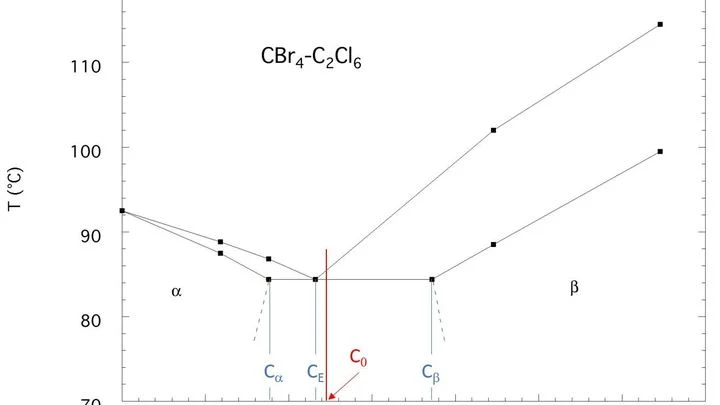
In a solid piece of tin-lead alloy, the layers of the two metals lie like pages in a book. When heated from one side, the layers don't melt uniformly but in whimsical tongues and fingers. Scientists studied this process using a transparent alloy that can be seen through under a microscope and compared it with a computer model.
A piece of dough, when pulled from the sides, doesn't stretch evenly: in one spot it thins and tears. Living tissue behaves similarly, but instead of a tear, shear bands appear — narrow zones where cells begin to slide past each other, like cards in a deck when cut.
Cells on the surface of an embryo resemble grains of rice that can align in one direction. This order is called nematic. It arises when cells start acting in concert, like a school of fish swimming in the same direction.
In the northern part of Arabia Terra, there are fields that look like a giant brain: ridges and troughs wind like convolutions. On Earth, similar patterns form in cold regions when water in the soil freezes and thaws, causing stones to sort themselves into stripes. But the Martian ridges are taller — averaging 3.29 meters — while Earth's mechanisms produce less than half a meter.