Control theory is the mathematics of maintaining order. It explains how to make a system do what you want despite wind, friction, and other whims of the real world. An engineer designs an algorithm (a controller) that continuously reads sensor data and doses commands to actuators to drive the difference between desired and actual values to zero.
History
The roots of the theory go back to Watt's governor (1788). James Clerk Maxwell laid the mathematical foundation in his paper 'On Governors' (1868), where he first analyzed the stability of a feedback system. In 1892, Russian-born Aleksandr Lyapunov introduced a rigorous definition of stability. The mid-twentieth century saw a flourishing of the field with contributions from Harry Nyquist, Hendrik Bode, Rudolf Kalman (for filtering and control problems), and Lev Semyonovich Pontryagin (the maximum principle). Today, control methods permeate aerospace, robotics, economics, and biology.
How it works
The basic feedback loop: a sensor measures the current value y(t), a summing junction computes the error e(t) = r(t) – y(t) (where r(t) is the setpoint), and the controller produces a control input u(t) based on the error. The system's response is described by dynamical equations. For example, in a PID controller, u(t) = K_p e + K_i ∫ e dt + K_d de/dt. The proportional term responds to the current error, the integral term eliminates steady-state error, and the derivative term anticipates future deviations. For complex multivariable systems, the state equation is used: dx/dt = A x + B u, y = C x + D u, and controller synthesis often reduces to solving algebraic Riccati equations.
In practice
Aircraft autopilots, household temperature control, camera stabilization systems in smartphones.
Fun fact
The Hubble Space Telescope locks onto a star using three gyroscopes and six fine guidance sensors. Its control system holds the image steady with an accuracy equivalent to keeping a laser beam on a coin in New York from the distance of Los Angeles.
In a rubber band stretched in the lab, three different elasticity mechanisms operate simultaneously. At small strains, Hooke's law prevails; at intermediate strains, entropic chain elasticity; at large strains, strain-induced crystallization.
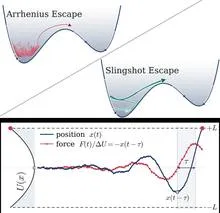
A particle sits in an energy pit like a pea in a dimple. To get out, it needs to go over the barrier, and usually this is rare: the higher the barrier, the longer the wait. The Arrhenius law says the waiting time grows exponentially, meaning doubling the barrier height increases the time by hundreds of times.
In an ultracold cloud of atoms cooled to near absolute zero, regions with different spin orientations emerge, like patches with different magnetization. The boundaries between them are called domain walls. Usually they are stationary, but in this experiment the walls started moving on their own.
A kitchen mixer runs at a single speed, but start jabbing the button and the mixture whips up differently. Chemical reactions behave much the same way when the rates of their individual steps are not constant but pulse over time.
You're standing in the shower: you turn the tap, and the water is either freezing or scalding. The pipes have a mind of their own — the pressure jumps unpredictably. The new controller learns on the go: it doesn't know the plumbing layout, but within minutes it adapts and gently guides the temperature to comfort, without breaching safety limits.
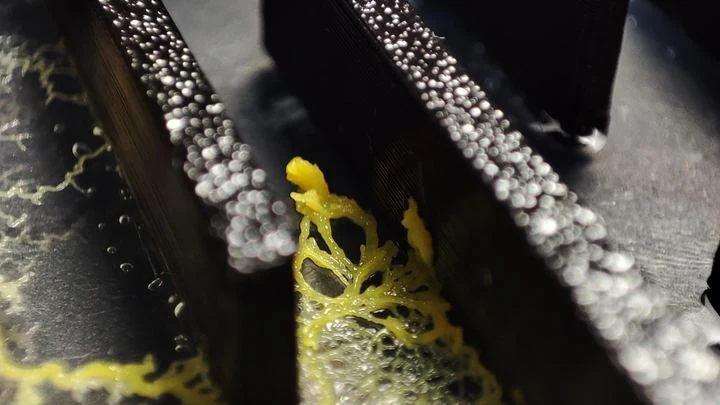
When a pipe bursts in the basement, a plumber acts step by step: locates the leak, measures the pressure, determines the cause, patches it up, and checks if it's dry. The same recipe — the standard model DMAIC — is being proposed against epidemics.
First, they determine the scope — how many hospital beds are occupied, which industries are sagging.
A search party combs a foggy field. At first, people spread out wide: a high 'temperature' of search means a great variety of attempts. Upon finding a trace, they close in. But the speed of convergence is critical — narrow the circle too early, and the best find stays aside. The coordinator assesses the spread of searchers and commands when to speed up or slow down.
A stable system behaves like a ball in a bowl: give it a push, and it rolls back to the bottom. The spread of possible trajectories, uncertainty, shrinks over time. But the speed depends on the slope of the bowl's walls. In complex systems, this 'bowl' has sections of varying steepness.
A typical tracking program resembles a navigator steering a ship by the stars. But as soon as the sky clouds over, coordinates drift, and entropy (a measure of uncertainty) builds up in the data. The new algorithm gets a ‘co‑pilot’ — a module that monitors how confident the main navigator is.
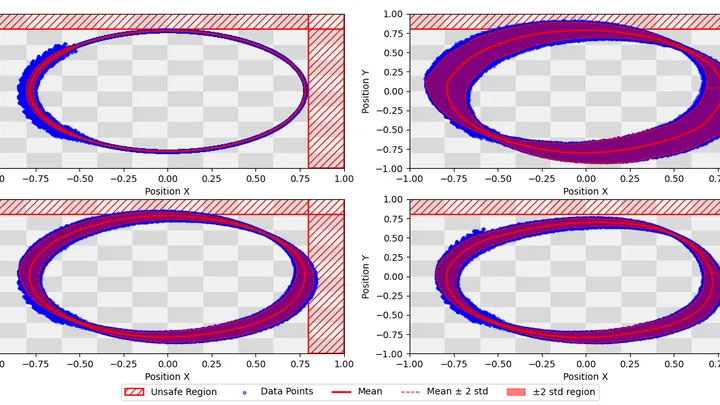
When an unmanned aerial vehicle learns from an experienced pilot, it memorizes not individual maneuvers but entire safe corridors — the trajectories along which the human mentor moved. This approach is called imitation learning: the machine mimics expert demonstrations.
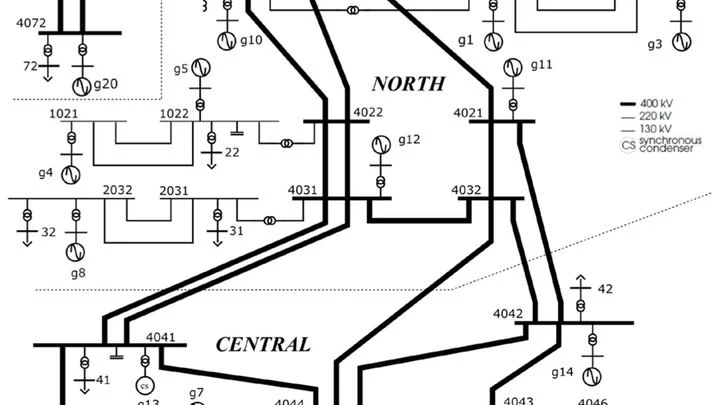
The power grid can be pictured as a water supply system: pipes are the lines, and pumps are the converters. When pressure (voltage) drops in some district, powerful pumps can send extra water (power) there. The trouble is, too strong a flow causes overload, and too weak a flow doesn't help. You need to know exactly how far to open the valve.
Engineers found the answer.
A person in a boat turns by shifting their body weight. An unmanned vessel uses the same trick: a sliding weight inside the hull does the steering. Its movement is controlled by a neural network, anticipating the chaos of waves and gusts of wind. The propeller pushes the boat forward, while the weight shifts balance — like moving from one foot to the other.
A driver on a slippery road doesn't know exactly how the car will respond to the steering wheel, and learns on the go, leaving room for error. A smart control algorithm behaves in a similar way.
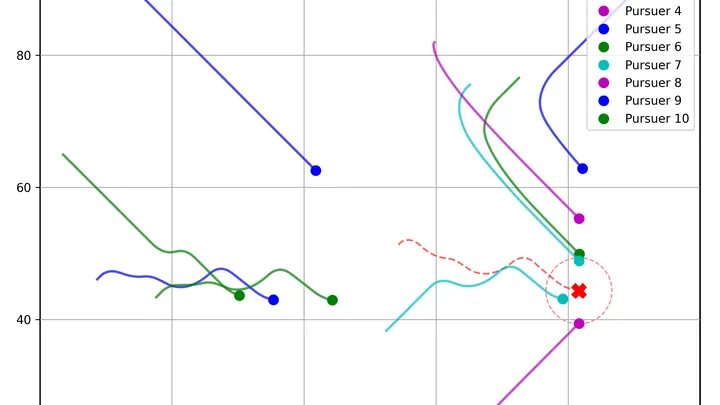
A wolf pack switches from chasing prey to defending its den in an instant. Engineers have instilled this same versatility into an algorithm for a robot swarm. The key is a method proposed by John von Neumann: instead of chasing the target, the robots calculate its future moves and block escape routes, like beaters cutting off trails.
The float in a toilet tank is an ideal controller: sensing the water level, it instantly brings the system into equilibrium without looking back at the past. Engineers applied this principle to neural networks.
Imagine a fleet of many ships, resembling a galaxy — a vast stellar system where every element follows the overall dynamics. From time to time, one ship breaks down, exploding like a supernova — a catastrophic event that can disrupt the integrity of the entire formation. If the damaged unit isn't replaced in time, the fleet loses combat capability.
Mathematicians confirmed: the ideal response to a pandemic is the 'hammer and dance' strategy. First, a sharp lockdown smashes the wave of infections like a hammer blow. When hospitals empty, the dance begins — a cautious, step-by-step return to normal life.
Complex machinery, from drones to surgical robots, sometimes behaves like a wild mustang: full of disorder and whims, where the slightest touch triggers a storm. Instead of rote memorization of formulas, the new method observes the system like a horse breaker.
An experienced detective doesn't calculate a criminal's path using the laws of physics: he checks a file of similar cases. The new prediction method works the same way: instead of complex equations, it has a vast archive of trajectories that have already happened — planetary motions, currency exchange rates, signals from space.
Quantum devices are no longer lab curiosities. They are assembled, tuned, and repaired like ordinary hardware — except inside them, it's not just current but intricate tangles of particles that can exist in multiple states at once. Engineers draw schematics, programmers write code, physicists calculate effects.
Molecules float in a pot of broth. Some copy themselves, others help their neighbors, and still others just get in the way. This isn't soup: it's a model of early life: a replicator system. Usually, we assume the rules of the game are fixed once and for all: whoever reproduces fastest wins. But the authors of this study proposed something different — the rules can change too, just very slowly.
In embryonic development, a cell resembles a musician in a vast orchestra: it must play its part, following a conductor — the gradient of signaling molecules. But the conductor is unreliable: morphogen concentrations constantly fluctuate. How then does a cellist not veer into a violin melody?
A hundred agents, two thousand tasks, less than a hundred iterations, and the market for unloved chores settled into equilibrium all on its own. No one was directing things from the center; each participant only responded to the nearest signal. That’s how multiplicative tatonnement works — a mechanism like the synchronized dance of a flock without a leader.
Stuttgart, 2025. A software engineer plugs a laptop into a test car, not for diagnostics, but to replace the car's 'personality'—like flashing a smartphone's firmware. But instead of a quick update, he faces a cascade of incompatibilities. Each electronic control unit (ECU) speaks its own dialect, tied to a specific supplier's chip.
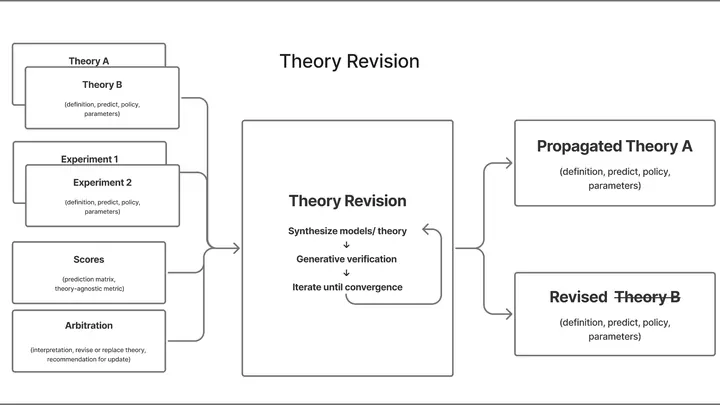
A closed loop: the machine proposes an idea, tests it on people, sees the failures, and spawns a new, more accurate guess. That's how AutoCog works — an automatic cognitive scientist. Previously, in the science of thinking (cognitive science), the hardest part, coming up with a theory, was done only by humans.
In the watery environment, vortices batter the mechanical fish. The AI agent, like an experimental chef, ran simulations, tried out 'recipes' of movements, and improved the program. Each experiment was like spectroscopy: the agent broke down behavior into elements, uncovering patterns. At first, the fish only paddled in one direction.
An orchestra plays without a conductor, and you hear the tempo speeding up and slowing down. All you have is a recording of the sound, not the score. Can you tell from that recording which string to pluck to make the whole orchestra play more steadily?
A supermarket cashier at rush hour doesn't memorize every scanned item: they keep the running total in their head and watch the queue. The brain allocates its resources similarly: the expensive, precise cortex (responsible for deliberation) and the simpler, economical subcortical nuclei (where habits live) work in tandem.
In a car, the steering, brakes, and accelerator gradually fail. At first, you can still swerve around a pothole, but each year the maneuver takes more effort. At some point, even a perfect road becomes impassable — the car no longer obeys the driver.
That's exactly how the authors describe aging: not as the accumulation of rust or wear and tear, but as the loss of "controllability" of the body.
A tightrope walker inches across a chasm. As long as they keep their balance and avoid sudden moves, they're safe. But one overcorrection, and a fall is inevitable. Life works much the same way at every level — from proteins inside a cell to entire ecosystems.
Inside every cell, life is bustling: tiny protein machines tirelessly haul cargo, read genes, and fix errors. But their work is far from perfect: they often 'spin their wheels,' take backward steps, or get stuck in futile cycles. It's like a city traffic jam where cars dart around aimlessly, burning fuel.
Imagine a factory where hundreds of tiny assembly lines run nonstop. Each line is a molecular motor that converts chemical fuel into motion. To make the motor go faster or in the right direction, an engineer tweaks the settings — the shape of parts, the strength of interactions.
A thermostat keeps a room at 20 degrees. Open a window in winter, and it kicks on the heat to restore equilibrium. The brain does something similar: it constantly predicts what will happen a moment ahead and corrects itself when wrong. That's how it learns.
Music relies on repetition: we expect the beat to return, like a chorus coming back. But if you repeat the same thing for too long, it gets boring. The composer seems to walk a tightrope between the familiar and the unexpected.
Scientists translated this balance into the language of physics.
A Network That Decides When to Stop
A crowd grows: each new person joins the group with a probability that depends on how large the group already is. If the group is small, joining is easy; if it is huge, people start to hesitate, and growth slows down. This mechanism, called feedback, changes the entire behavior of the network.
An epidemic is like a fire in a dry forest: a spark flares up, the flames leap from tree to tree, and within a week the whole area is burning. A hundred years ago, scientists devised a simple mathematical model for such a fire: they divided people into those who had not yet fallen ill, those who were ill, and those who had already recovered.
To understand a mechanism, you have to poke it. A child taking apart an alarm clock doesn't just stare at the gears: they turn the wheel and listen to how the ticking changes. Scientists do the same: instead of passive observation, they feed specially chosen signals into the system and watch the response.
Thick honey spreads slowly across a plate. In such a world, where friction suppresses inertia, motion is governed not by force but by viscosity. This is how many soft materials behave: polymer gels, colloidal suspensions, the contents of living cells.
A cell is a city where tiny motors work nonstop. They carry cargo, move cilia, and make muscles contract. All this work generates heat, just like a car engine warms up. But measuring the heat from a single motor a few nanometers in size is no easy task.
Stochastic modeling helps us peek into this world.
Water in a circular hose, pumped around by a pump, won't stop even if you pinch one section: the flow finds a detour and keeps going around. That's roughly how some parts of our circulatory system are arranged — not as single pipes but as closed loops.
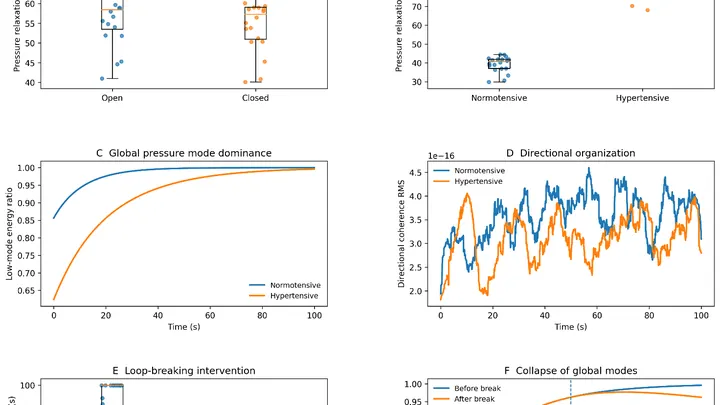
Scientists built a computer model of blood flow and compared two scenarios: an open vessel and a closed loop.