Mini

Stellar Palimpsests: How We Read the History of Swallowed Planets

Original: "A Bayesian Search for Planet Engulfment Signatures in Solar Analogs"
arXiv:2607.03504 · 2026-07-03 · CC BY 4.0 · 1 min · Exoplanets Stellar
Bayesian analysis, like a restorer, revealed hidden layers of a cosmic palimpsest: three out of 113 solar twins show chemical fingerprints of swallowed worlds.
Links in the knowledge graph 1

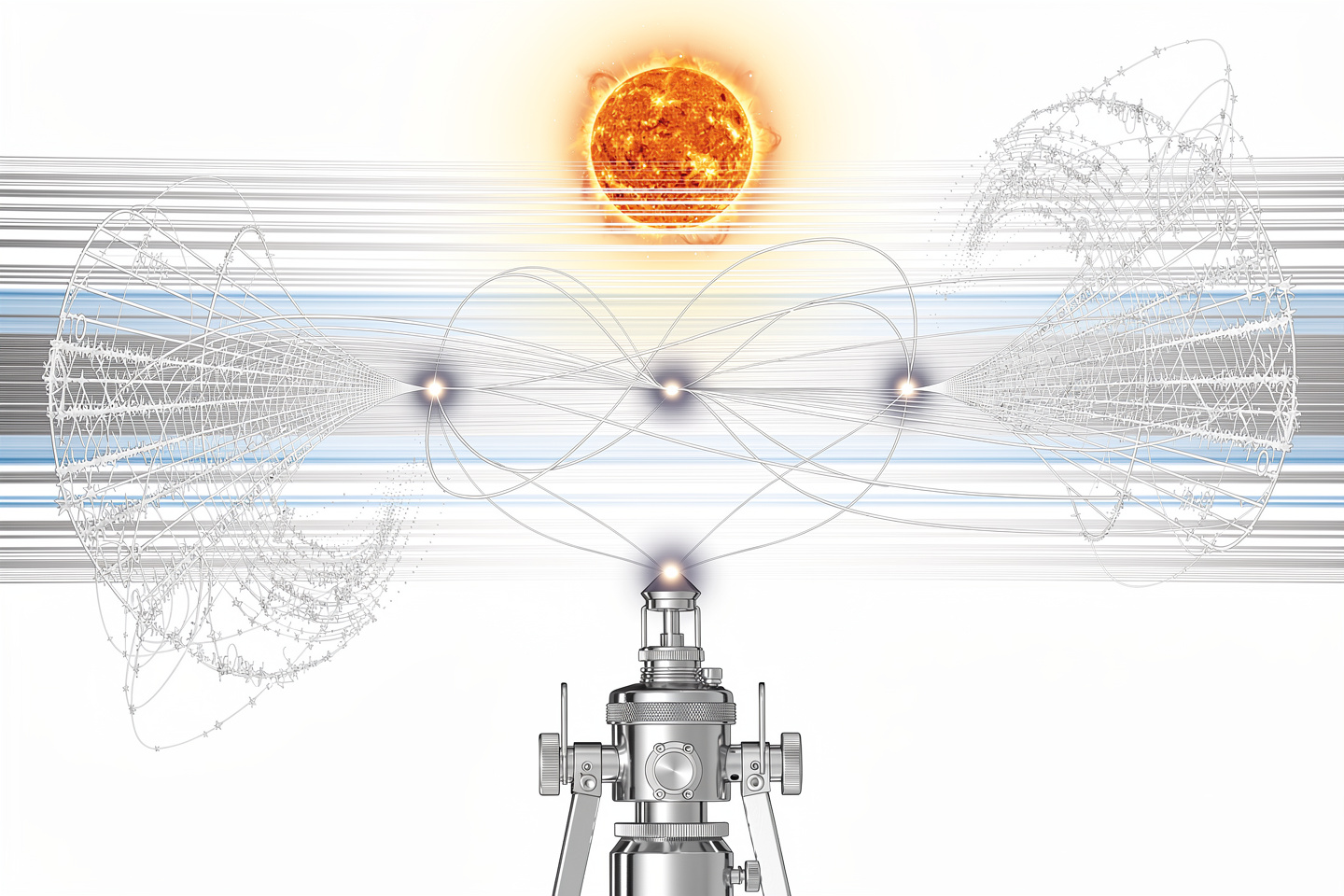
A star swallowed a planet — and forever preserved its chemical portrait in its light. The spectra of three solar analogs, decoded by a Bayesian algorithm, tell of catastrophes that happened millions of years ago. We read stellar palimpsests, where beneath the layer of galactic evolution the lines of devoured worlds emerge. Someday, we'll likewise read the story of our Sun.

🎯 If the Sun swallowed Earth, the iron content in its photosphere would increase by just 0.004% — almost imperceptible to most methods, but high-precision spectroscopy can catch such traces in other stars where the events were more massive.

🎬 In Stanisław Lem's 'Solaris,' the sentient ocean consumes people, but on a cosmic scale, entire planets become food for their suns, leaving behind only spectral shadows — chemical memories of perished worlds.

\Delta[X/H] = \log_{10}\left(1 + \frac{M_{p,\text{eq}} \, f_{X,\text{planet}}}{M_\odot f_{cz,\odot} f_{X,\odot}}\right)
Here M_{p,eq} is the equivalent ingested mass (accounting for the convective zone fraction), f_{X,planet} and f_{X,⊙} are the mass fractions of element X in the swallowed body and in the solar convective zone, and M_⊙ f_{cz,⊙} = 7000 M_⊕.
Scientists
Christian DopplerD. B. McLaughlinDidier QuelozMichel MayorR. A. RossiterDavid Charbonneau
Tags
exoplanet spectroscopy stellar evolution Sun galactic evolution metallicity nucleosynthesis protoplanetary disk
Laws
Doppler effectKepler's third lawmass–energy equivalenceMaxwell's equationsPlanck's lawPlanck–Einstein relation
Original: arXiv:2607.03504 · CC BY 4.0 · bridge42worlds