The Arrow Piercing the Disk: Recipe for an X-ray Flare
Original: "Radiation-hydrodynamics of star-disc collisions: From system parameters to outflows and lightcurves"
The speed of the cosmic arrow and the density of the target dictate the brightness and duration of flares near the event horizon of a black hole.
Links in the knowledge graph 1
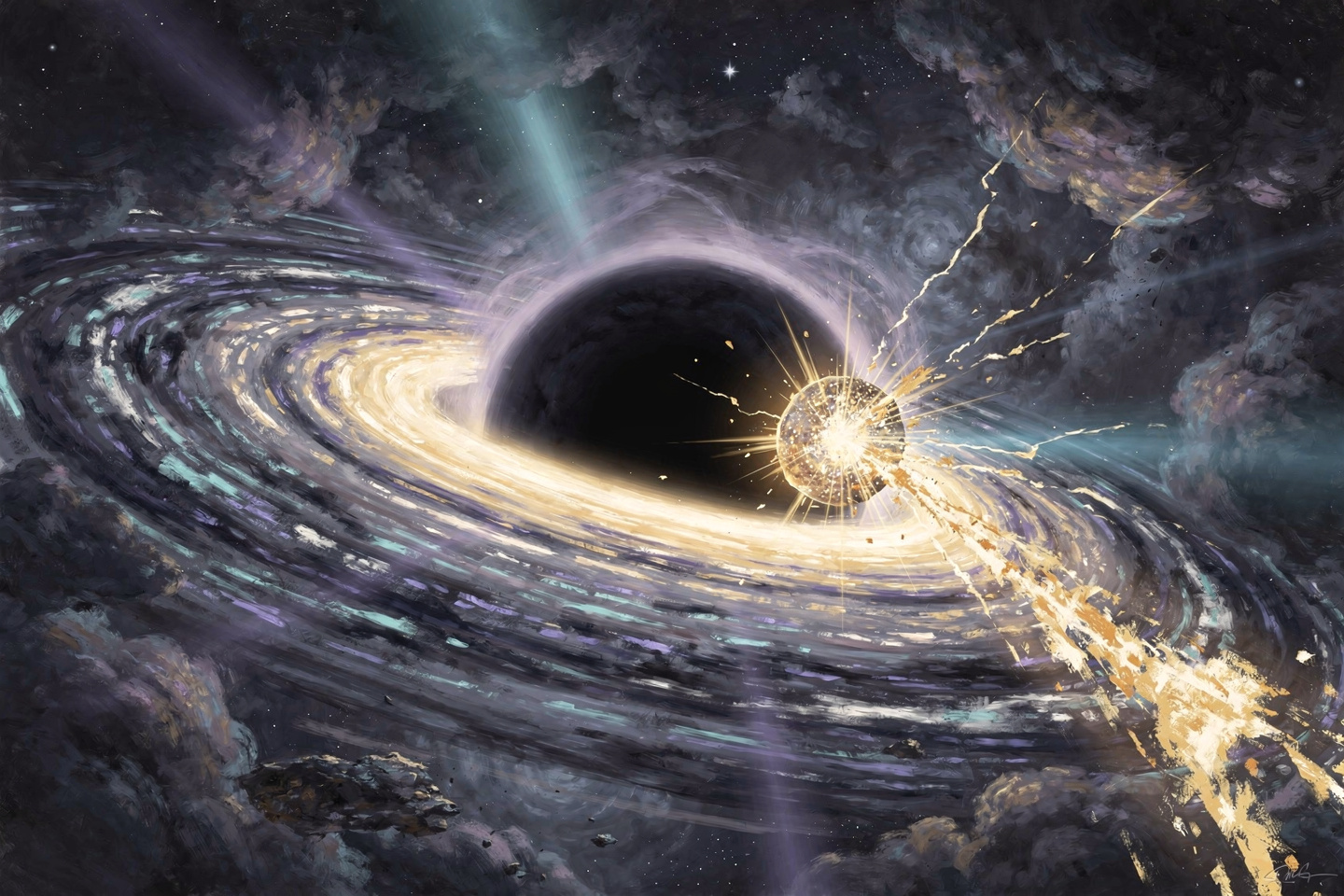
When a star-arrow slams into a black hole disk at 0.1c, a flare is born, briefly outshining the galaxy. Simulations show: brightness scales as the square of velocity, duration as the square root of disk density. It’s a cosmic archer: every shot leaves a luminous trail. Future gravitational-wave antennas will catch these shots, unveiling secrets of the event horizon.
🎯 The temperature at the shock front reaches 100 million degrees — ten times hotter than the Sun’s core.
🎬 The plot of "Interstellar," where a ship approaches a supermassive black hole, gains real physical grounding: here stars really do periodically pierce the accretion disk, spawning X-ray flares.
\dot{E}_{\text{in}} = \pi R_{\star}^2 \rho v_{\star} \Delta u \approx 5.6\times 10^{42} \,\text{эрг/с} \left(\frac{v_{\star}}{0.1c}\right)^3 \left(\frac{\rho}{3.6\times 10^{-8}\,\text{г/см}^3}\right) \left(\frac{R_{\star}}{R_{\odot}}\right)^2
Dependence of energy release on star velocity, disk density, and star radius.
\mathbf{F}_{\text{diff}} = -\lambda \frac{c}{\kappa_s} \frac{\nabla e_{\text{rad}}}{\rho}
Describes radiation transport in optically thick media, where λ is the flux limiter.
Scientists
Christian DopplerD. B. McLaughlinDidier QuelozMichel MayorR. A. RossiterStephen Hawkingblack hole
gravitational waves
spectroscopy
speed of lightLaws
Doppler effectHawking radiationgravitational lensingprinciple of constancy of the speed of lightBekenstein-Hawking entropymass–energy equivalence