The Arrow Piercing the Disk: Recipe for an X-ray Flare ✛
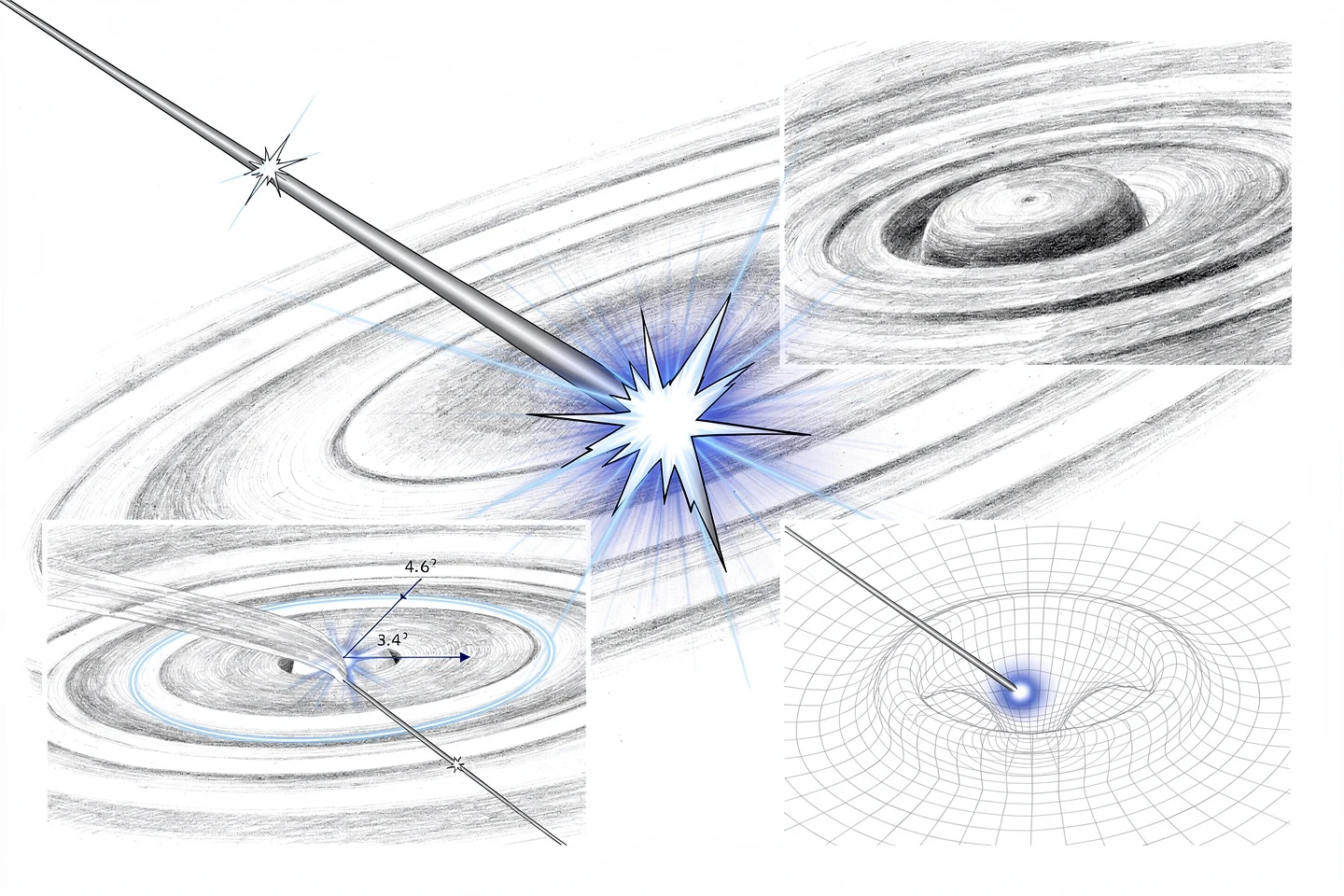
Deep space, galactic center. A supermassive black hole is surrounded by a scorching disk of gas and dust. And then, through this fiery veil, a star shoots by every few hours — like an arrow loosed from the bow of gravity. Each passage triggers a dazzling X-ray flare that for a moment outshines the entire galactic nucleus. These are quasi-periodic eruptions, or QPEs — a phenomenon discovered just a few years ago and still baffling astrophysicists.
A group of scientists built a local model: the star, as a solid body, crashes into a patch of the disk at various angles, speeds (up to 0.15 of the speed of light), and disk densities. Smoothed-particle hydrodynamics simulations with radiation transport allowed them to track how the shock wave forms, how hot ejecta fly apart, and, crucially, how the bolometric radiation is born. It’s like an arrow striking layered fabric: the sharpness of the tip (star radius), the bow’s draw strength (velocity), the density and number of layers (disk surface density and vertical profile), the angle of impact — every nuance changes the picture.
Systematic analysis uncovered clear laws. Peak luminosity scales as the square of the star’s velocity: the kinetic energy shock transitions into radiation almost perfectly. Flare duration is proportional to the square root of the disk’s surface density — the thicker the layered barrier, the longer the star rips through it and shines. A larger star radius amplifies the asymmetry of the ejecta and makes the forward flow dominant. A vertically concentrated disk, like a stack of dense sheets, produces brighter and shorter flares: radiation escapes more easily through the tenuous edges. And a shallow entry (small angle of attack) stretches the event and smoothes the difference between the two ejecta — like an arrow grazing in leaves a long smoldering trail.
Applying these scalings to the real source GSN 069, the scientists concluded: the best fit is a star of solar radius moving on a retrograde orbit and piercing a dense, flattened disk that itself arose from the tidal disruption of another star. Such a configuration naturally explains the alternation of bright and weak flares. Thus, from repeated pinpricks, a map of an invisible structure is born: QPEs become a kind of tomography of accretion flows in the strongest gravitational field, where spacetime is warped.
The work turns mysterious flares into a calibrated tool. Just as a craftsman deduces a string’s tension from its snap sound, astrophysicists will reconstruct disk density and geometry from a QPE’s light curve. This links the dynamics of relativistic objects, the evolution of stellar populations in galactic nuclei, and may even shed light on the fueling of active nuclei. And where classical physics meets quantum effects at the horizon, the legacy of Schwarzschild and Hawking takes on new resonance. The cosmic arrow continues its flight, and each impact brings us closer to understanding the nature of black holes.
The temperature at the shock front reaches 100 million degrees — ten times hotter than the Sun’s core.
The plot of "Interstellar," where a ship approaches a supermassive black hole, gains real physical grounding: here stars really do periodically pierce the accretion disk, spawning X-ray flares.