Star colliding with a disk: How black holes produce enigmatic flashes ✛
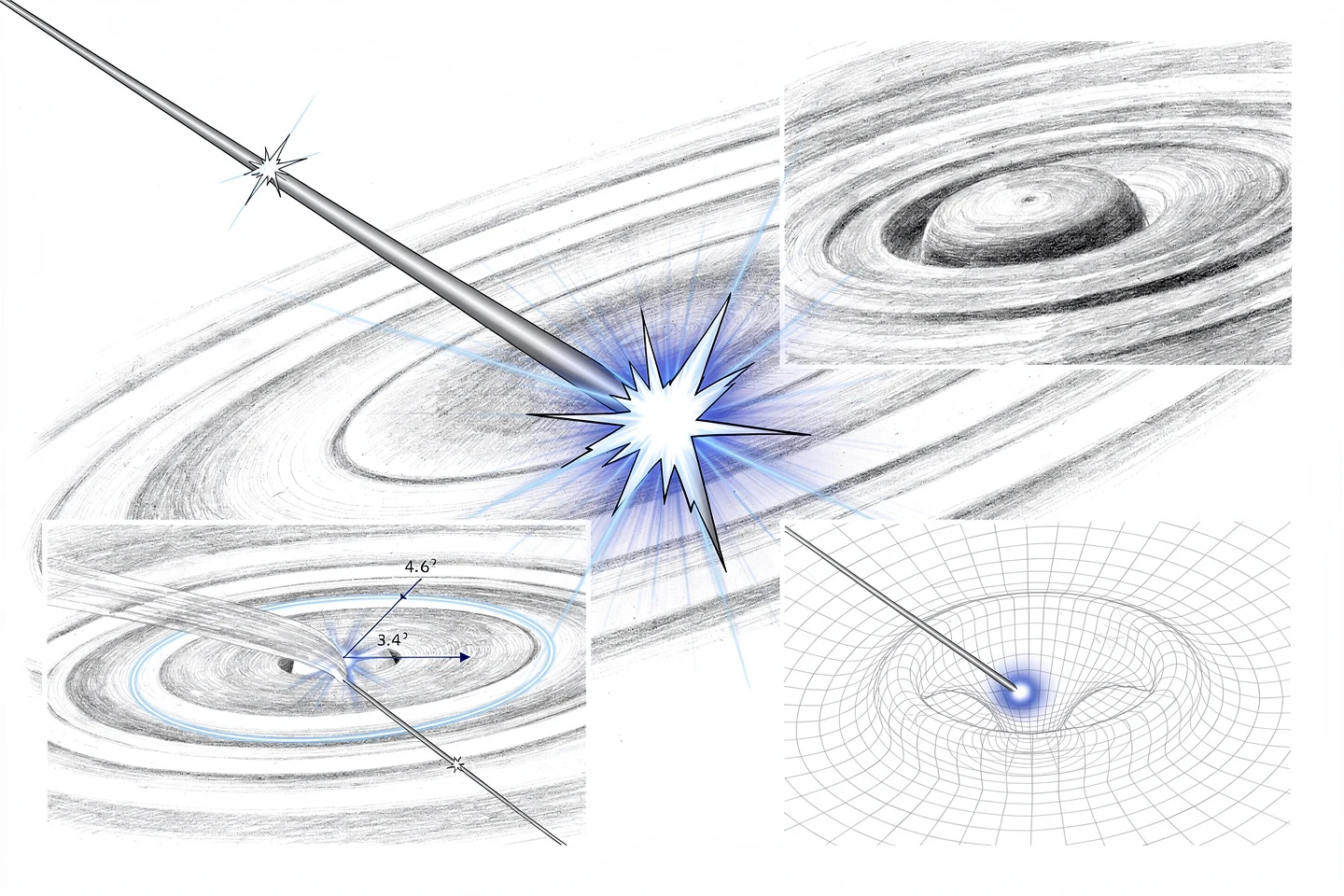
Some distant galaxies behave oddly: from time to time, their centers flare up brightly in X-rays. These repeating, pulse-like flares are called quasi-periodic eruptions. Scientists have long suspected that they are caused by a star colliding with a dense cloud of gas swirling around a supermassive black hole at the galaxy's core. To test this idea, a computer model was created.
The model showed that when a star slams into this disk at nearly one-third the speed of light, the superheated gas at the impact site produces a blinding flare. The faster the star and the denser the disk, the more powerful and longer the glow. Interestingly, the angle at which the star enters the disk also matters: with an oblique impact, flares of different brightness emerge — one ahead, one behind. This exact pattern is observed in the mysterious source GSN 069. It seems that a star about the size of our Sun is racing on a tilted orbit through a very dense disk, left over after the black hole tore apart another star.
This discovery not only solves an old puzzle but also provides a new tool for studying the neighborhoods of black holes. In the future, scientists hope to refine details using spectroscopy — splitting light into colors, which reveals the composition and motion of gas. Moreover, such colossal events may generate gravitational waves — ripples in space that can be picked up by sensitive detectors. Early steps in this direction were taken by Joseph Weber, while the theoretical groundwork was laid by scientists like Karl Schwarzschild and Stephen Hawking.
If such a star actually smashed into the disk at 0.1 times the speed of light, the energy released would be enough to outshine an entire galaxy for a moment.
In the movie 'Interstellar', the protagonists explore the accretion disk of the giant black hole Gargantua; in reality, similar star-disk collisions can cause repeating X-ray flares.